AQA Physics
Cosmology
Cosmology is the study of development and structure of the universe.
9.3.1. Doppler Effect
If a wave source moves relative to an observer, the observer will receive the wave with different frequency and wavelength, compared to hen they both are stationary.
If source and observer move closer to each other: f  , and λ
 .
.
If they move away from each other: f, and λ.

Note: wave speed stays constant as long as the wave is travelling through the same medium.
If a star is moving away from us the light coming from it shifts towards the red end of the visible light spectrum (red shift).
If is getting closer we see it moving towards the blue end (blue shift).

This also can be seen in the absorption spectrum:

To determine the relative velocity of a galaxy:
1) The absorption spectrum of an element present in the galaxy is printed in the lab;
2) The absorption spectrum of the element is obtained from the receding galaxy;
3) The difference in wavelengths of the two spectra is used in the following formula to determine the relative velocity:
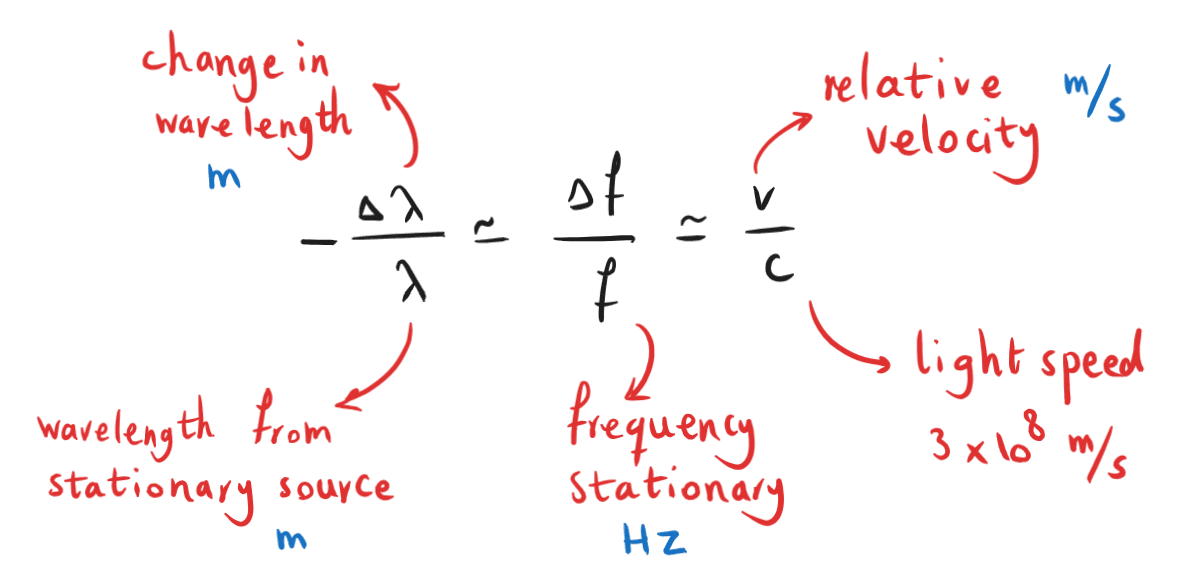
Relative velocity is the approach velocity!
Meaning if objects are approaching it is positive, and negative if receding!
Doppler equation is valid only if v is much smaller than 0.1c.
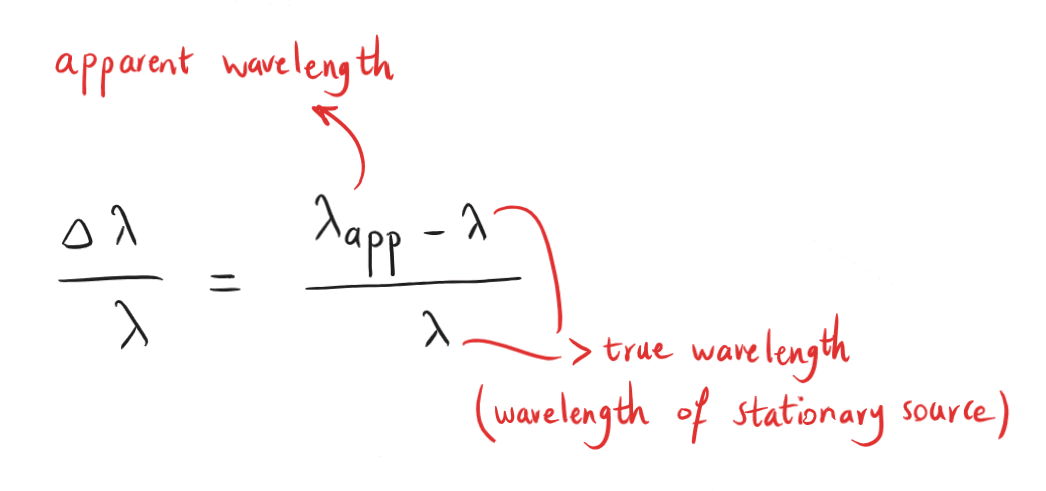
And this how we get Δλ:
Example 1:
Absorption line for hydrogen shows a wavelength of 656.285 nm in the lab.
The corresponding line from a star has a wavelength of 656.245 nm.
Calculate the speed of star relative to the Earth and determine if it is approaching or receding.
Answer:
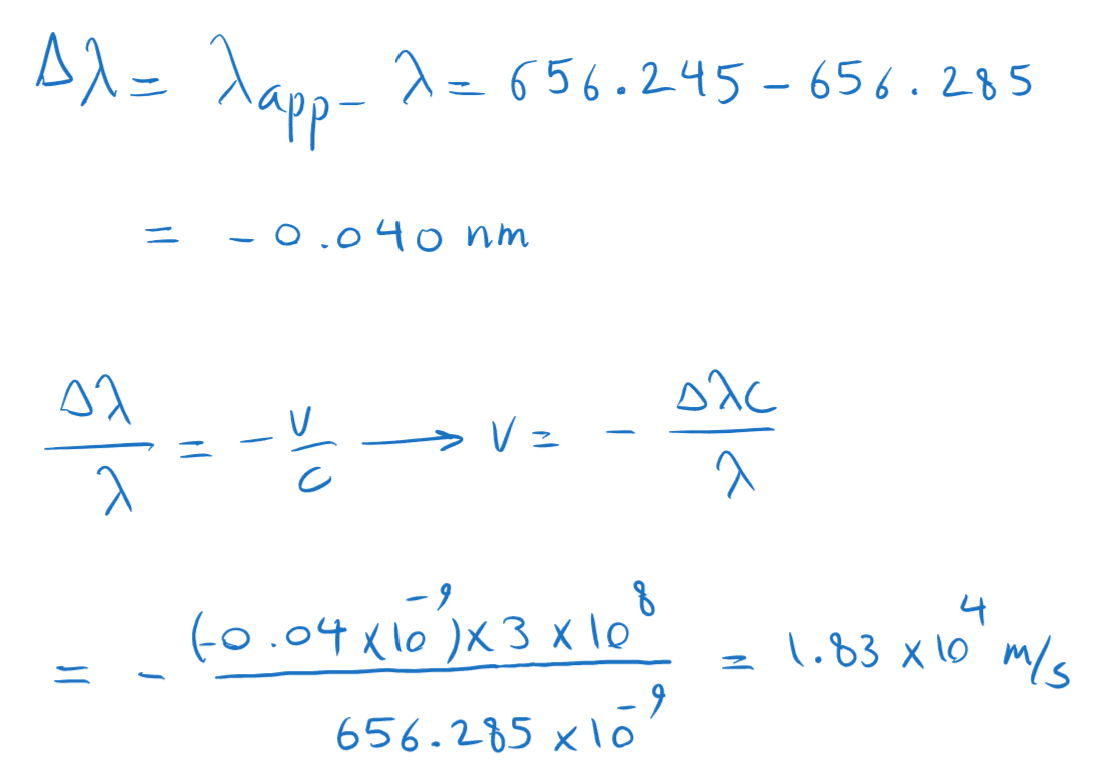
Since we get a positive speed, means the star is approaching us.
9.3.1.1. Binary stars
When two stars orbit the same centre of mass:
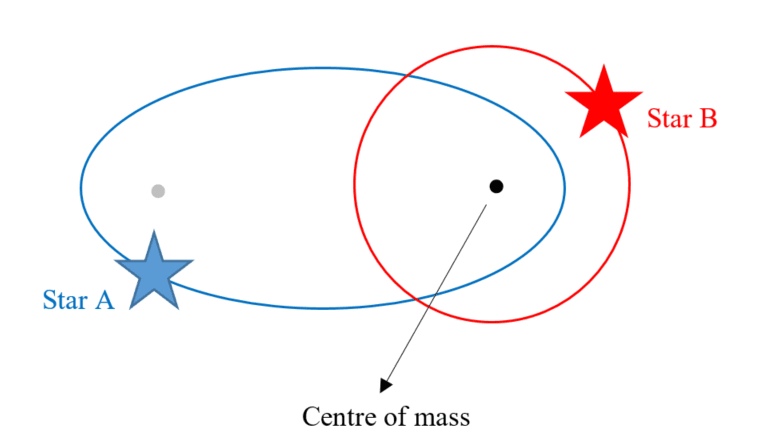
Doppler equation is used to find the rotational velocity and distance of the two stars in a binary system.
Eclipsing binaries: those that stars orbit in the same plane as the line of sight from the Earth.
Eclipsing binaries are studied by their combined light curves.
Because as one star eclipses the other, the apparent brightness of the combined light curve decreases.
Two types of eclipsing binaries:
1) Partial
2) Total
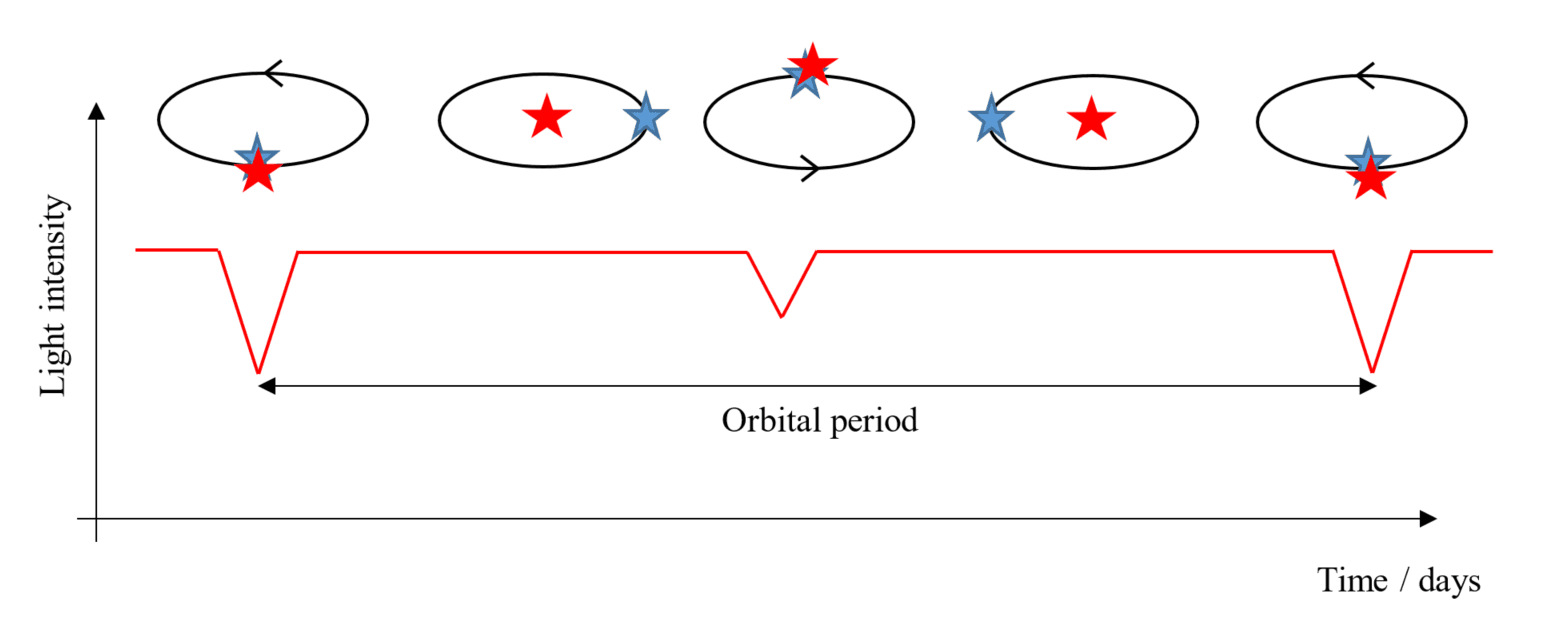
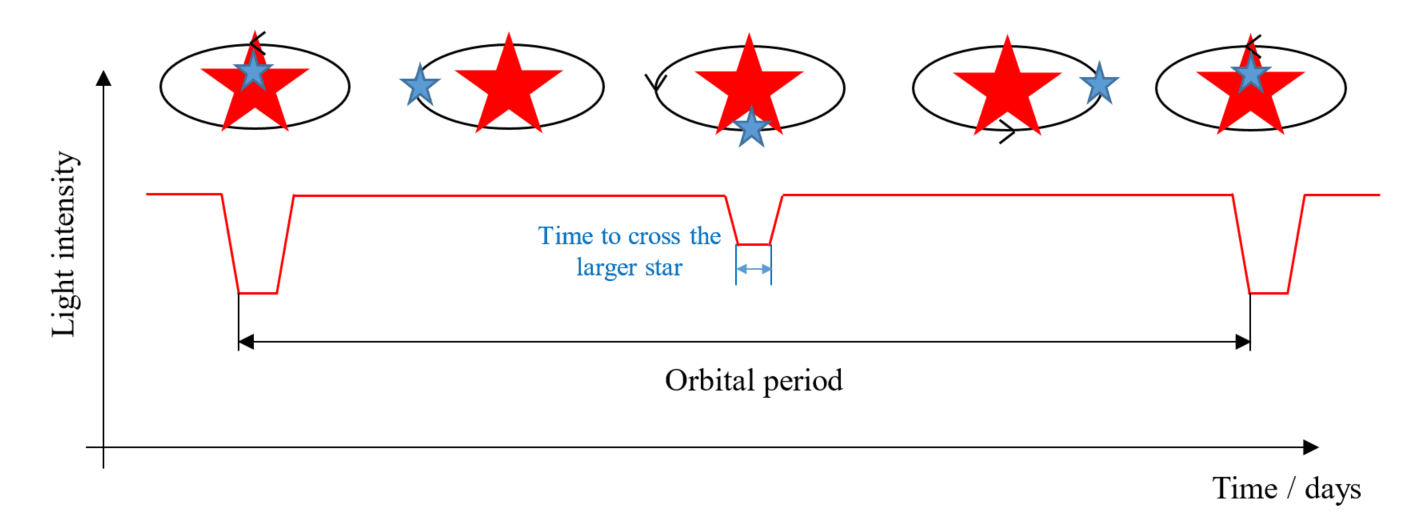
When one of the stars is moving towards earth we see a blue shift in its absorption spectrum, and red shift when it goes away from us.
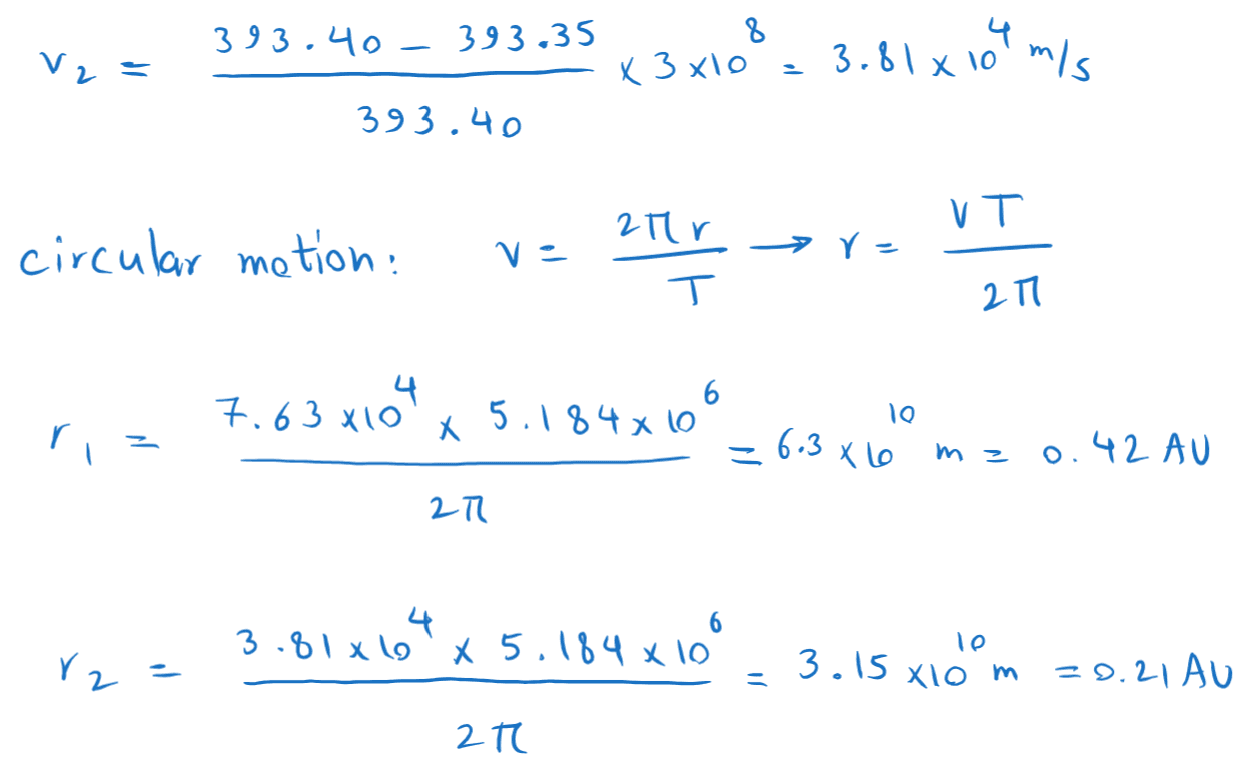
Example 2:
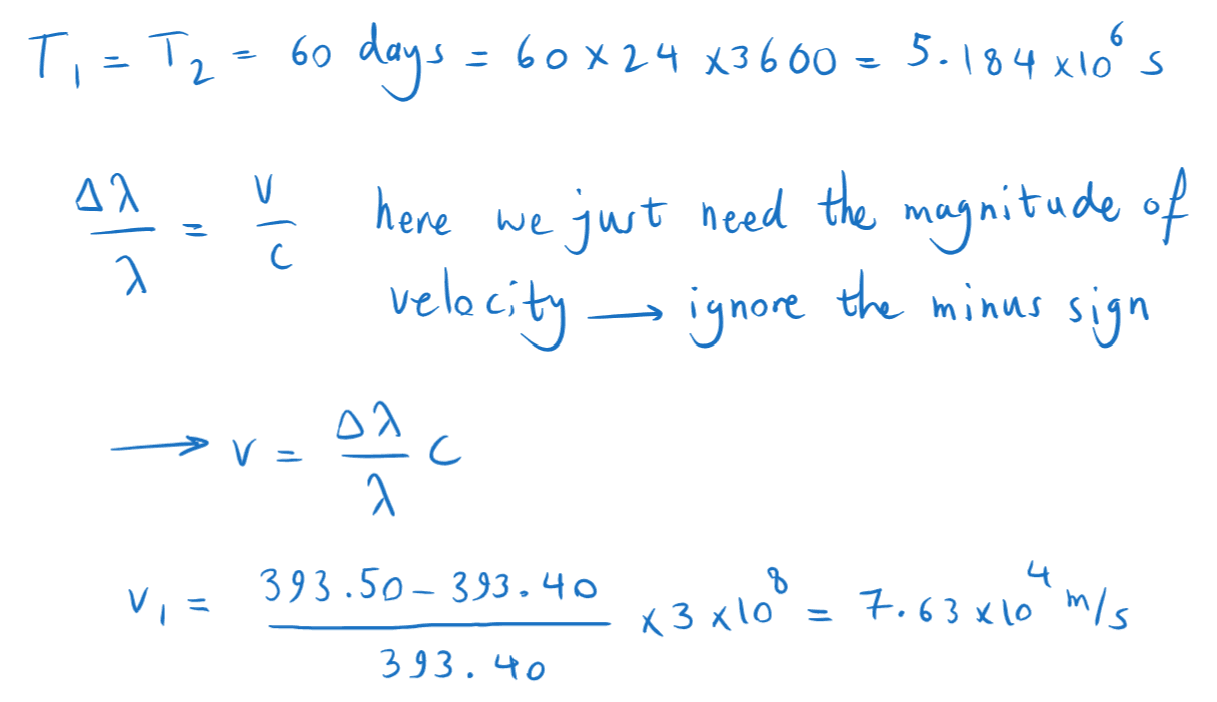
Absorption line of calcium is observed from a binary system of stars with period of 60 days.
Absorption line of calcium in laboratory is 393.40 nm.
Two absorption lines of calcium are received periodically from the binary system.
When one of the lines is at a maximum of of 393.50 nm the other is at a minimum of 393.35 nm.
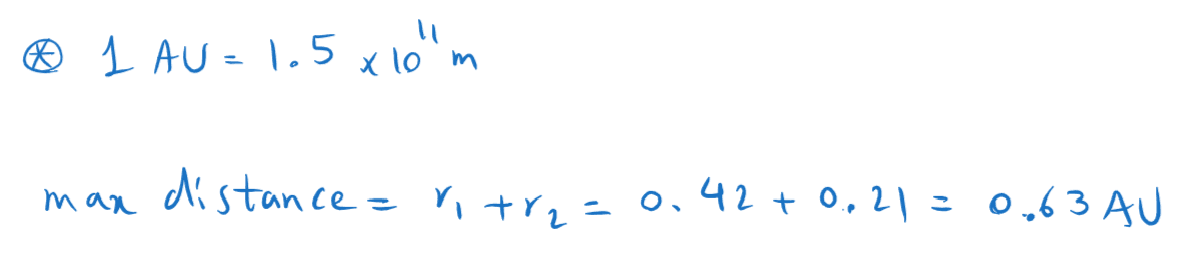
Assuming the stars both have a circular orbit and we see them directly along the plane of the orbit, find the maximum distance between the two stars in AU.
9.3.1.2. The great recession
Most of light we get from other galaxies is red-shifted.
Meaning everything is moving away from us!
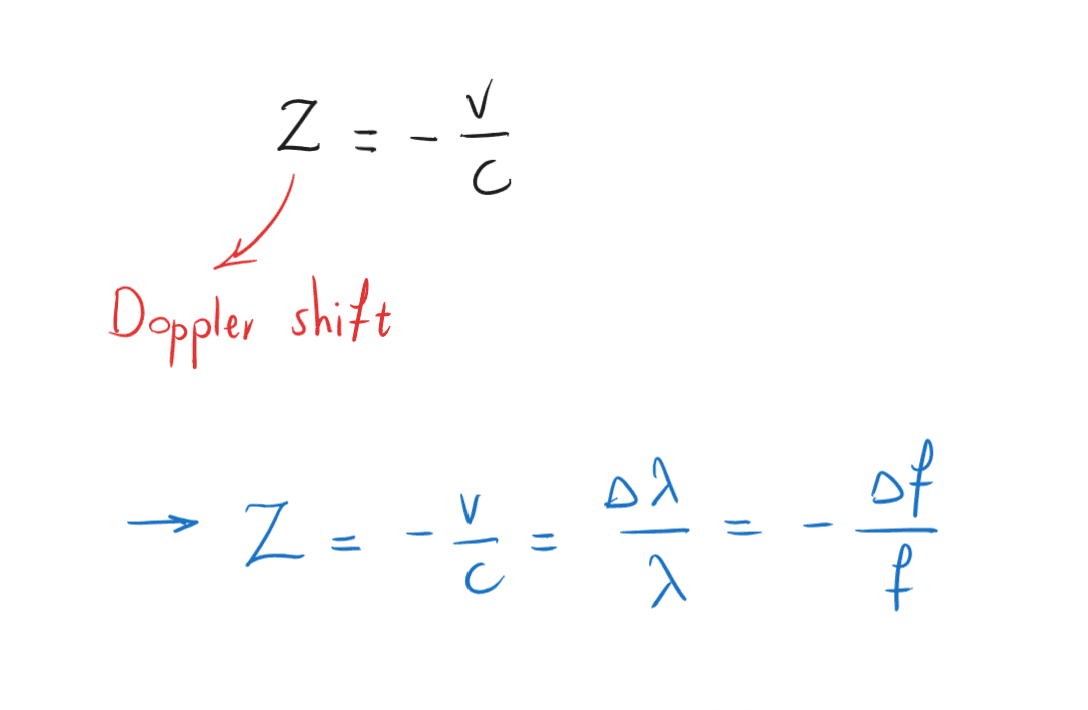
This red-shift is found by the Doppler shift (z):
Doppler shift:
It’s the fraction below:
If galaxies are approaching V is positive, and negative if receding!
Doppler equation is valid only if v is much smaller than 0.1c.
Galaxies far far away sometimes show red-shifts more than 1 (Z > 1).
Which means they are moving faster than speed of light!
So for those the equation should be modified to implement special relativity.
Quasars:
Quasars are believed to be the most distant objects in the universe!
Their Z > 7.
Which is not possible! But still shows they are moving close to speed of light!
Another explanation is that quasars are not moving that fast! But universe is expanding causing the wavelength to stretch!
This is called cosmological red-shift and is related to general relativity theory.
We cannot tell the difference between cosmological and Doppler red-shift by looking at spectrums.
We will talk about quasars later.
9.3.2. Hubble’s Law
Hubble’s two main observations:
1) Most galaxies are red-shifted; meaning they are going away from us;
2) Farther galaxies are going away faster! So they are more red-shifted!
Plotting recessional speed vs. distance shows a linear relationship between the two.
Gradient of the best fit line is called the Hubble constant (H0).
However there the uncertainty for H0 is quite large!

The point below the x-axis show blue-shift!
Hubble’s Law:
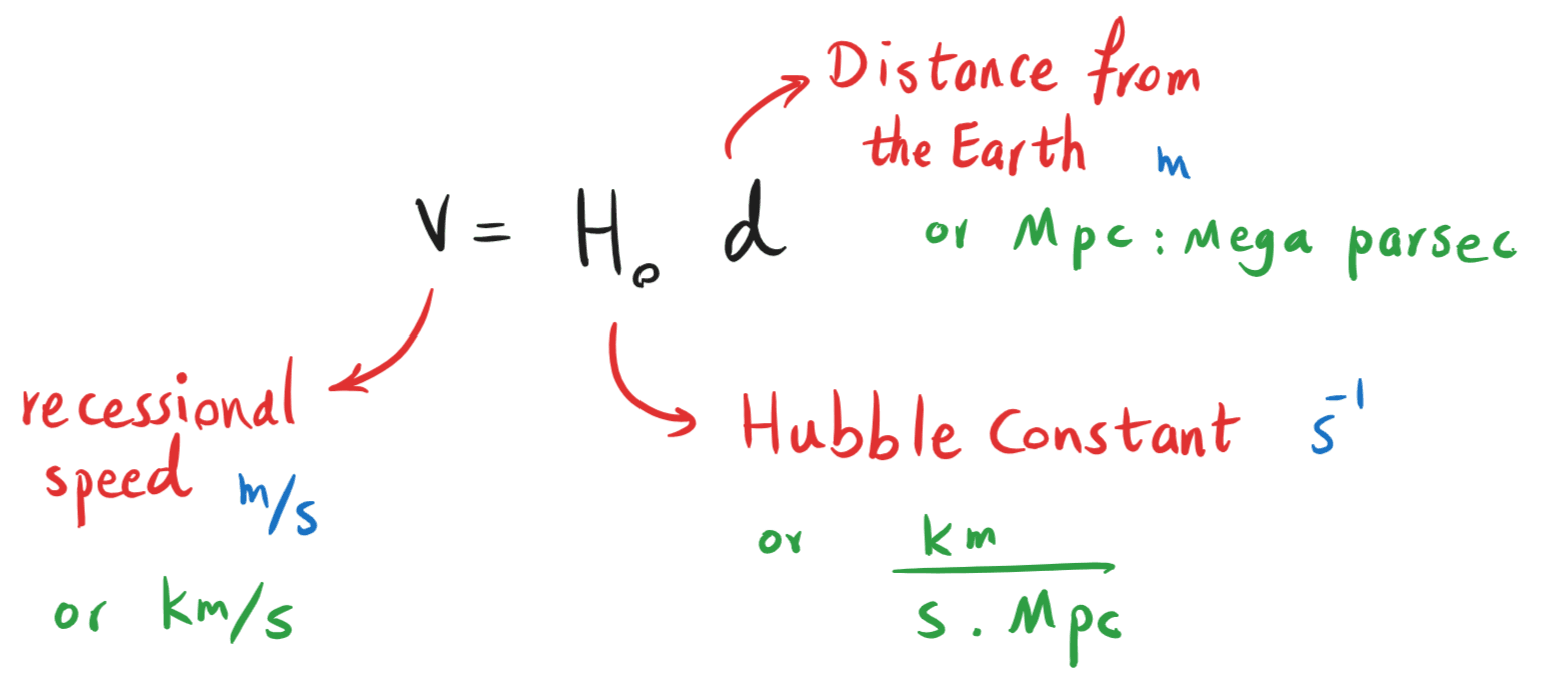
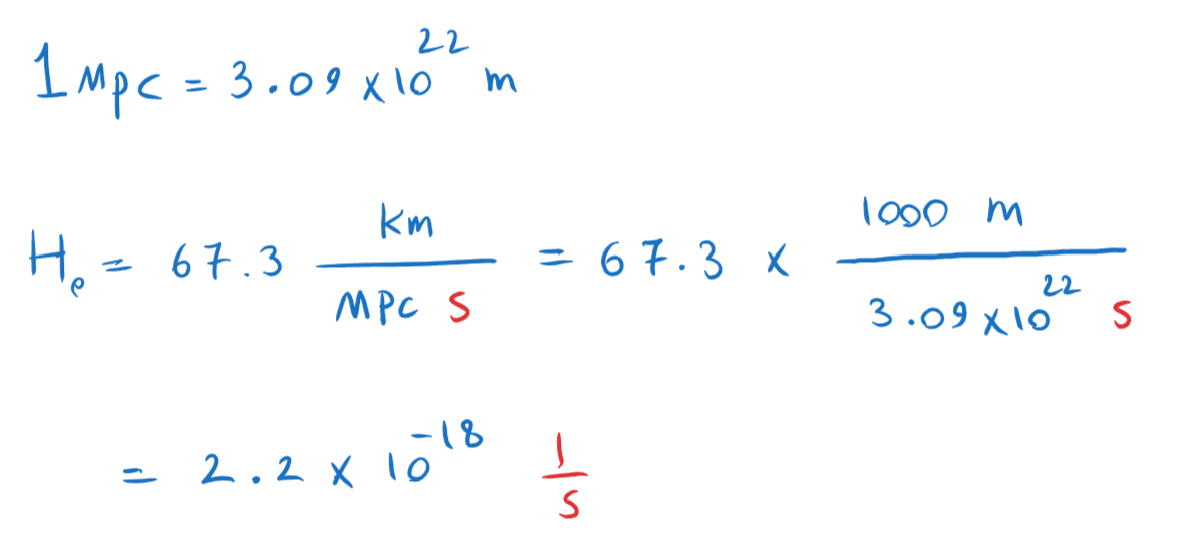
Latest figure for Hubble constant: 67.3 kms-1 Mpc-1 or 2.2 × 10⁻¹⁸ s-1 (65 in formula sheet).
Example 3:
Convert Hubble constant of: 67.3 kms-1 Mpc-1 to s-1.
Solution:
Example 4:
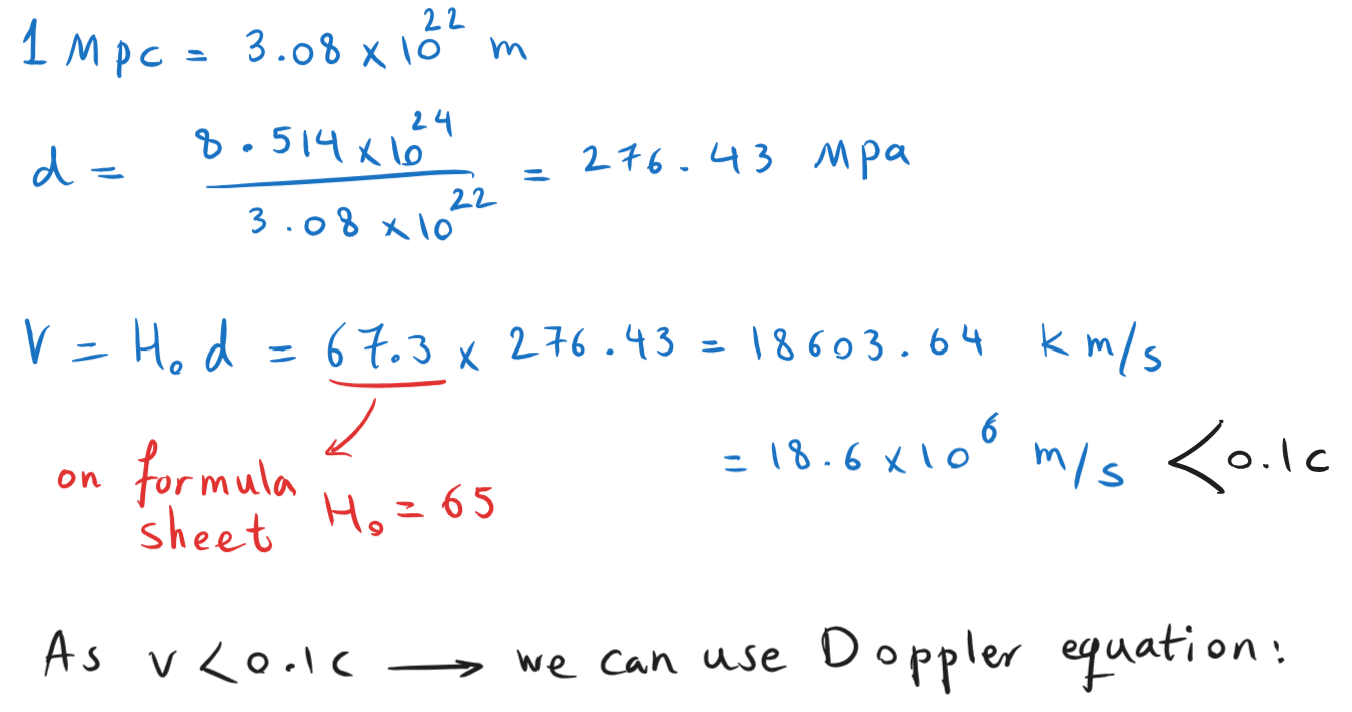
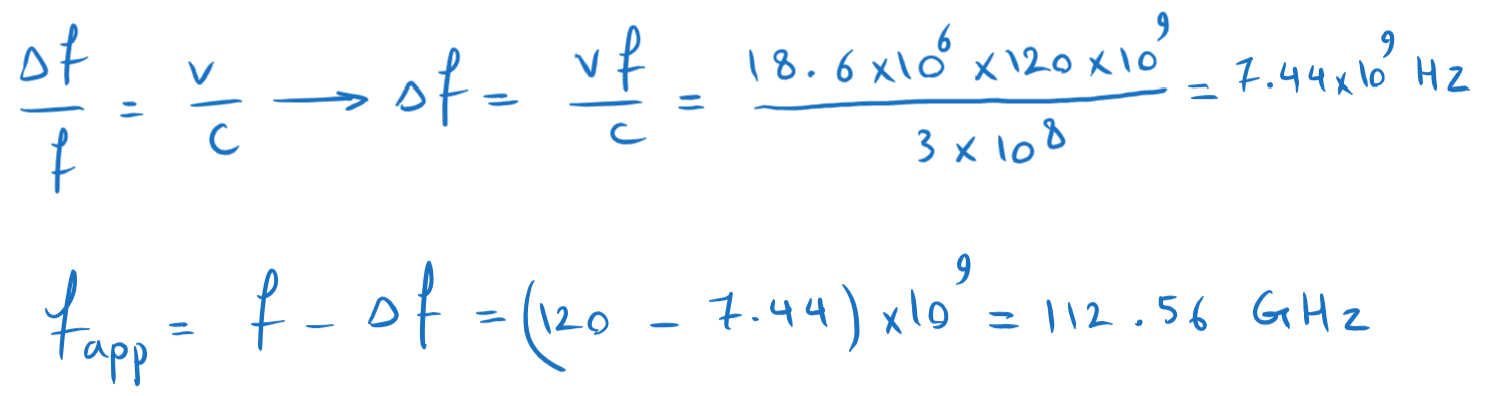
Radio wave from CO (carbon monoxide) molecules has frequency of 120 GHz in the laboratory.
Calculate the frequency of these waves from a galaxy 900 million light years away.

Hubble’s law says the universe is expanding, and that means it gets cooler as it expands.
So if we go back in time, universe was smaller and hotter!
This leads to the Big Bang Theory, also called the Hot Bing Bang (HBB).
9.3.2.1. The Age of Miss Universe
Expansion of universe is not uniform, and it is getting faster!
But assuming universe has expanded uniformly since the big bang, using Hubble’s law we can roughly estimate the age of the universe:
· Assume our galaxy and a distant one were next to each other at the big bang;
· Because of expansion of universe, assume the distant galaxy is now moving with a constant speed of v since the big bang;
· If the distance of galaxy from us is d now, the time since we were next to each other is d/v.
Using Hubble’s law we get:
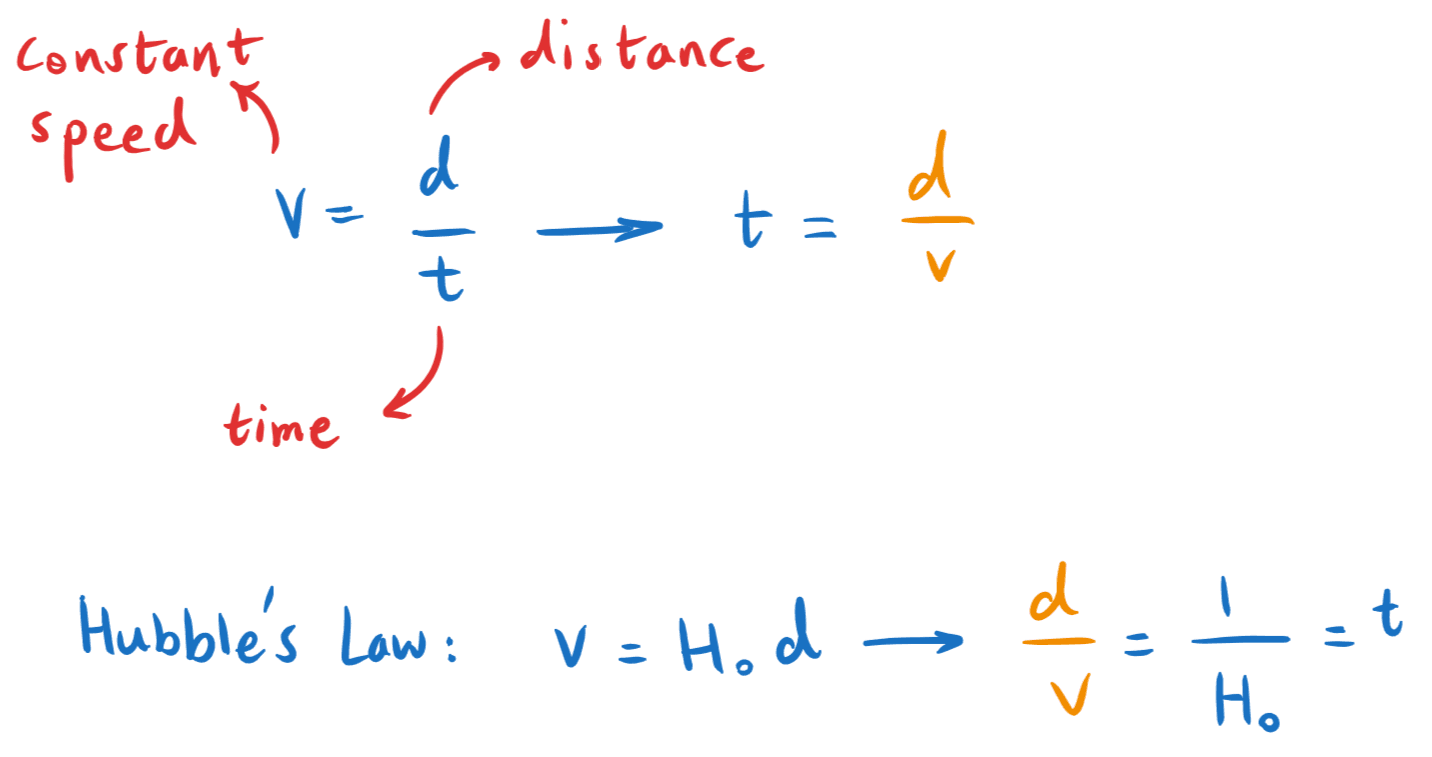
So time since the big bang is equal to inverse of Hubble’s constant.
If we take Ho = 2.18 × 10¹⁸ s-1.

Which is almost 14.5 billion years!
Of course this a rough value as the Hubble’s constant itself has a large uncertainty, and universe expansion is accelerating, but we assumed it is uniform!
Reasons for acceleration:
· Type 1a supernovae (as standard candles) are fainter than what is predicted by Hubble’s law;
· Cosmological microwave background (CMB).
So actually universe is older than 14.5 billion year as predicted by Hubble’s law.
Acceleration needs force and force needs energy.
We don’t know the source of this energy. So we just call it dark energy!
We estimate 73% of the universe is dark energy.
9.3.2.2. The Big Bang
Evidence for the Big Bang:
1) Cosmological microwave background (CMB): at the time of big nag there must have been plenty of highest energy EM wave: i.e. Gamma radiation. But due to expansion of universe, the gamma should be red-shifted towards longer wavelength.
And if it has been expanding for about 14 billion years the wavelength now should be in the order of millimetres! Which is the wavelength of microwave actually!
So when we get microwave in all direction in the universe, we think it is the remnant of that initial gamma.
2) Abundance of hydrogen and helium: the universe is 73% hydrogen, 25% helium, all other elements are a mere 2%!
This confirms formation of hydrogen and its fusion to helium at the early stages of HBB.
Because 2 hydrogen are needed to form a helium, we expect the amount of hydrogen to helium to be 3: 1, which is consistent with the discovered amount of H and He in the universe.
9.3.3. Quasars
Quasars are the most distant measurable objects in the universe!
They are highly red-shifted (because they are so far!).
They look like stars so we call them quasi-stellar objects (QSO).
First they were discovered we thought they emit only strong radio waves.
But today we know they also emit infra-red.
They appear very faint, but using inverse-square law we see that have great luminosity! Typically their luminosity is 20 trillion of our Sun!
Quasars are formed from active massive black holes in the centre of galaxies.
9.3.4. Exoplanets
Exoplanets are plants orbiting a star, other than the Sun!
Exoplanets are hard to see, because they don’t emit light. They reflect the light of their star.
A few have been seen directly.
Most are detected indirectly with two methods:
9.3.4.1. Radial velocity method
We usually think a planet orbits a star.
But because they both apply a gravitational force on each other, they both orbit a distinct centre of mass.
Now because usually the star is much bigger than the planet, this centre of mass is very close to the star, or even is in it!
Either way, the star is orbiting a centre of mass and that means we see a periodic Doppler shift in star’s spectral lines.

So if we compare this periodic change with star’s radial velocity when coming towards or away from the Earth, and we see a match; it means the star is orbiting, and that means there must an exoplanet there that causes this!

The above is a cool GIF. Check out the source.
Doppler equation is used to draw the radial velocity curve of the star. See below:

The period of the radial velocity curve is equal to the orbital period of the exoplanet.
Though the velocity curve is for velocity of the star!
The curve can show us the size and shape of the exoplanet’s orbit, and lower limit of its mass.
9.3.4.2. The Transit method
Transit: when a planet moves across star’s disk, and dims the star’s brightness.
E.g. wen mercury transits the Sun, we see a tiny black dot going across the Sun’s bright face!
With very sensitive devices we can see this slight dimming in a transit of an exoplanet.
If we know the radius of the star, and we measure the fraction of decrease in brightness, we say:
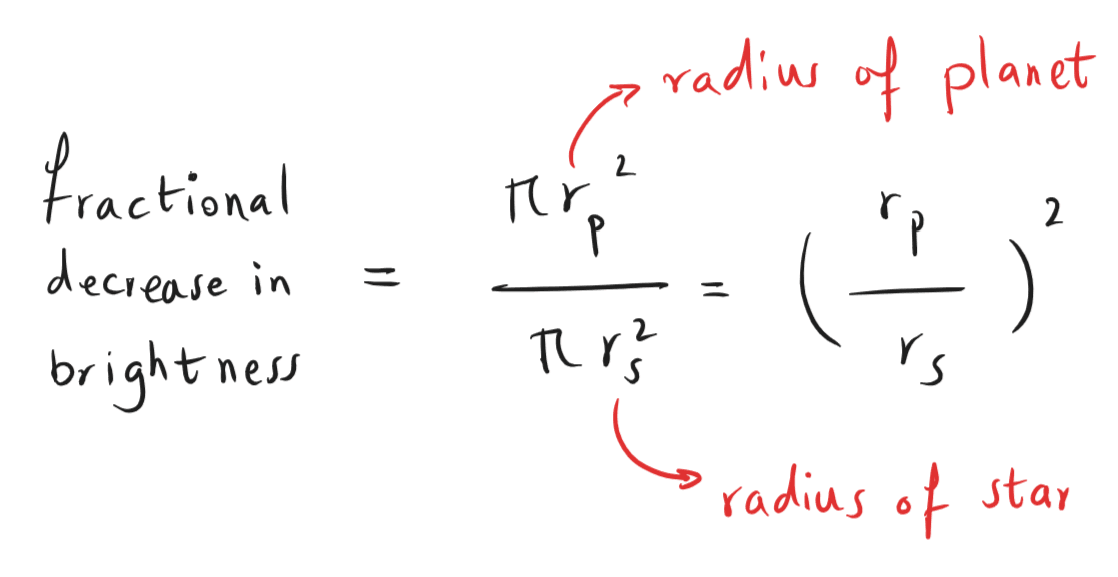
The dip in brightness is periodic. And that is the orbital period of the exoplanet.

.
Revise and Get Paid!
If you like taking summary notes of lessons and solving past papers, see the Join Us page!