OCR Physics

Oscillations
5.3.1 Simple harmonic motion (SHM)
* NOTE: your calculator needs to be radian mode before any calculation of SHM including sin and cos.
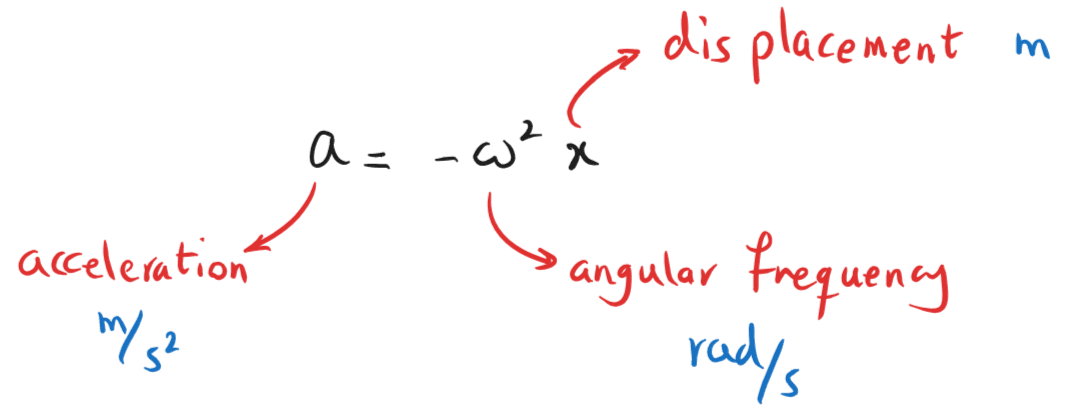
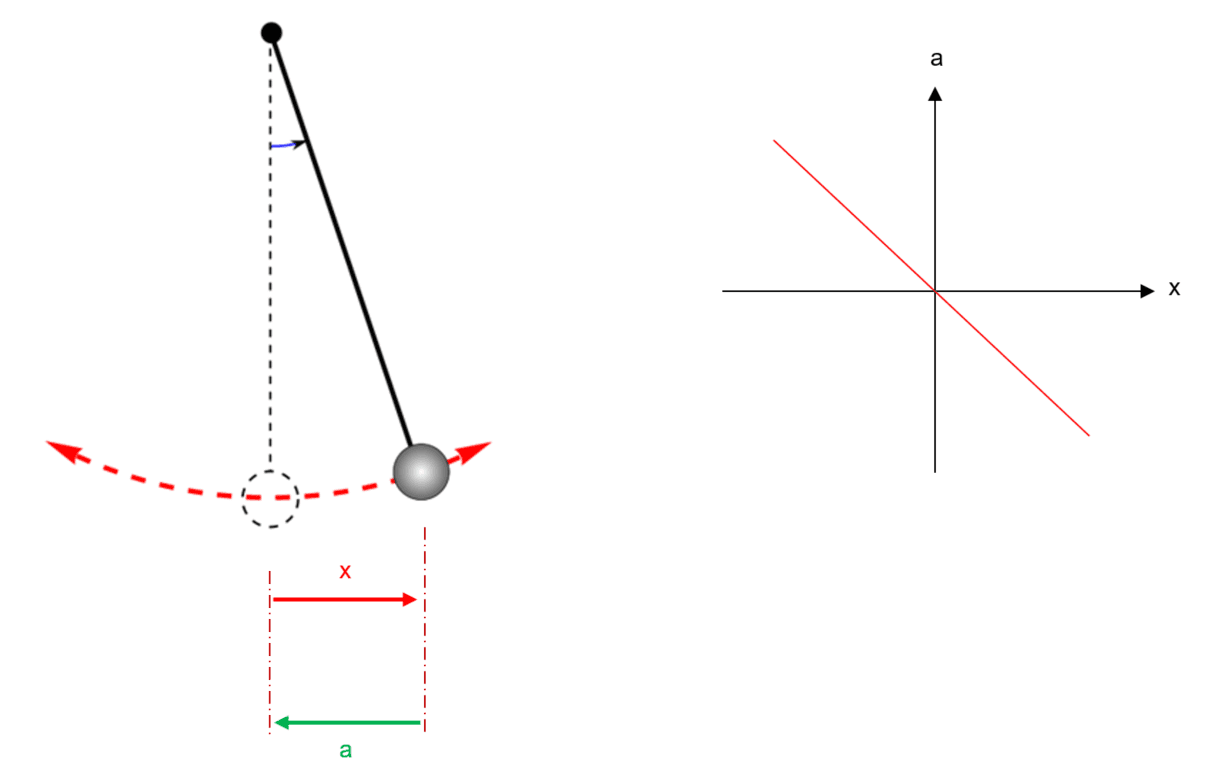
SHM: motion that the acceleration is directly proportional to the displacement, but always in opposite direction.
We usually see SHM in pendulums or mass-spring systems.
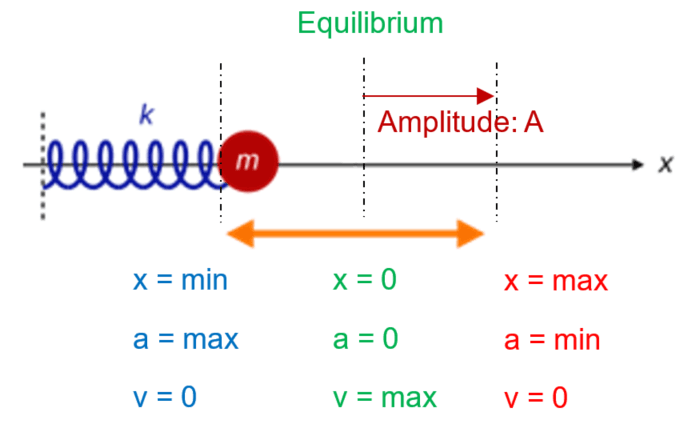
Diagram below shows a mass-spring system.
We can use wave and circular motion concepts for SHM.
x: displacement from the equilibrium position;
A: amplitude i.e. max displacement;
T: time period;
f: frequency;
a: acceleration
v: velocity
Ф: phase difference
ω: angular frequency which is equivalent to angular velocity in circular motion.

Mass-spring could be vertical:
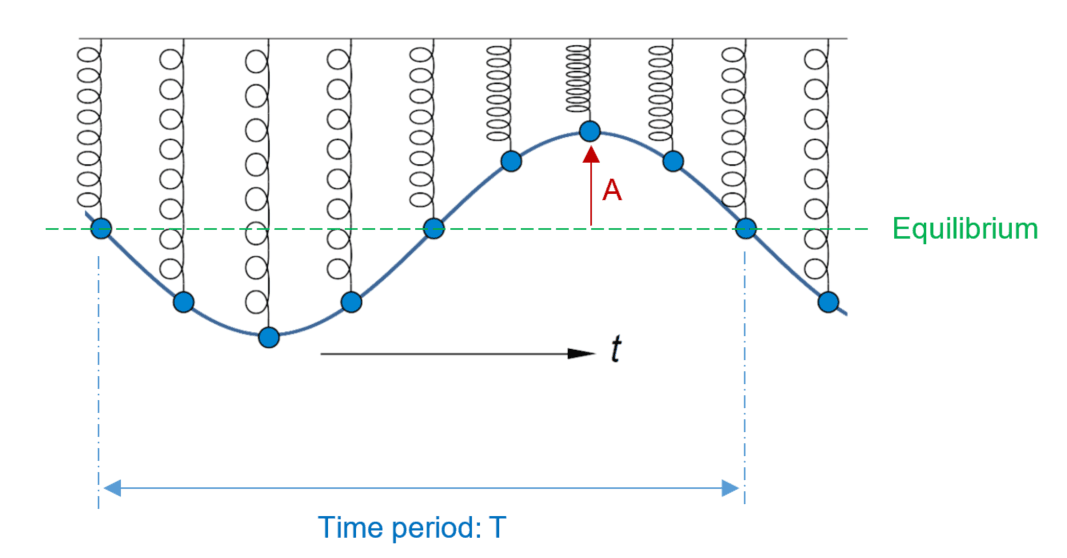
Note: Period of oscillation does not depend on amplitude! If amplitude is larger, the object will just move faster! This is called isochronous oscillator.
SHM defining equation:
5.3.1.-1 Determining period of the SHM
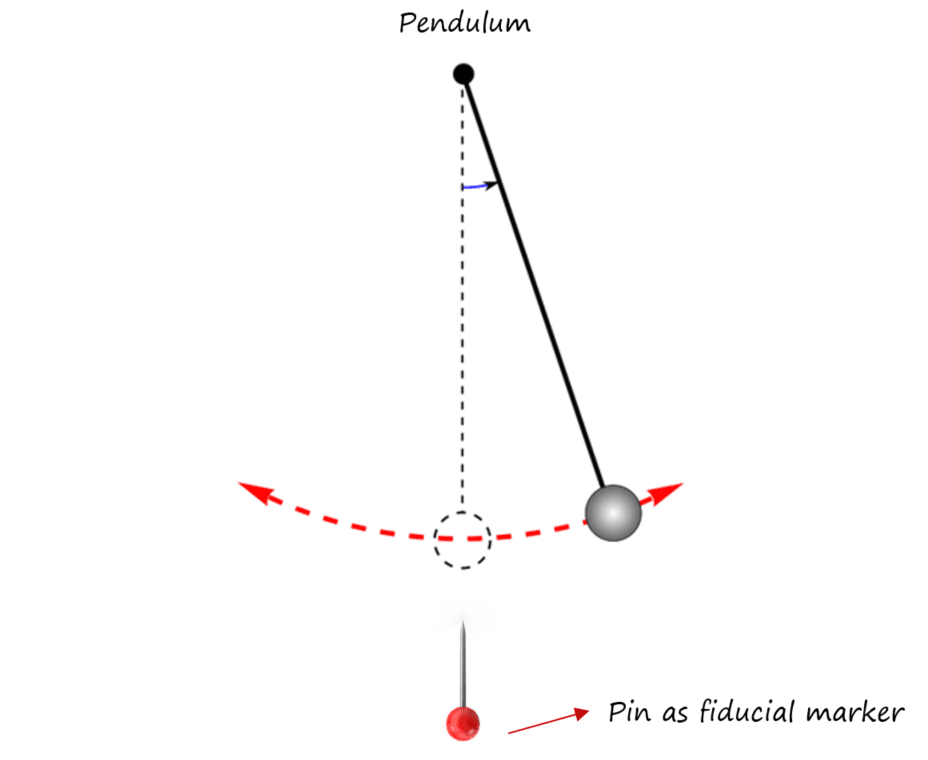
Time at least 10 complete oscillations.
To find the time period divide the total time by number of oscillations.
Place a pin as a fiducial marker at the equilibrium position. This creates a clear point as where to start and stop the time measurement with a stop watch.
5.3.2 SHM Equations:
Defining equation:
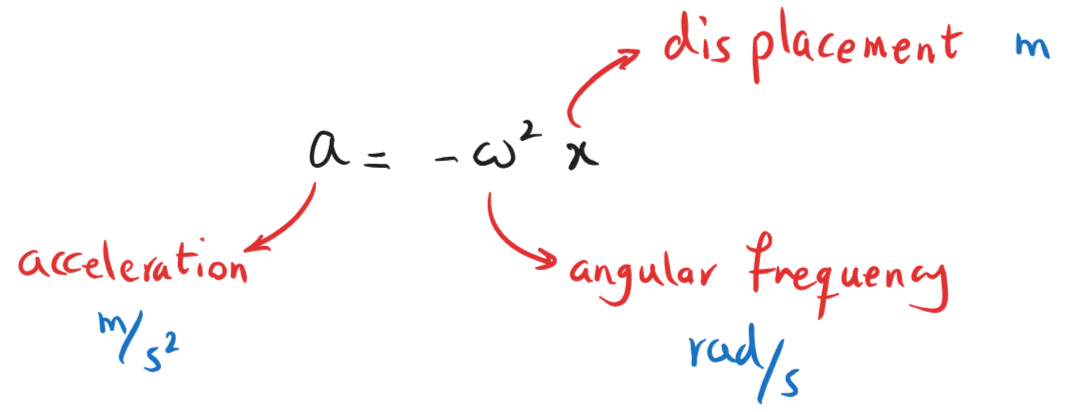
Maximum acceleration happens when displacement is equal to the amplitude!
Displacement:
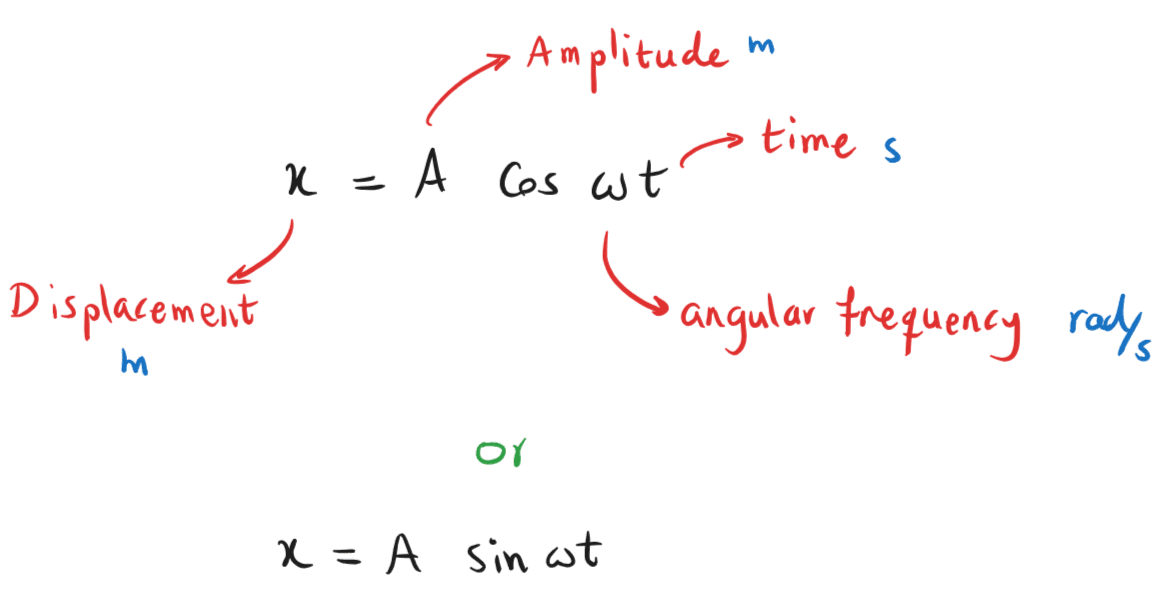
We use sin or cos depending on where the motion starts (at time of t = 0):
- If starts at the equilibrium position (x = 0) it is sin, because sin 0 = 0.
- If it starts at max displacement (x = A), then it is cos because cos 0 = 1 which is the max value for cos!
Velocity:
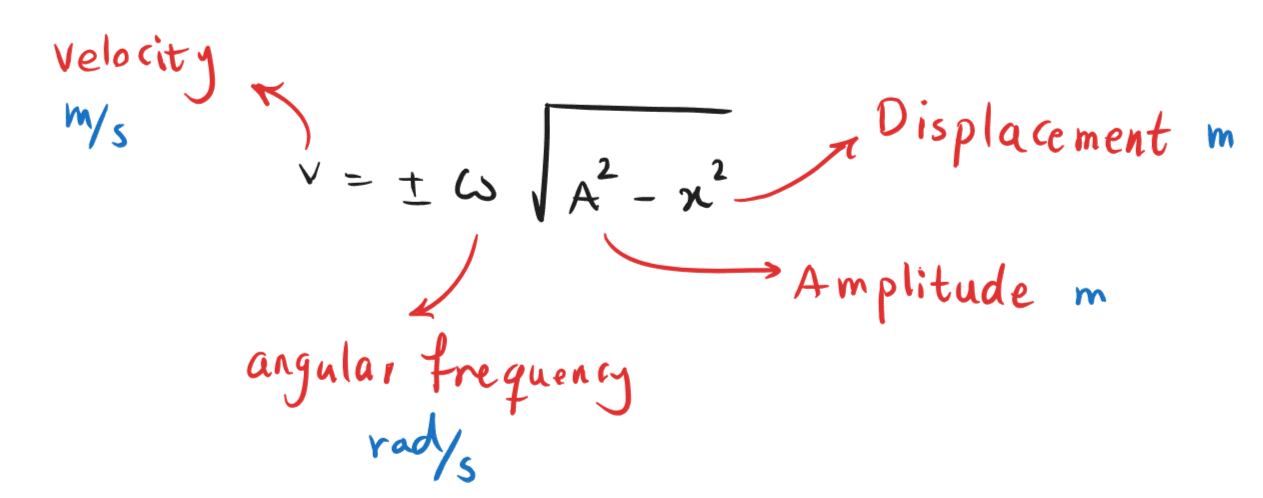
The negative or positive sign depends which direction you have assumed as positive!
Maximum velocity occurs when displacement is zero!
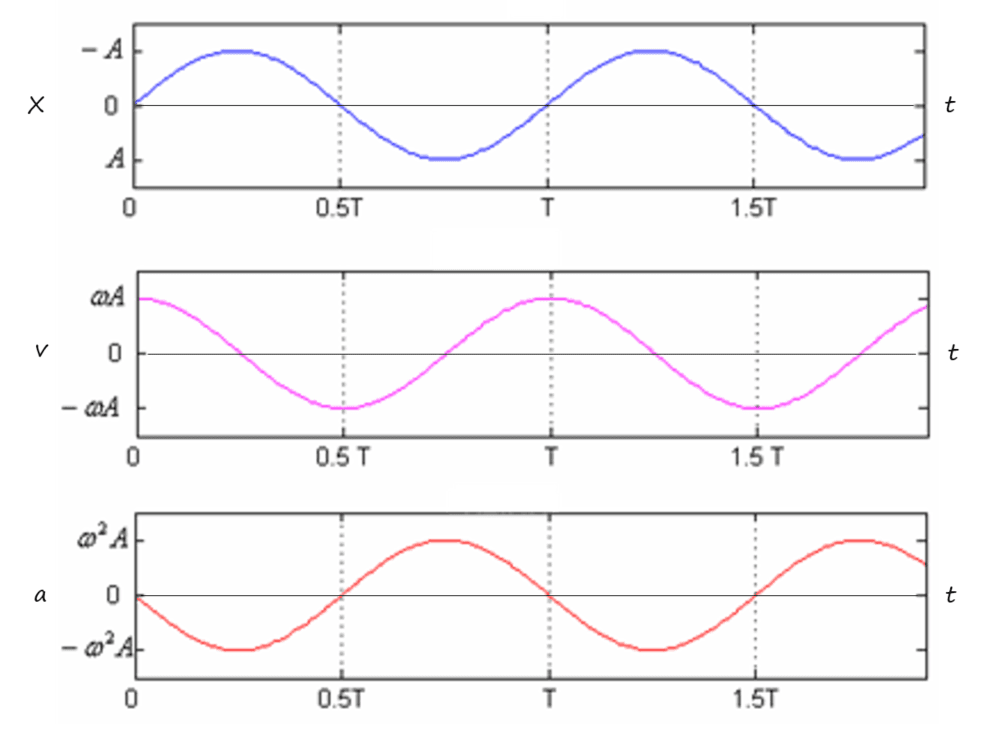
5.3.2.-1 SHM Graphs:
Diagrams below show:
x - t: displacement – time graph;
v – t: velocity – time graph;
a – t: acceleration – time graph;
Note:
- Velocity is the gradient of x-t graph;
- Acceleration is the gradient of v-t graph.
5.3.3 SHM & energy changes
Diagram below shows variation of gravitational potential energy (GPE) and kinetic energy (KE) for a pendulum in SHM.
This can be applied to any other object moving with SHM.
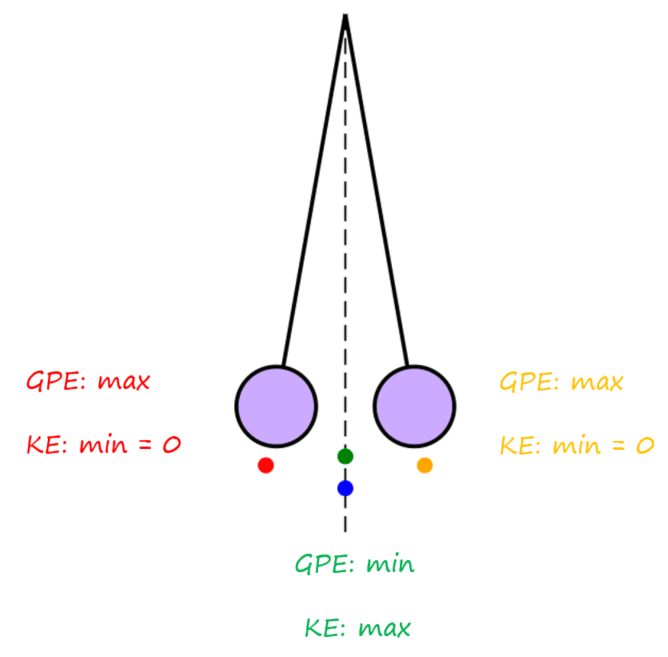
Ignoring energy losses due to friction, the total energy remains constant at all times.
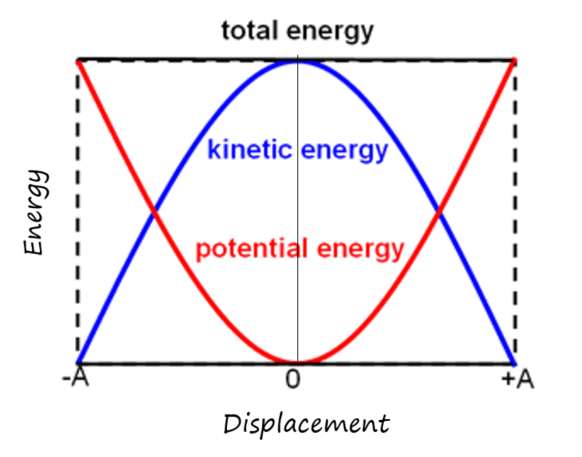
- If you have a horizontal mass-spring system, the interchange is between KE on one hand, and elastic potential energy of the spring on the other;
- If you have a vertical mass-spring system, the interchange is between KE on hand, and gravitational potential, and elastic potential on the other!
5.3.4 Damping
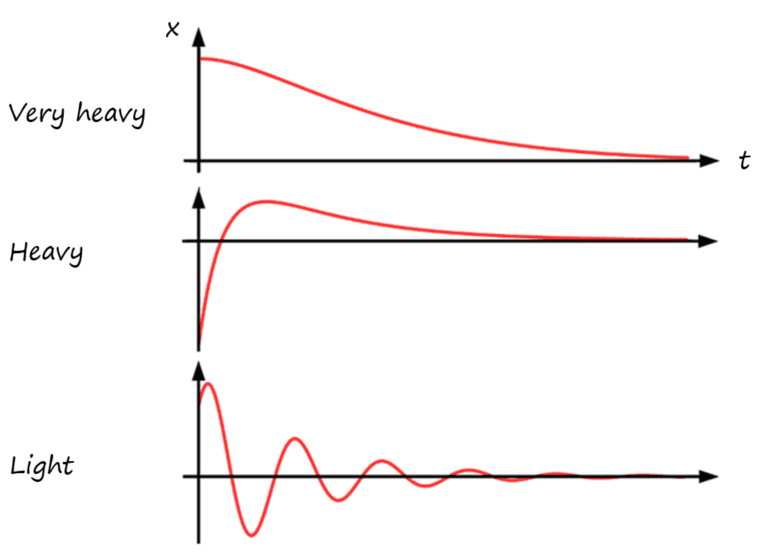
Damping happens when amplitude of oscillation is reduced by an external force.
There are three types of damping:
- Light damping: small resistive force, amplitude reduces gradually, period remains the same;
- Heavy damping: large resistive force, amplitude reduces fast, period gets longer;
Critical (very heavy) damping: no oscillation, object slowly moves towards equilibrium position.
5.3.5 Resonance
Free oscillation: when an object is displaced from its equilibrium position and allowed to oscillate without any external force.
Natural frequency: frequency of free oscillation.
Forced oscillation: when a periodic force drives the oscillating object. The frequency of this force is called the driving frequency.
Resonance: when the driving frequency is equal to the natural frequency, the amplitude of oscillation gets larger.
If a resonating oscillation is not damped, the amplitudes get very large and the system may break!
5.3.5-1 Examples of resonance
String instruments (guitar, violin): The body of the instrument resonates with the vibrating strings to amplify the sound.
Wind instruments (flute, trumpet): Air columns inside the instruments resonate at specific frequencies to produce notes.
MRI Machines (Magnetic Resonance Imaging) is used in MRI scanners. It relies on resonating atomic nuclei in the body using radiofrequency pulses in a magnetic field to produce detailed images.
Quartz Watches: A quartz crystal oscillator resonates at a very stable frequency when voltage is applied, helping keep precise time.
Car Suspension Systems: Shock absorbers are tuned to reduce resonance effects from road bumps, making rides smoother by damping oscillations.
Radio and TV Tuning: LC circuits (inductors and capacitors) are used in radios and TVs to select a particular frequency (station) by resonating at that frequency and filtering out others.
Resonance can have negative effects too. For example Tacoma Bridge built in 1940. It was designed to resist very strong winds, but one day a wind with a moderate speed of about 40 miles/hour which had the same frequency as the natural frequency of the bridge cause large amplitudes and made the bridge to collapse!
5.3.5-2 effect of damping on resonance
To avoid negative effects of resonance, we damp the oscillations.
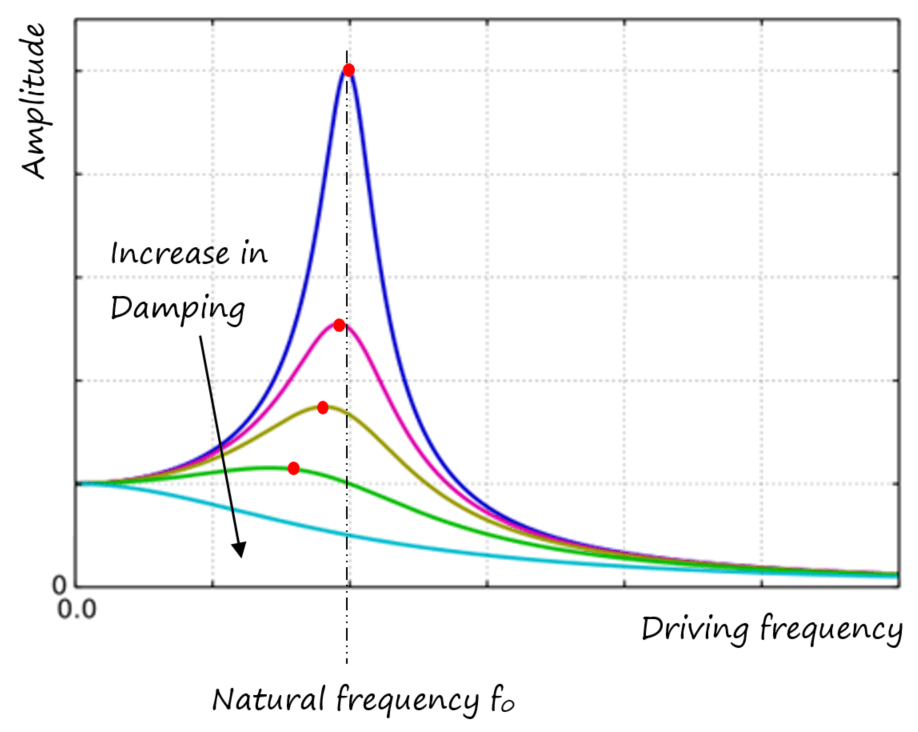
When there is not damping max amplitude occurs at natural frequency (f0).
As the damping increases the max amplitude occurs at a lower driving frequency.
:
Revise and Get Paid!
If you like taking summary notes of lessons and solving past papers, see the Join Us page!