AQA Physics
Classification of stars
9.2.1. By Luminosity
A large star may appear with same brightness as a small one if it is further away!
Luminosity (L): amount of energy radiated from a star per second (power).
Brightness (b): imagine a star is at centre of a sphere with radius r, the power (luminosity) received per unit area on the surface of the sphere is the brightness of the star; with unit of Wm-2.

Inverse square law: The brightness is inversely proportional to the distance from the star.

Apparent magnitude (m): is a subjective measure of how bright a star appears from Earth.
A smaller (or more negative) apparent magnitude means the star appears brighter.
The scale used is called Hipparchus, in which 1 was the brightest and 6 was the faintest.
Today the scale is beyond 1 and 6 e.g. the sun m = -26.74, moon m = -12.6.
Apparent magnitude does not take into account how far the star is from us, and is only limited to visible part of EM spectrum.
So the luminosity could be very different!
Pogson’s law:
Pogson is a formula for Hipparchus scale:
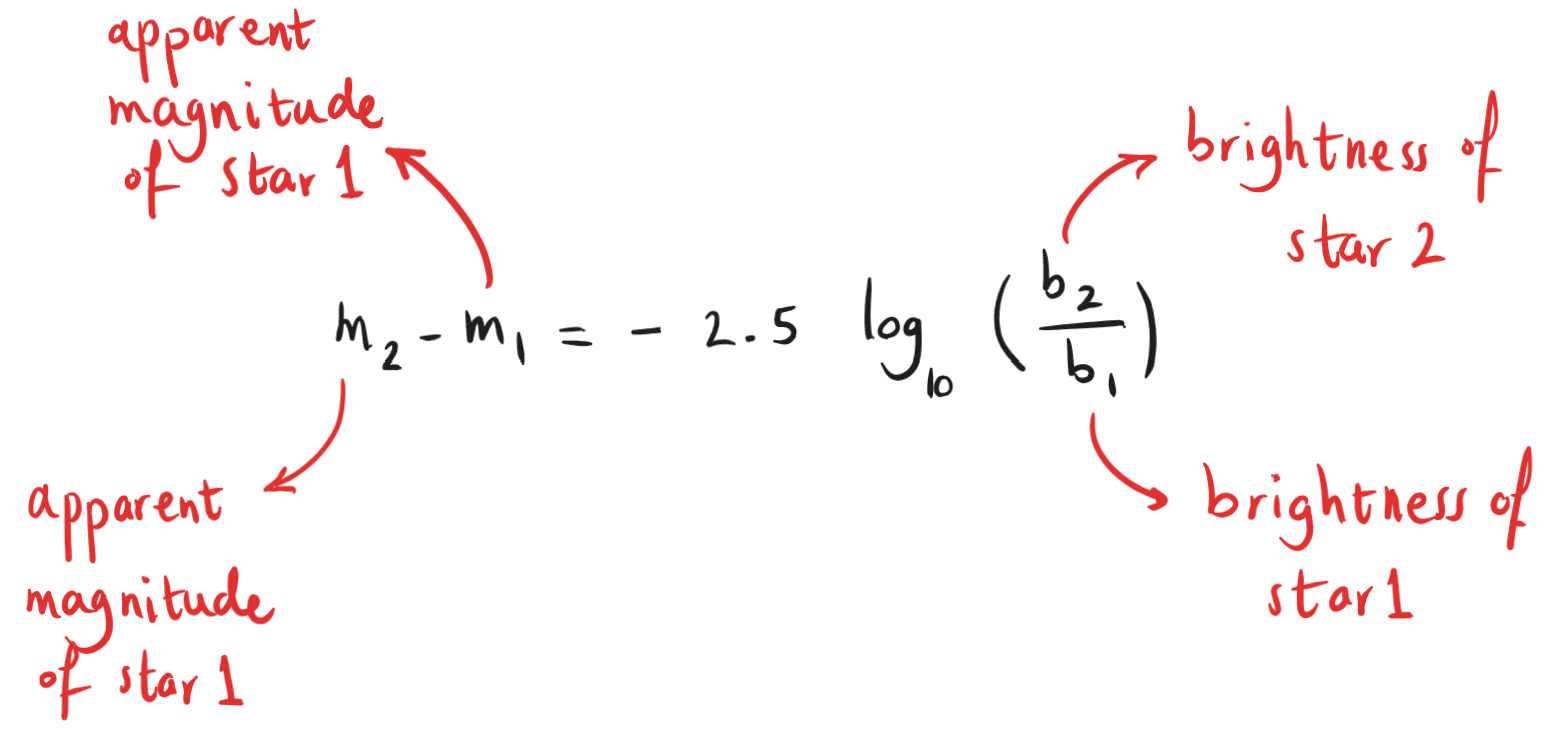
Meaning of the formula:
Difference of max to min apparent magnitude (m):

Pogson assigned this difference of 5 units to brightness ratio (  ) of 100.
Human vision responds roughly logarithmically to light intensity.
So:
1 magnitude difference → brightness ratio = Δm
2 magnitudes difference → brightness ratio = (Δm)2
3 magnitudes difference → brightness ratio = (Δm)3
5 magnitudes difference → brightness ratio = (Δm)5
Which means:


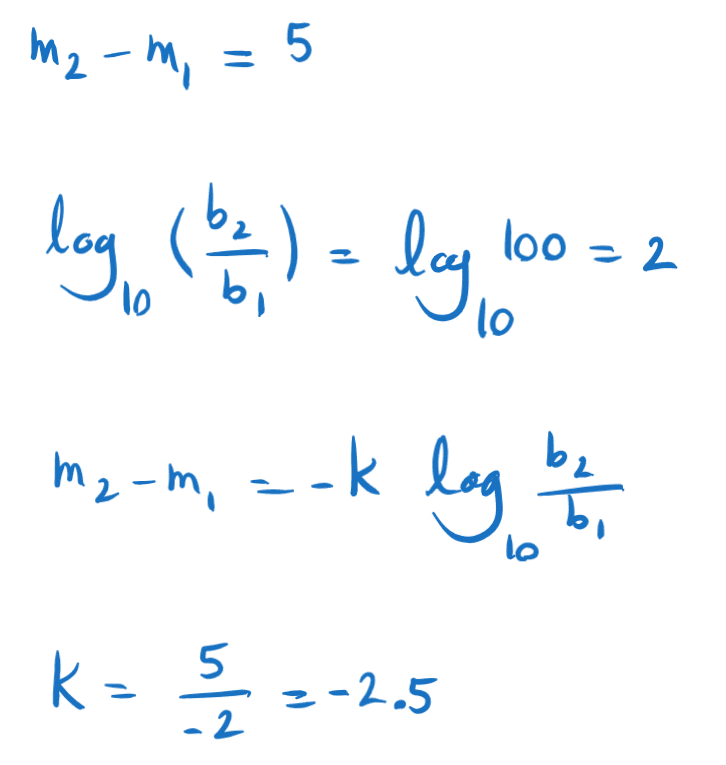
But be careful the 2.5 in the formula is not the same as 2.512. That one is derived this way:
9.2.2. Absolute magnitude
9.2.2.1. Some definitions:
Astronomical unit (AU): average distance between the Sun and the Earth = 1.50 x 10¹¹ m.
Arcminute: an angle equal to 1/60 of a 1 degree. 1’ =  1o
1o
Arcsecond: an angle equal to 1/60 of an arcminute. 1” =  1o
1o
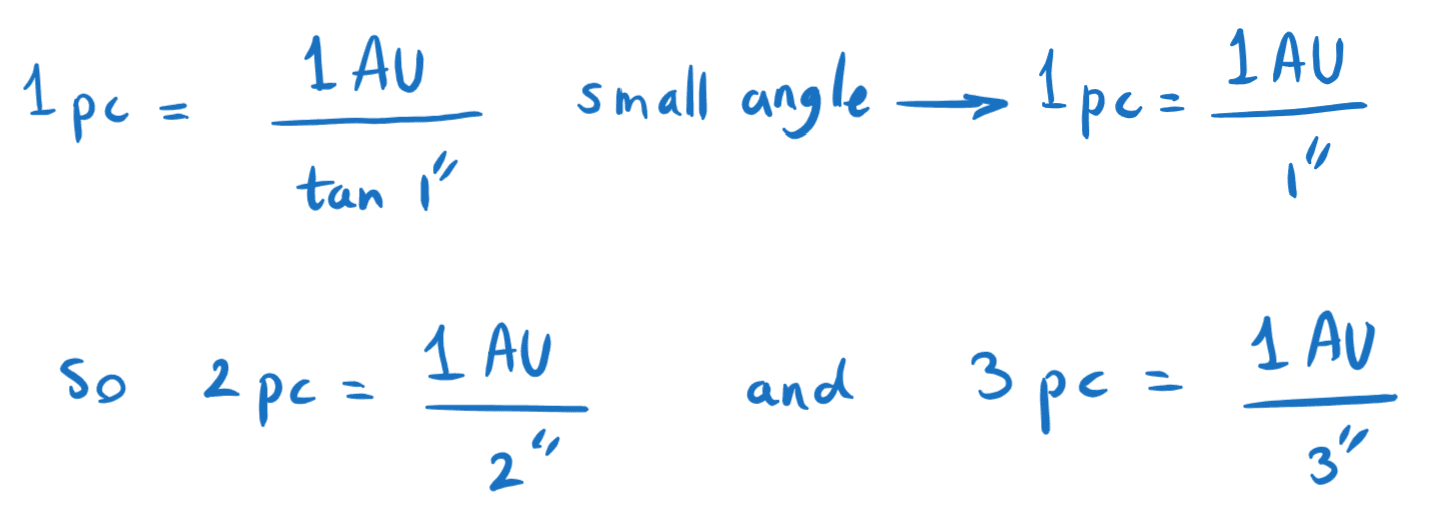
Parsec (pc): the distance at which one astronomical unit (AU) subtends an angle of one arcsecond (1/3600 of a degree)
1 pc = 3.1 x 10¹⁶ m.

In triangle above:
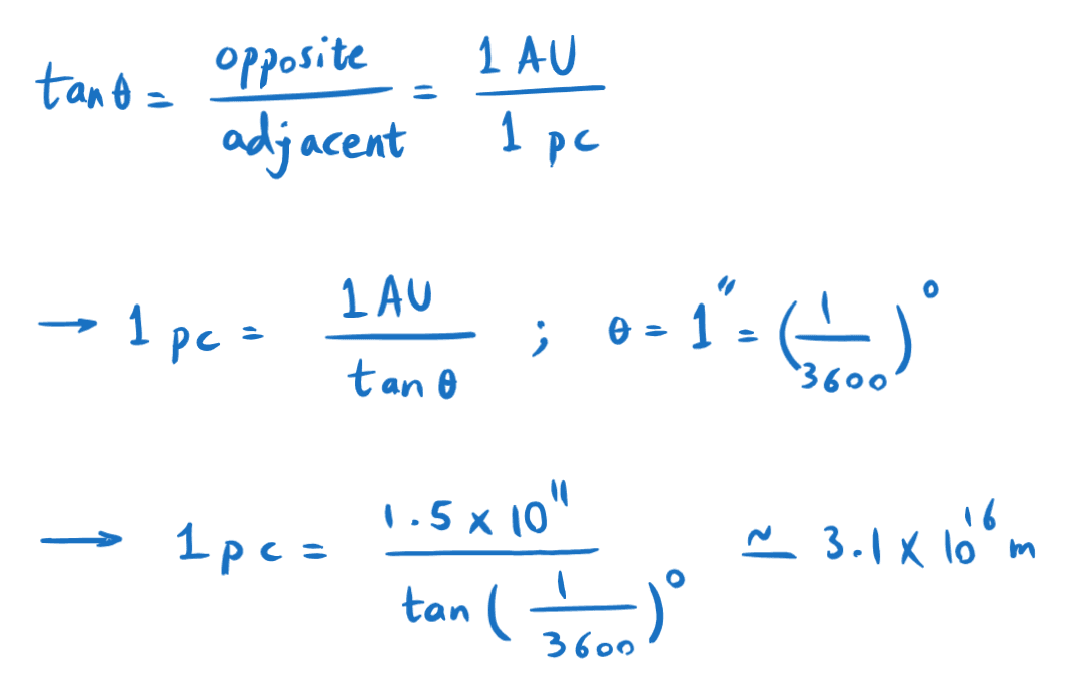
Small angle approximation: if θ is small, then we can say: tan θ = θ.
So, if θ = 1” the distance between the Sun and point P will be 1 pc.
If θ = ” the distance will be 2 pc.
If θ = ” the distance will be 3 pc.
And so on!
Reason:
Stellar parallax: imagine in June we are at position A and look at a star C as shown below. We will see it at position D.
Then when December comes (6 month later) we are at point B, and we will see the same star at point E.

This change in location of star C is called the apparent shift. Because it appears it has shifted!
We can measure the angle P (parallax angle) shown above in arcsecond.
Then distance d of star C is given by:
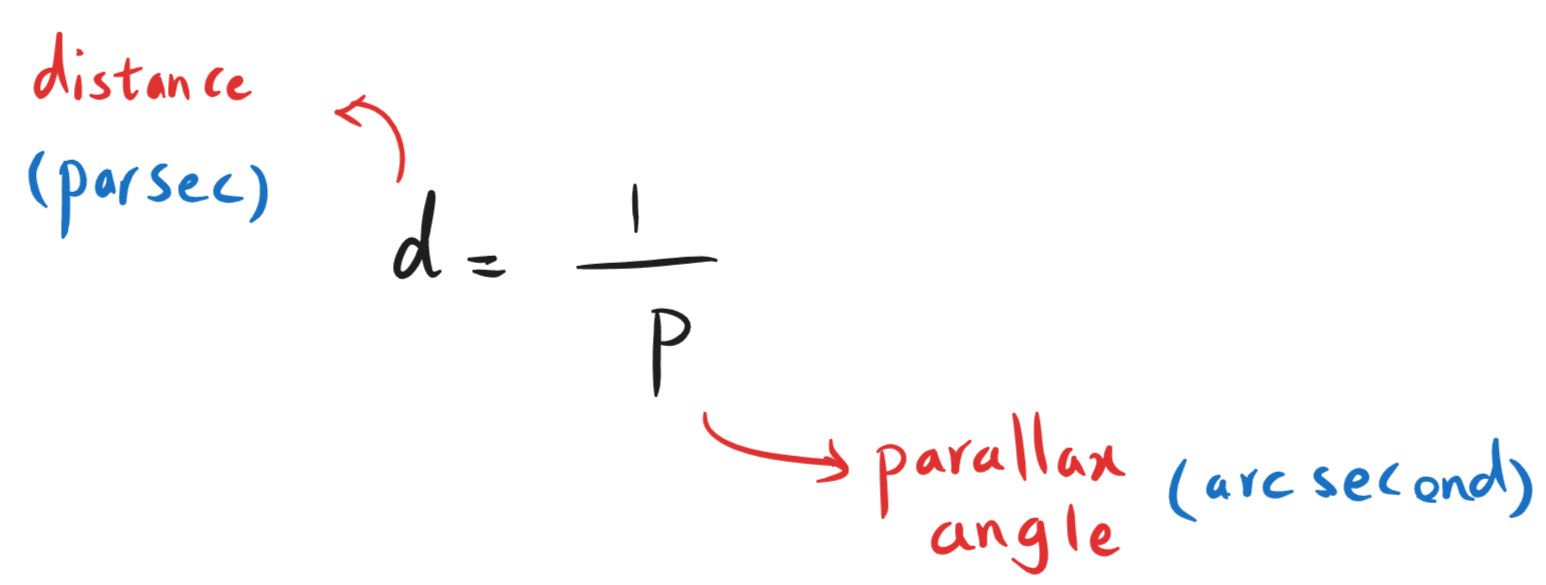
This formula is valid for distances less than 100 pc.
Because as the distance increases the angle P decreases and becomes impossible to measure with current technology.
Light-year (ly): distance travelled by light in vacuum in one year = 9.46 x 10¹⁵ m.
9.2.2.2. Absolute magnitude:
Imagine all stars in the sky were at the same distance from us, their brightness would only depend on their luminosity.
We call this brightness absolute magnitude (M).
The imaginary same distance = 10 parsec.
Relationship between apparent and absolute magnitudes:
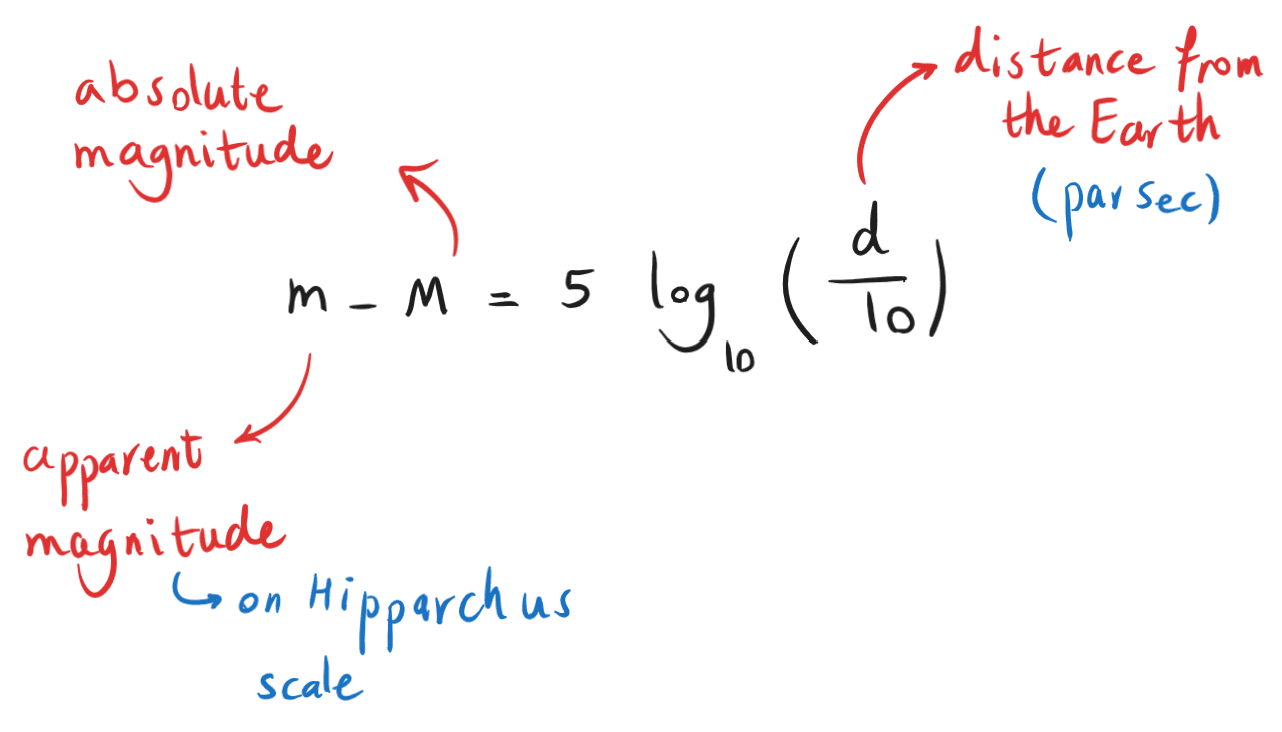
The expression “m – M” is called distance modulus.
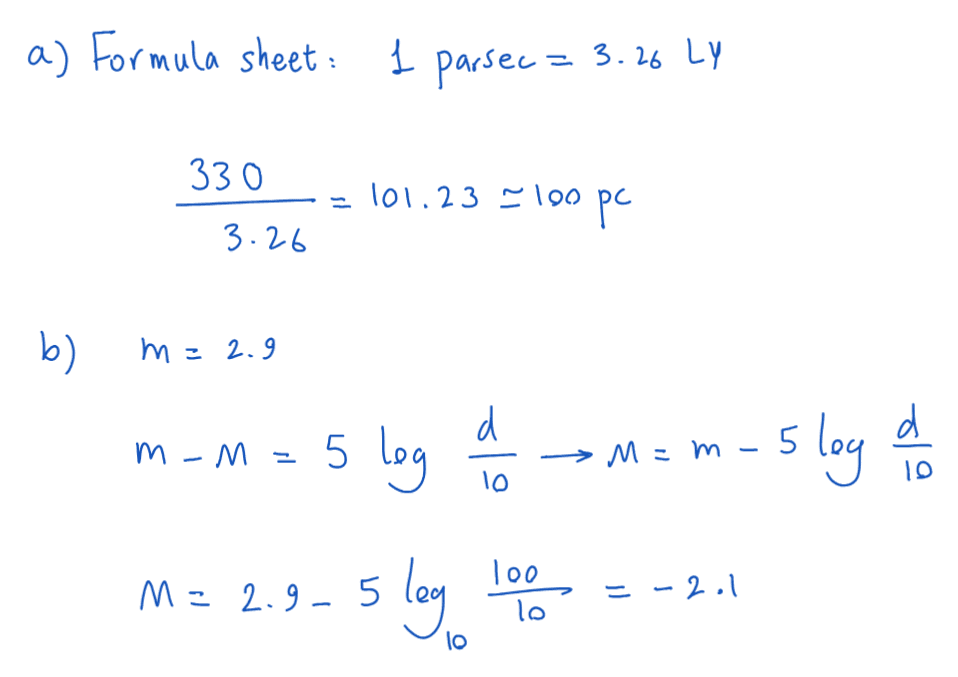
Example 1:
Matar is a star at a distance of 330 light years.
a) Find its distance in parsec;
b) If apparent magnitude of Matar is 2.9, calculate its absolute magnitude;
9.2.3. Classification by temperature
9.2.3.1. Stefan’s law
Stefan’s law applies to an object in thermal equilibrium (its temperature is constant).
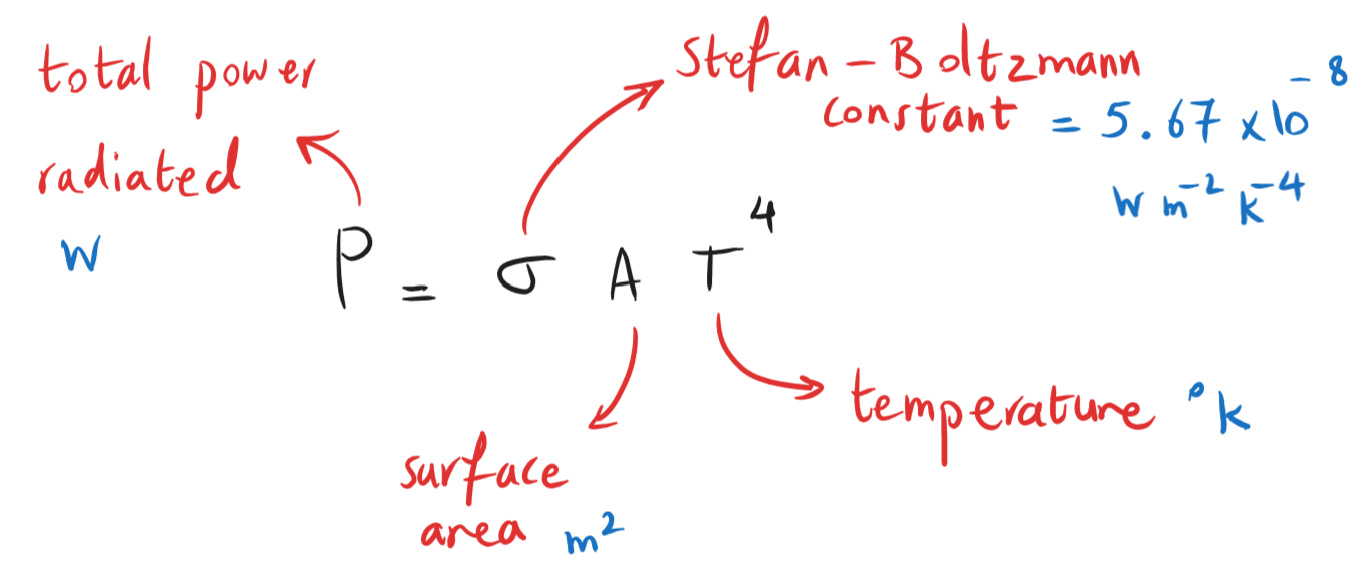
Black body: A black body is an idealized object that absorbs all electromagnetic radiation (light, heat, etc.) that falls on it, without reflecting or transmitting any of it. It is also a perfect emitter of radiation based only on its temperature.
Examples of black body:
✅ The Sun – Closely behaves like a black body, emitting a spectrum that peaks in visible light.
✅ Incandescent Light Bulbs – The filament glows due to black-body radiation.
✅ Cosmic Microwave Background (CMB) – The afterglow of the Big Bang follows a black-body spectrum.
A black body cannot emit all of its energy over all wavelengths at once. According to Kirchhoff’s law of thermal radiation:
For a body in thermal equilibrium, at a given wavelength and temperature, emissivity equals absorptivity.
9.2.3.2. Wien’s displacement law
This law is used to determine the temperature of objects by analysing the EM waves they emit.
Hotter objects emit shorted wavelength radiation. Red à Orange à Yellow à Blue
At a certain temperature a black body emits electromagnetic radiation across a broad range of wavelengths, but there is one particular wavelength — called the peak wavelengthλmax— at which the emitted radiation has maximum intensity.
Diagram below shows the black body curves:

Wien said peak wavelength is inversely proportional to absolute temperature:
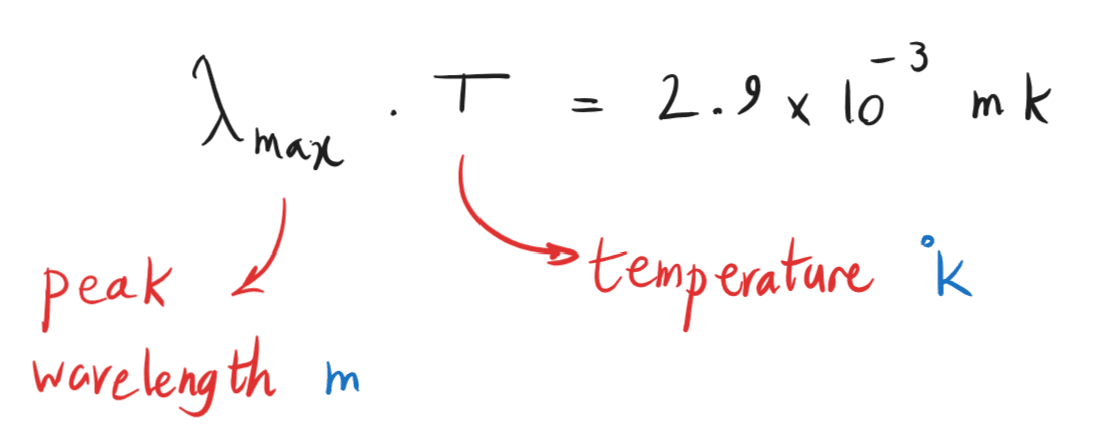
Measurements of sunlight above Earth’s atmosphere show the Sun closely matches the black-body curve for a temperature of about 5800 K, with a peak in the yellow region of the visible spectrum.
Although the whole Sun is not in thermal equilibrium and has a temperature gradient toward its centre, the photosphere (where the light is emitted) is close to thermal equilibrium and remains at a nearly constant temperature over long periods.
Because stars closely resemble black bodies, their surface temperatures can be determined from their spectra (range of λ received from the star).
Hotter stars emit more radiation at shorter wavelengths and appear bluer, while cooler stars emit at longer wavelengths and appear redder.
9.2.4. Stellar spectral classes
9.2.4.1. Star Temperature
Stars classification based on temperature:
Spectral class | Intrinsic colour | Temperature/K | Prominent absorption lines |
O | Blue | 25 000 – 50 000 | He+, He, H |
B | Blue | 11 000 – 25 000 | He, H |
A | Blue-White | 7 500 – 11 000 | H-(strongest) ionized metals |
F | White | 6 000 – 7 500 | ionized metals |
G | Yellow-White | 5 000 – 6 000 | ionized & neutral metals |
K | Orange | 3 500 – 5 000 | neutral metals |
M | Red | < 3 500 | neutral atoms, TiO |
7 classes in total.
Memorise them with this mnemonic:
Oh Be A Fine Girl, Kiss Me!
I am sure you can make you own versions too!
In that order temperature is decreasing, but not sure that is also true if she kisses you!
As you can see because this is my website, I can write whatever I want! And I am sure no one is going to read this, so if you just did that; send me an email and I’ll send you some money!
I think I will die a millionaire!
The Sun is glass G.
9.2.4.2. Stellar Spectroscopy
From the light received from a star, in addition to its temperature, we can also tell its chemical composition and physical condition.
We get three types of spectra from a star:
· Emission continuous spectrum;
· Emission line spectrum;
· Absorption spectrum.
Emission spectrum: is a spectrum of bright lines or bands produced when excited atoms emit light at specific wavelengths as their electrons fall to lower energy levels.
Absorption spectrum: a series of dark lines on the background of continues spectra. It is made by passing white light through a cooler gas. The electrons in atoms of gas absorb photons with energy equal to ΔE of energy levels of the atom.
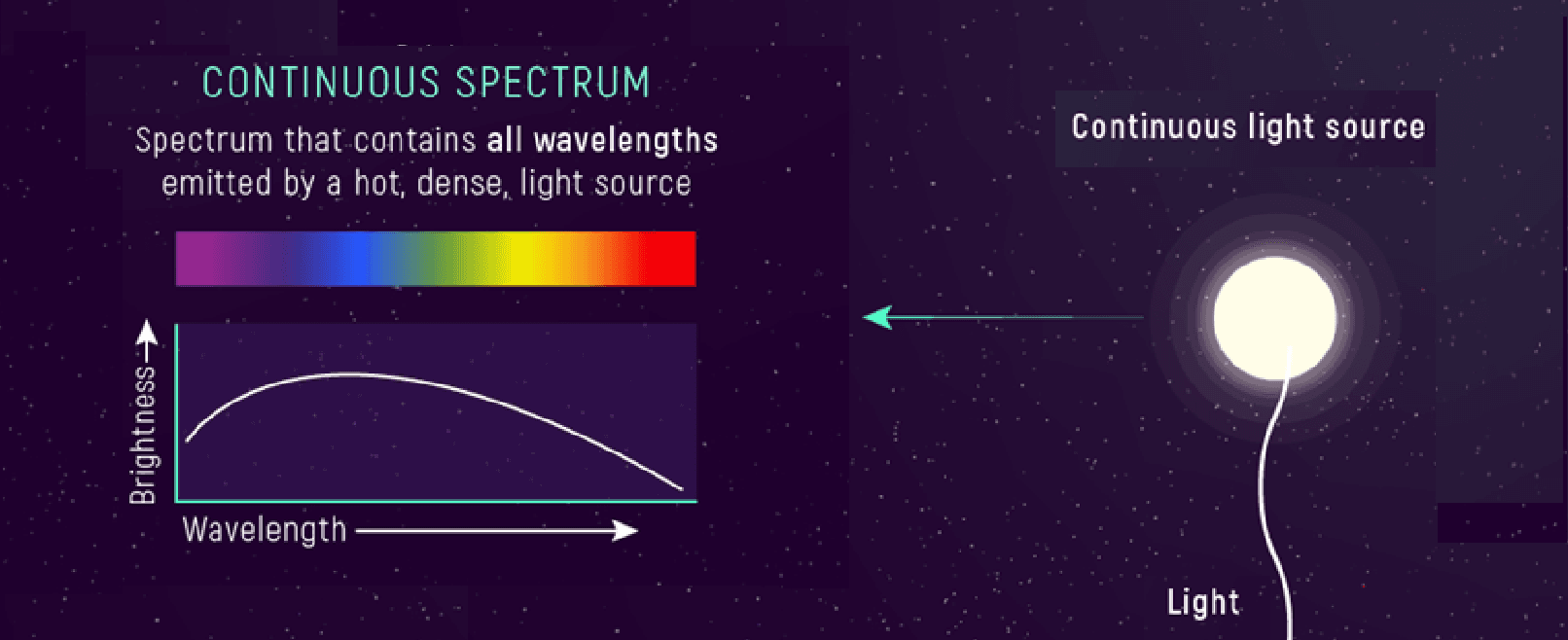
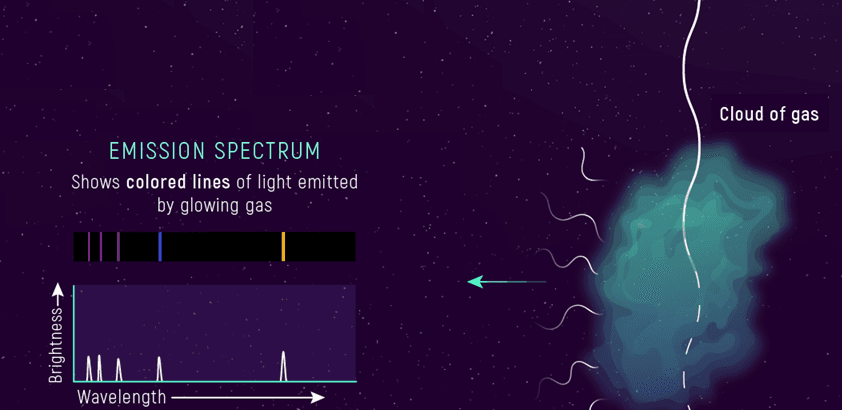
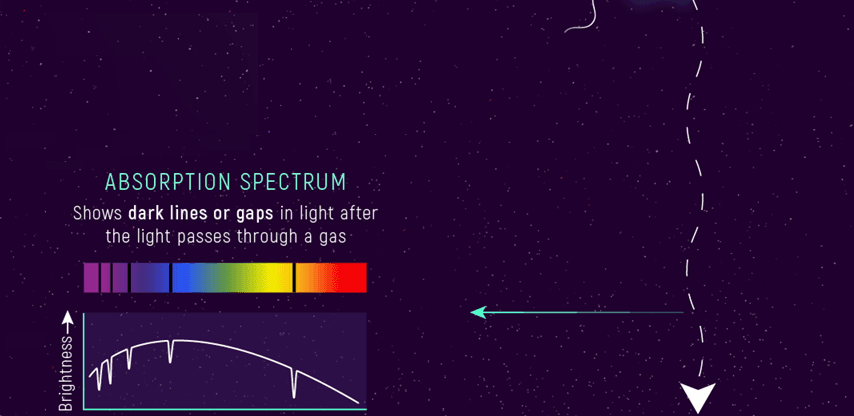
If we put an emission and absorption spectra on each other, they give us the continuous spectra!
Light from the core of a star is white. But before it gets to us, it has to pass through cooler gas around the core. The gas usually is hydrogen.
This means we get an absorption spectra from the star.
By comparing the wavelength of the light from the stars, with emission spectra obtained in lab, we can deduce the elements that the star is made of.
9.2.4.3. Balmer Series
Figure below shows the emission line spectrum and absorption of hydrogen.
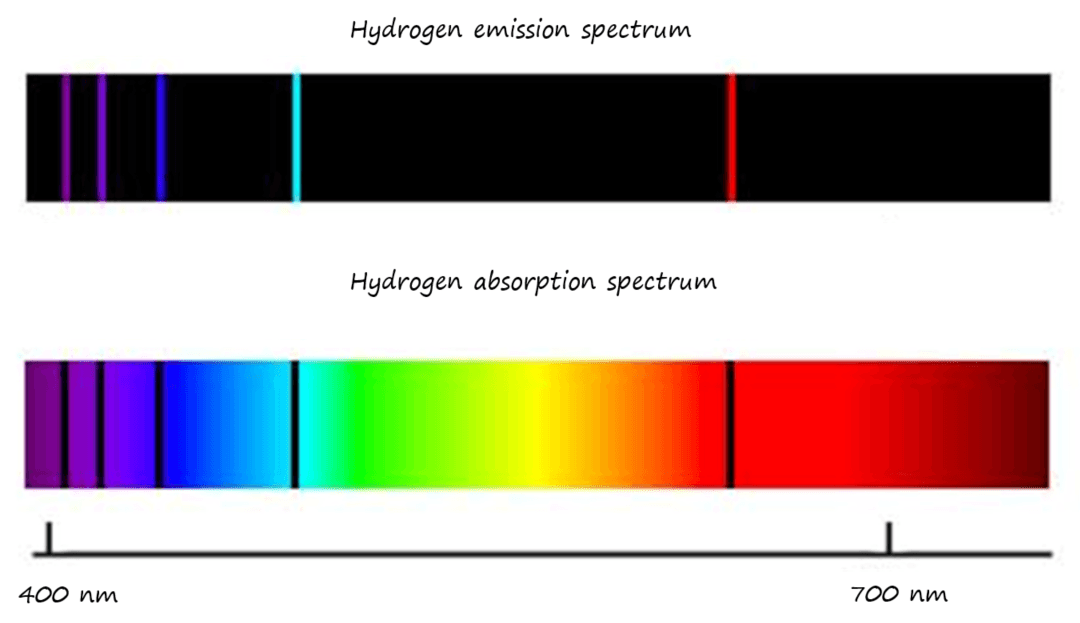
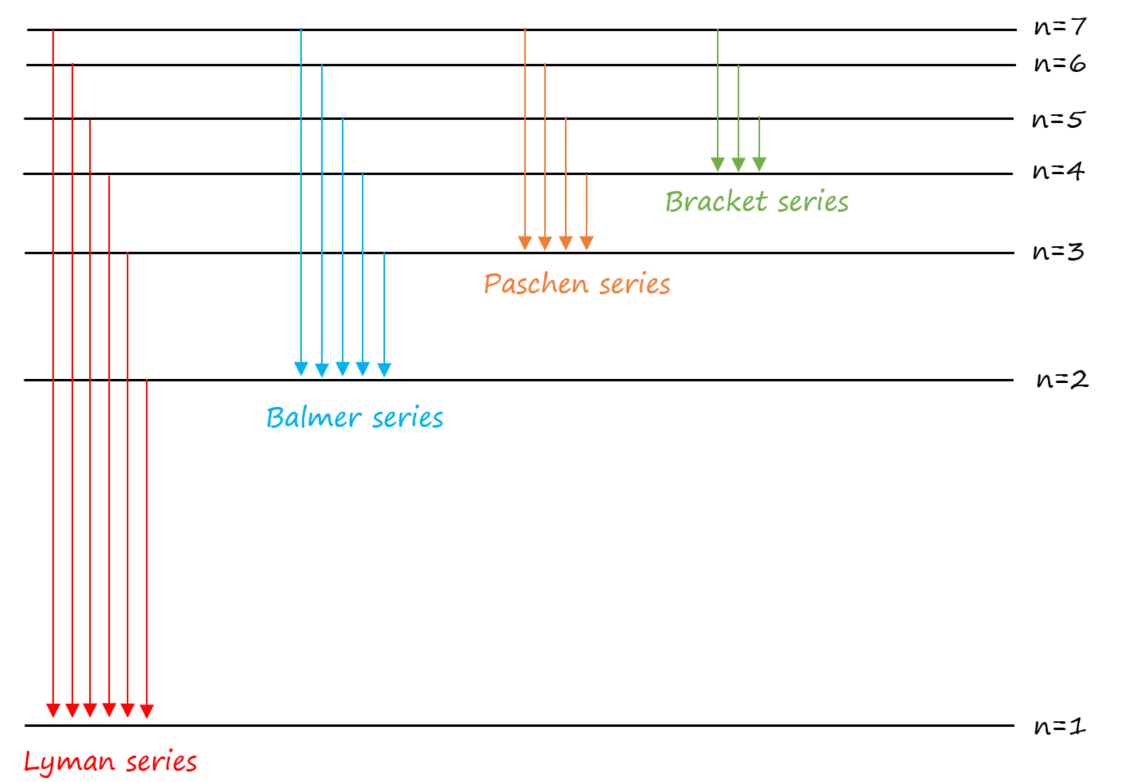
The electron transitions in hydrogen atom that produces visible light are called Balmer Series.
The intensity of lines in the spectrum depends on the temperature of the star.
By finding the temperature and elements in the star we find the star spectral class.
9.2.5. Life cycle of low-mass stars
These are stars with mass similar to our Sun (M☉).
9.2.5.1. A star is born!
Area between stars is called interstellar medium.
This area contains molecular clouds made of cold gas (mostly hydrogen) and dust (graphite and silicate).
Fragments of molecular clouds rotate due to gravitational forces and spin inward to form a dense spherical centre called a protostar.
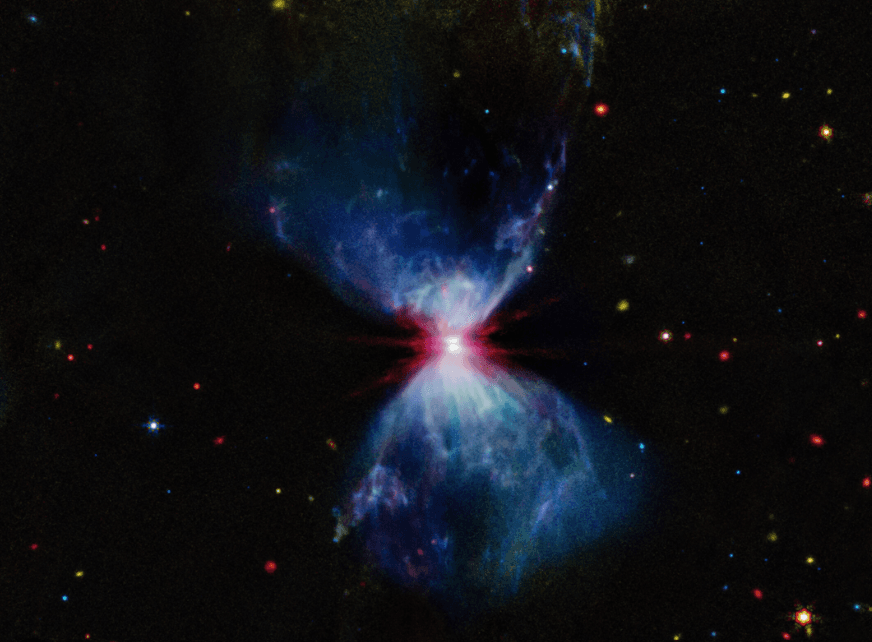
Flat discs of material (called circumstellar disc) are rotating around this protostar, which may be come future planets.

As protostar gets bigger its gravitational field strengthens, and attracts more material.
Protostar size, density and temperature (due to friction between clumps of material) also increase.
It begins to shine slightly in infrared, this energy comes from gravitational energy of falling material colliding and causing friciton.
After some time (that can be millions of years!) repulsion of hydrogen nuclei is overcome by high temperature and pressure of protostar, and fusion starts.
Fusion causes an outward pressure which counter acts the pull of gravity.
It now glows more in the visible light spectrum and is called pre-main-sequence star.
9.2.5.2. Star continues to shine
Main sequence star: When the outward expansion of fusion is in equilibrium with the contraction of gravity, and all of energy comes from fusion (not gravity).
Hydrogen burning: fusions of hydrogen in star’s core. And has two types:
a) p-p chain: In stars with similar mass to the Sun: Proton-proton chain;
b) CNO cycle: Stars with greater mass than Sun: carbon–nitrogen–oxygen cycle.
In both of these due to loss of mass in fusion, energy is released: 
Transfer of energy from core to outer layers:
a) By convection: hot gas arise and cool gas fall down, creating circulation currents;
b) Radiative (photon) diffusion: photons created in fusion travel outside of core. Photons motion is random and it may take tens of thousands of years for them to get to the outer core!
9.2.5.3. Even stars die!
Stars similar to the Sun remain on main sequence for about 10 billion yeas!
Then hydrogen in the core is finished.
Star begins to burn hydrogen in outer layers.
Outer layers expand and we call it red giant.
Red giant has lower surface temperature but highly luminous.
Finally hydrogen in outer layer is finished too, and star throws off the outer layers to space which we call a planetary nebula.
Core shrinks under gravity, called white dwarf.
White dwarf is very hot initially, and very dense: 108 to 109 kg/m3.
Core shrinking stops due to fact that electrons cannot occupy the same space.
So while gravity wants to shrink, electrons create an outward pressure, called electron degeneracy pressure.
This whole story is called Pauli Exclusion Principle, which says No two identical fermions (such as electrons) can occupy the same quantum state at the same time in an atom.
For electrons in atoms, this means:
· No two electrons can have the same set of four quantum numbers.
· An orbital can hold a maximum of two electrons, and they must have opposite spins.
This principle explains atomic structure and the arrangement of electrons in energy levels.
Anyway…
Finally temperature of white dwarf decreases and now we have a black dwarf.
The Star will rest in peace now!
Star’s age vs spectral class:
Star’s Mass / M☉ | Spectral Class | Main-sequence / 106 years |
25 | O | 3 |
15 | B | 15 |
3 | A | 500 |
1.5 | F | 3000 |
1.0 | G | 10 000 |
0.75 | K | 15 000 |
0.50 | M | >200 000 |
So the smaller the star the longer it lives, and the older it is.
The oldest ones are called red dwarfs!
They have low: mass, temperature and luminosity, which means they burn hydrogen slowly.
Sun is a G class star with main sequence of about 1010 years.
9.2.5.4. Hertzsprung-Russell diagram
A diagram with absolute magnitude (Luminosity) on the vertical and spectral class (temperature) on its horizontal axis.
The temperature on horizontal axis is decreasing (left to right)!

Four main regions on the HR diagram:
1) Long diagonal: shows main sequence stars, that is about 90% of visible stars; top-left of the diagonal hot and blue stars, at the bottom right, red and cool stars;
2) Red giants: when stars with mass similar to the Sun run out of hydrogen and start fusing helium. Expanded outer shell, cooler and redder;
3) Supergiant: stars with mass 10-100 time mass of Sun, their core is at such high temperatures that fusion can produce carbon and heavier elements;
4) White Dwarfs: a star at the end of its life cycle, no more fusion, small, very dense, high surface temperature, low luminosity. When no more light comes from them they are called black dwarfs.
Evolution of a star on the HR Diagram:

This is a little annoying but you should just remember the shape and regions of the HR diagram.
Many questions give you a space for the axis and ask you to draw all of it!
9.2.6. Life cycle of massive stars
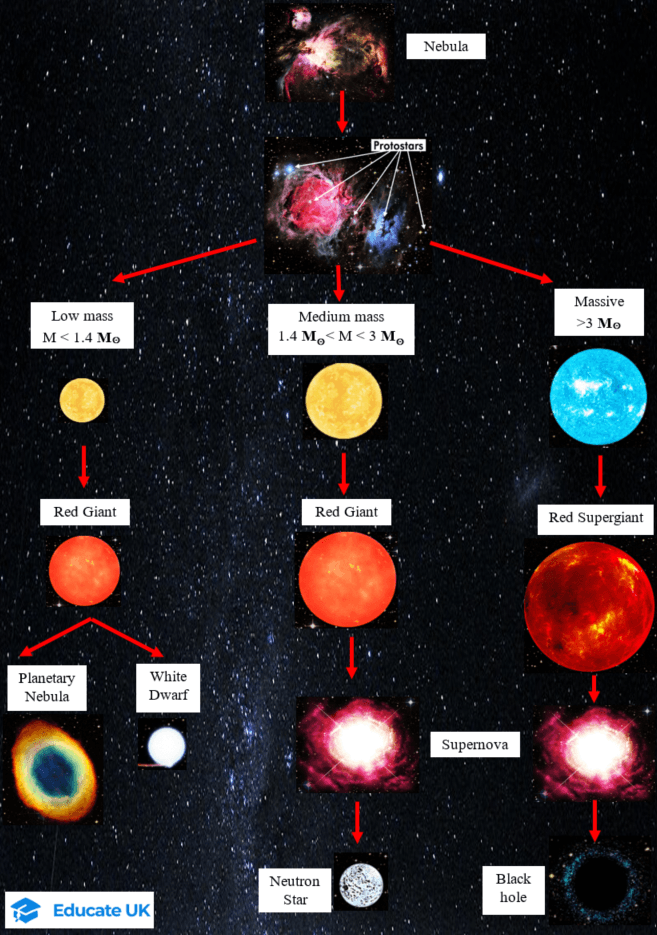
Stars with mass more than 1.4 of mass of the Sun (M☉) burn hydrogen via CNO cycle (see 9.2.5.2), because their core has higher temperature and pressure
And they burn hydrogen faster.
If:
1.4 M☉ < M < 3 M☉ à red giant (like Sun) à Supernova (unlike Sun) à neutron star.
M > 3 M☉ à red supergiant à supernova à black hole.
Red supergiant is similar to red giant. They are formed when hydrogen in the core is depleted.
Gravity takes over and core shrinks.
Hydrogen in outer layers keep fusing causing these layers to expand and become more luminous and red.
Temperature of supergiant’s core will be more than red giants. This means larger elements that hydrogen and helium can be fused.
Fusion in supergiant can produce elements as heavy as iron in layers around the core.
Blue supergiant: Stars with mass more than 10 M☉ where even heavier elements are formed.
This is how we get the chemical elements that we know today, including carbon and oxygen.
As Professor Brian Cox says: “In order for us to live, a star must die!”
.png)
9.2.6.1. Supernova – Type II
Supernova is the explosion at the end of a red supergiant, which ejects most of star’s mass into space.
Supernovae are divided into two main types:
· Type I: Occurs in a binary system when a star pulls in matter from its companion until runaway nuclear reactions trigger a massive explosion. I know this makes no sense! We will explain in section 9.2.7.
· Type II: Happens when a massive red giant or supergiant exhausts its nuclear fuel, collapses under gravity in seconds (implosion), and then violently ejects its outer layers (explosion).
Type II supernova can release a huge amount of energy and becomes luminous very rapidly.
Remember the following numbers:
Energy released by supernova’s explosion: 1046 J;
Energy released by the Sun every day: 3.3 × 1031 J.
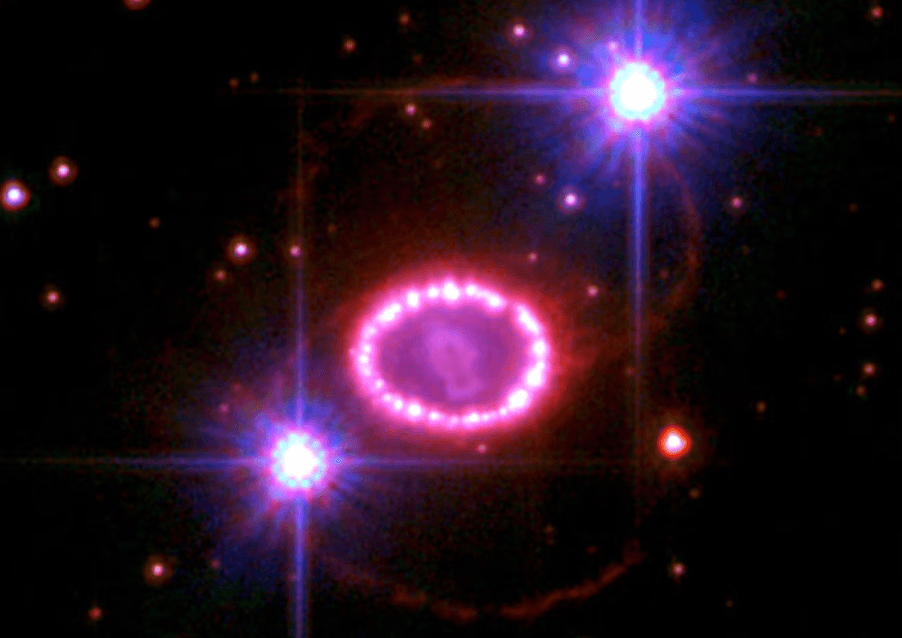
The result of explosion is called supernova remnant, at its centre we have a neutron star.
9.2.6.2. Neutron star
In neutron stars, due to high gravity, electrons are pushed into protons forming neutrons. Hence it has very high density.
Gravitational field of a neutron star is so powerful that escape velocity from it is about 80% of speed of light!
Density of neutron star is about 2 × 10¹⁷ kg/m3.
The core is made of neutrons and it has an iron shell.
If you had material of neutron star on a teaspoon (5 ml) it would have a mass of 5.5 × 10¹² kg! Crazy! It’s all made of tightly packed neutrons!
A little about escape velocity:
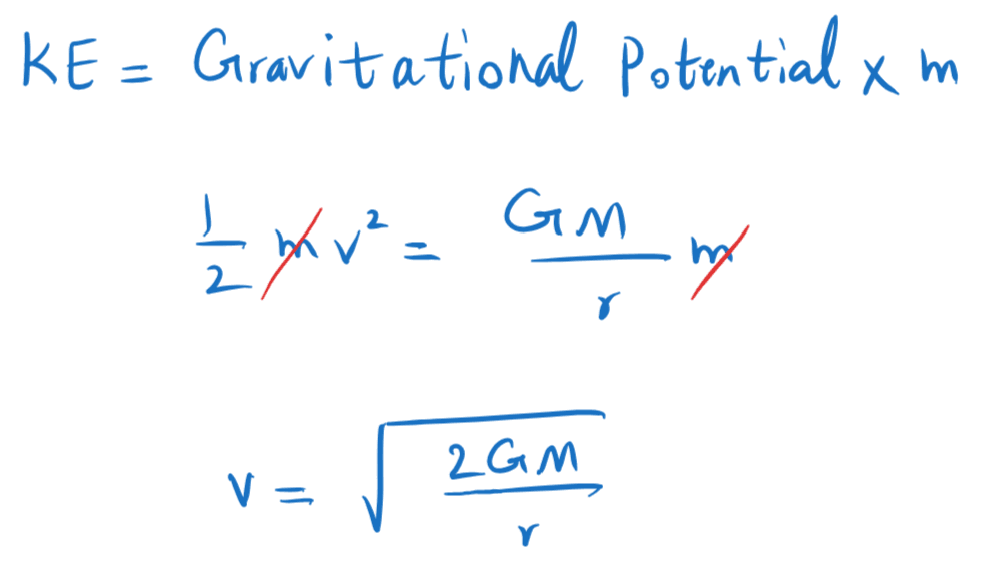
An object can escape a gravitational field if its kinetic energy is more than or equal to the gravitational potential energy at the point where escape is possible.
Gravitational potential energy = gravitational potential × object’s mass
Neutron stars can be formed either single or in a pair!
The pair is called the binary system which will talk about more in a bit…
9.2.6.3. Pulsar
At the surface of neutron star the gravity is not strong enough to push electrons and protons into each other to form neutrons any more.
If neutron star is rotating, these protons and electrons create a magnetic field.
Because moving charges create a magnetic field!
So the charged particles accelerate towards magnetic poles of the neutron star.
While moving they emit a wide range of EM radiation in a narrow beam in opposite directions.
Neutron star may have a frequency of 600 (rotates 600 times per second).
So a pulsar is a neutron star that emit EM waves!

9.2.6.4. Black hole
If:
M > 3 M☉ à red supergiant à supernova à black hole.
Black hole is actually a remnant of neutron star that collapses under its gravity.
The gravitational field of black hole is so strong that even EM waves cannot escape it!
Meaning the escape velocity is more than speed of light.
According to Einstein’s theory of special relativity no speed exist more than light’s speed!
So for neutron star to become a black hole, there is a minimum radius:
This is calculated based on minimum speed needed to escape the back hole: which is speed of light, and it is called Schwarzschild radius.
9.2.6.5. Schwarzschild radius
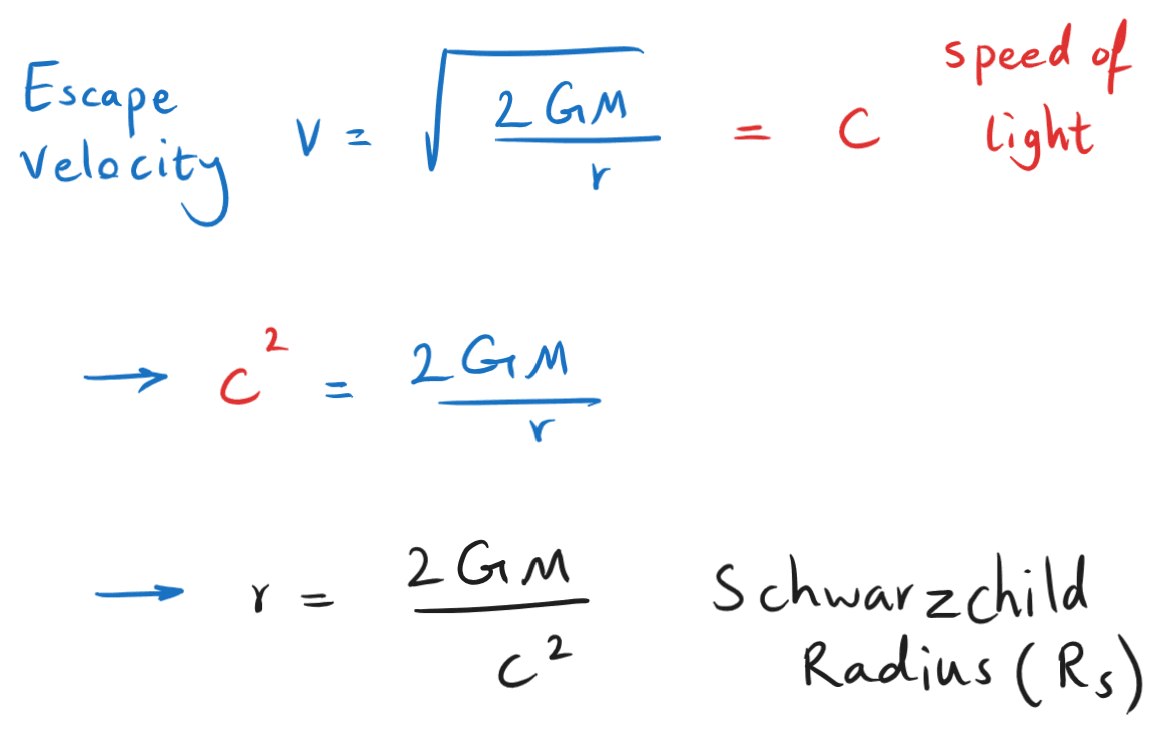
So any object with enough mass and min radius (Schwarzschild radius) will trap light (and all other EM waves) and we cannot see it or get any info from it!
All we can study of a black hole is its effect on the surrounding objects.
The boundary of a black hole is called the event horizon out of which no info comes out!
In other words: what happens in black hole, stays in black hole!
9.2.6.6. Gamma ray bursts (GRB)
Gamma ray telescopes register intense bursts of gamma rays once a day which lasts from few milliseconds to tens of seconds.
These are received in random directions and come from other galaxies, from a supernova.
The total energy in a GRB is about 1048 J, we only get a fraction of it though!
If a GRB happens in our galaxy, it can kill most life on Earth! This may have happened before our time!
9.2.6.7. Supermassive black holes
We have not seen supermassive black holes (black holes cannot be seen!).
But we have seen gas and stars near the centre of galaxies, accelerate to high angular velocities.
So we suspect there must be a massive black hole with strong gravitation field that accelerate those stuff!
Two ways supermassive black holes are made:
1) Collapse of huge amount of dust and gas when galaxies are formed;
2) Ordinary black holes eat up a lot of stuff (because of their high gravity) and become fatter!
3) Ordinary black holes join together.
Obviously on your exam paper don’t write fat!
Just say massive or enormous! Not sure if they are more polite, but I doubt big black holes care that much!
But as explained before because this my website, I can write whatever I want!
The exam paper technically is yours too, but you don’t own the person who marks it!
“Understanding Power” is a good thing and a good book too.
RIP Noam Chomsky, although at the time of writing he is still alive!
9.2.6.8. Type 1a supernova
In section 9.2.6.1 we said there is a Type1 supernova. Here is what it means:
Binary system: when two objects orbit the same point. They can be on different orbital radii or paths.
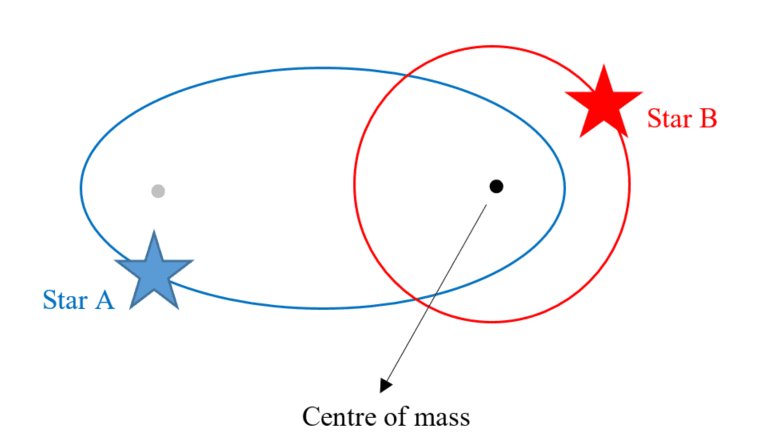
Type1a supernova: Sometimes a white dwarf is in a binary system with another star (the companion).
When the companion reaches its end and turns to a red giant, white dwarf’s gravity attracts material from the companion’s red giant.
As mass of white dwarf increases to a critical mass, nuclear reactions increase and leads to a supernova explosion.
Brightness (and absolute magnitude) of supernova increases shortly (less than a day), but then decrease over a few months.
Light curve: graph of absolute magnitude vs. time.
Below you can see the light curve for supernovae Type 1a and 2.
The peak magnitude defines t = 0.
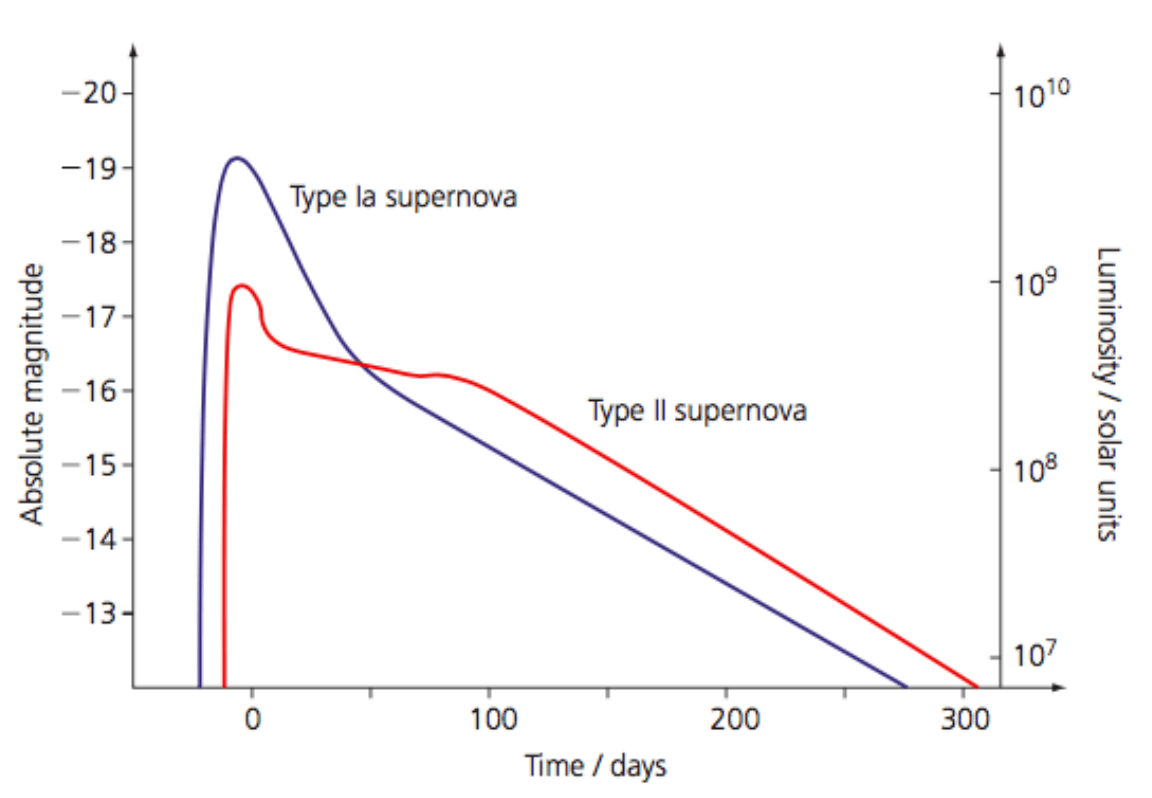
Type 1a:
· The explosions all happens at the same critical mass in different stars;
· And as a result all light curves of 1a’s are consistent;
· And have the same absolute magnitude peak = - 19.3 (brighter than Type 2);
· This peak happens about 20 days after the collapse of the core.
Type 1a can be used as a standard candle to measure cosmological distances.
9.2.6.9. Standard candle
Standard candle is a bright object that we know its luminosity, and absolute magnitude.
We measure large astronomical distances using standard candles.
Supernova Type 1a is a standard candle.
Distance in parsec is measured using apparent magnitude:
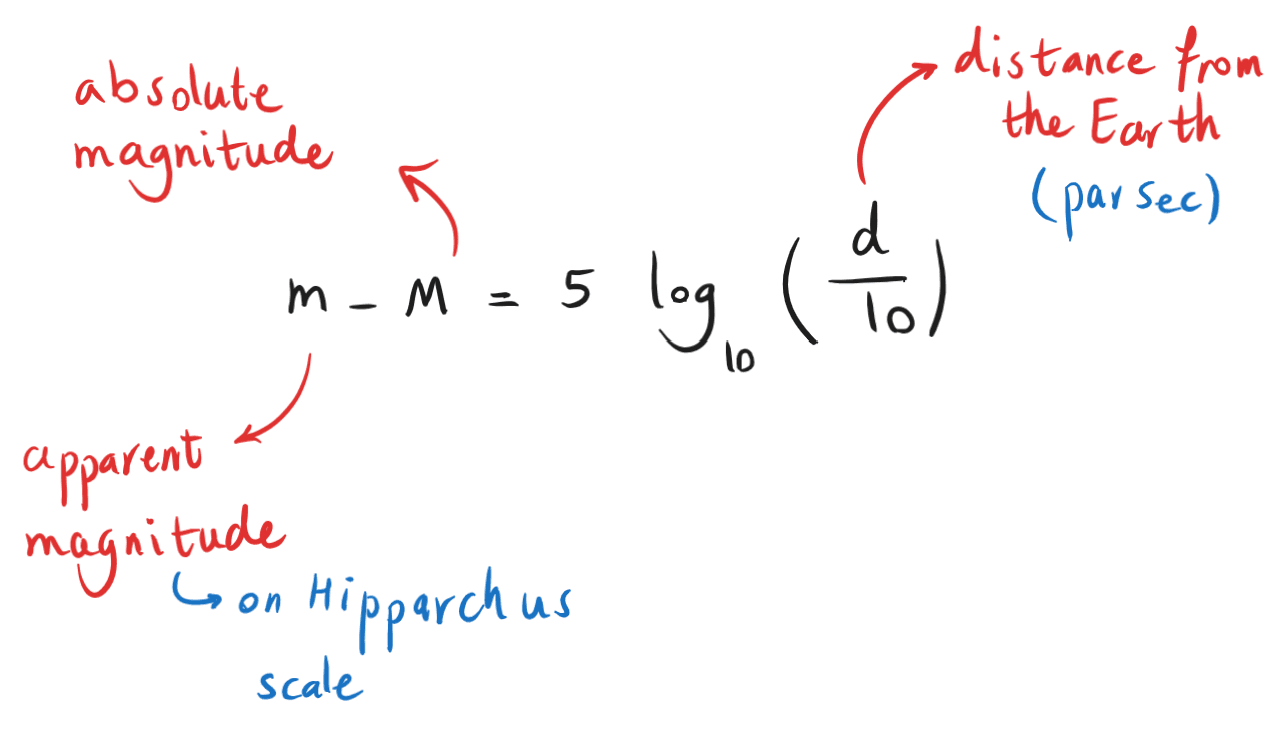
We use absolute magnitude (M) of Type 1a supernova.
Because we can see supernova in other galaxies (but not stars in galaxies), as supernova releases much more energy!
Supernova can be seen even from a distance of 1000 Mpc (3.26 billion LY).
These distances are called cosmological distances.
They are a significant fraction of the known universe.
Example 1:
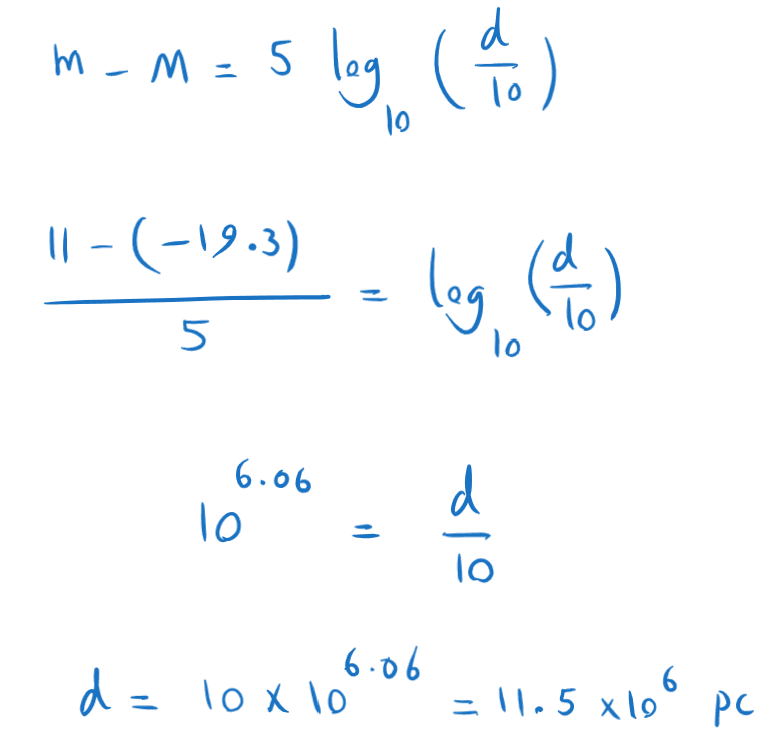
A type 1a supernova with an apparent magnitude of +11 is seen in a nearby galaxy. Find an estimate of the distance of this galaxy from the Earth.
Answer:
We should know that the max absolute magnitude of a Type 1a supernova is -19.3
Then we use the above formula:
Dark energy:
Estimation of distance using Type 1a supernova showed us that the expansion of universe is accelerating!
This meant that there must be some undetected energy throughout the universe which we call the dark energy!
.
Revise and Get Paid!
If you like taking summary notes of lessons and solving past papers, see the Join Us page!