AQA Physics

Telescopes
9.1.1 Refractive Telescopes
Telescopes with two converging lenses.
We call these telescopes refractive, because the light refracts in a lens!
Lenses:
Convex à converging
Concave à diverging

F: focal point
f: focal length
The shorter the focal length, the more light rays refract, and higher the lens’s power. 
Types of images:
Real: can be formed on a screen.
Virtual: cannot be formed on a screen (we can see it with our eyes!).
Convex lens diagrams:
If object is at ∞, the image is formed on the focal point.
If object further than 2F:

If object on 2F:

Object between 2F and F:

Object between F and lens:

9.1.1.1 Normal adjustment
A simple telescope made from two convex lenses.

Objective lens: object at ∞, image at focal point of objective (Fo).
Image: real.
Eyepiece’s focal point (Fe) is matched with that of objective. So uses the real image formed by objective as an object to create a larger, virtual image.
9.1.1.2 Angular magnification

You can find α and β on the diagram above!
Angular magnification is also called magnifying power of telescope.
9.1.1.3 Chromatic aberration
Dispersion: When refraction of white light from lens, causes separation of colours of light.
This happens because the refractive of glass is different for different wavelength!
So different colours have different focal points (chromatic aberration).
Red is further away as it has the longest λ.

9.1.1.4 Spherical aberration
This happens because of curvature of the lens.
Even if the light is monochromatic this happens!
Rays from the edge of the lens are refracted more, and meet closer to the lens.
Larger lenses suffer more from spherical aberration.

To overcome the aberrations the objective lens is made as a doublet.
That is a combination of a convex and a concave lens.

Convex is made of crown glass, which has low dispersion.
The concave is made from flint glass, which has higher dispersion.
9.1.2 Reflective telescopes
Convex and concave mirrors:
Curved mirror suffer from spherical aberration, but not chromatic!
Spherical aberration of concave mirror:
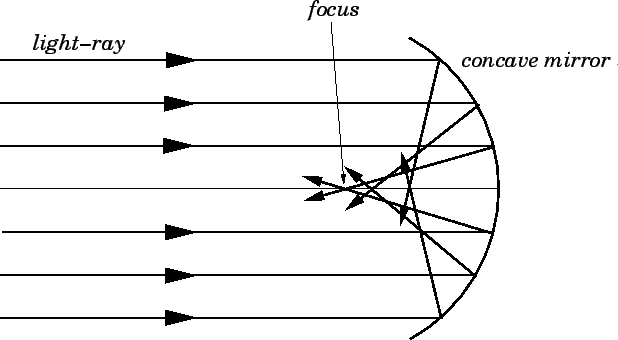
Ideal shape for objective mirror: parabolic, because it converges all rays from a distance object to a focal point, which eliminates spherical aberration.

Cassegrain arrangement:
First a large concave mirror, called primary or objective mirror, collects the light.
Then a convex secondary mirror sends light to an eyepiece lens or an electronic camera.

If a lens is used for eyepiece, chromatic aberration can happen. To minimise, an achromatic doublet (combination of concave and convex lenses) is used.
Magnifying power of reflective telescope:
Same as refractive ones:

9.1.2.1 Refractive vs. reflective
Disadvantages of Refracting Telescopes
The objective lens can only be supported around its edge, limiting stability.
Manufacturing large, high-quality glass lenses that are perfectly clear and free from defects is extremely difficult.
Large lenses are heavy and can distort under their own weight.
They suffer from chromatic aberration and may also experience spherical aberration.
The overall structure is heavy and difficult to move quickly.
Mounting heavy cameras and electronic equipment is challenging.
High magnification requires very large objective lenses and long focal lengths, making the telescope bulky.
Advantages of Reflecting Telescopes
Large mirrors can be constructed and supported from behind, reducing distortion.
Mirror surfaces can be polished to nanometre precision, producing high-quality images.
Only the front surface reflects light, avoiding many problems associated with lenses.
No chromatic aberration, and spherical aberration can be eliminated by using parabolic mirrors.
Lighter mirror systems allow quicker repositioning to observe transient astronomical events.
Segmented mirrors can be combined to form a very large effective objective mirror.
9.1.2.2 Limits of optical telescopes on earth
Atmospheric distortion and absorption of EM waves including visible light;
Oxygen, ozone, water vapour absorb light;
Dust particles absorb and scatter light;
Telescopes are built at high altitudes or placed above the atmosphere;
Atmospheric opacity: describes how much electromagnetic radiation is absorbed by the atmosphere, depending on its wavelength.
Most visible light passes through atmosphere;
Atmosphere is transparent for some radio waves;
Gamma rays, X-rays, majority of ultraviolet and some infrared are highly absorbed;
9.1.3 Radio, UV, X-Ray Telescopes
9.1.3.1 Radio Telescopes
We receive radio waves from centre of the Milky Way Galaxy.
Radio waves are produced by changes in the energy state of neutral hydrogen atoms in the galaxy. We can see distribution of hydrogen gas that cannot be seen with visible light.
Majority of radio waves pass through the atmosphere, so radio telescopes can be ground based.

Compared to visible light, radio waves have longer λ. Hence they have low angular resolution.

To offset this, radio telescopes have dished with large diameters.
Based on international agreements radio telescopes study frequencies in MHz and GHz.
Frequencies lower than 30 MHz are absorbed by ionosphere.
Frequencies above 60 GHz are absorbed by water vapour.
Radio telescopes are built in isolated areas, because of interference from artificial frequencies (normally between 30 MHz and 60 GHz).
9.1.3.2 Infrared (IR) telescopes
Infrared: 0.7 μm < λ < 450 μm.
Most IR is absorbed by atmosphere except wavelengths 3-5 μm and 7-14 μm.
So many IR telescopes are placed out of atmosphere.
They use same lens or mirror structure as an optical telescope.
The eyepiece would be an IR detector!
IR is used to study cool regions of space such as interstellar gas, star formation, and cooler stars.
9.1.3.3 UV & X-Ray
UV: 10 nm < λ < 400 nm.
Atmosphere’s ozone absorbs any UV with λ shorted than 300 nm.
UV telescopes use Cassegrain mirror arrangement, and should be placed higher than ozone.
The UV detector (instead of eyepiece) uses photoelectric effect to produce electrons.
UV is used to find chemical composition and temperature of hot young stars and the interstellar medium.
X-Ray: 0.01 nm < λ < 10 nm.
Atmosphere absorbs all X-Ray.
X-rays originates from very hot gas, in the temperature range 106–108 K, such as supernova remnant, binary stars, and active galaxies.
X-ray will pass through normal mirrors!
Mirrors for X-ray telescopes is very smooth, and it is shaped as both parabolic and hyperbolic curves.
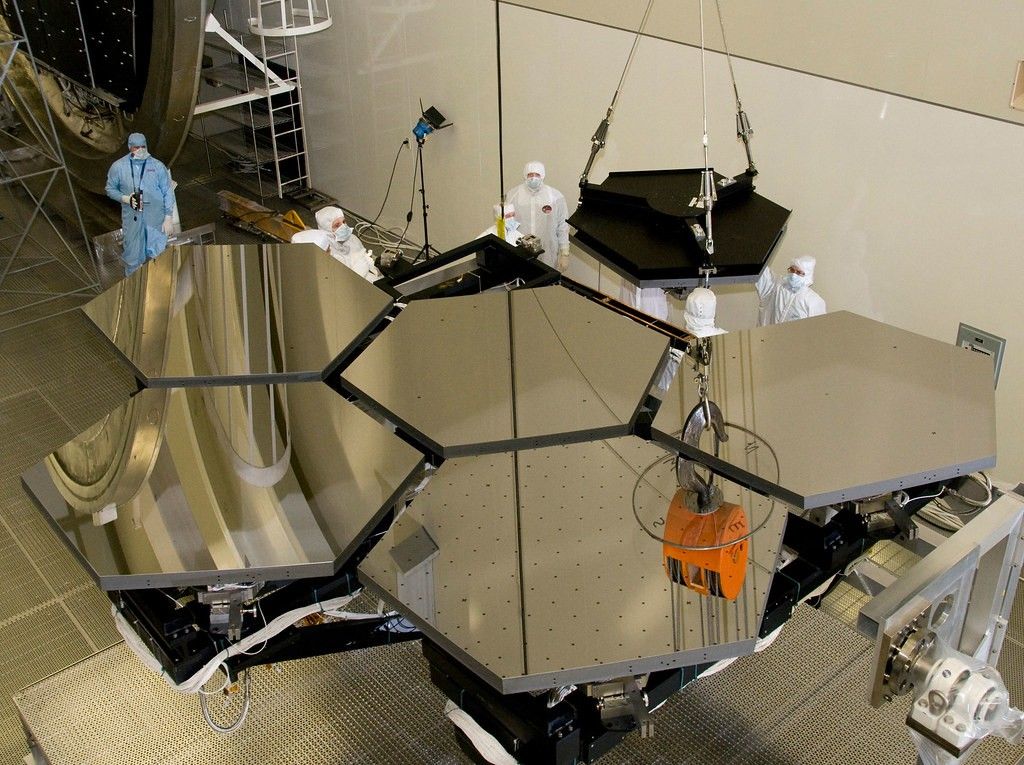
The X-Ray photon skims off the mirror’s surface (grazing incidence) and is brought to focus and detected by charged-coupled devices (CCD).
γ-Ray: λ < 0.01 nm.
No mirrors! Just detectors to measure direction and energy of γ photons.
Gamma originates from: supernova remnant, pulsar, quasar, and solar flares.
9.1.4 Large diameter telescopes
9.1.4.1 Rayleigh criterion (resolving power)
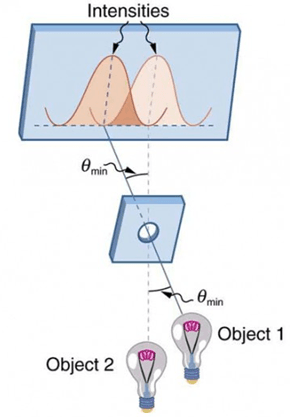
Resolving power is ability of a telescope to produce separate images of objects that appear very close to each other.
EM radiation travels as waves, and when it passes through a telescope’s opening (circular aperture) it diffracts and interferes to produce a diffraction pattern.
As a result, a star cannot be focused to a perfect point but forms a small disc known as an Airy disc.


The larger the aperture, the smaller the central maximum, and the less blurry and more detailed the image (higher resolution).
If the two objects appear very close to each other, their airy discs will not be seen separately.
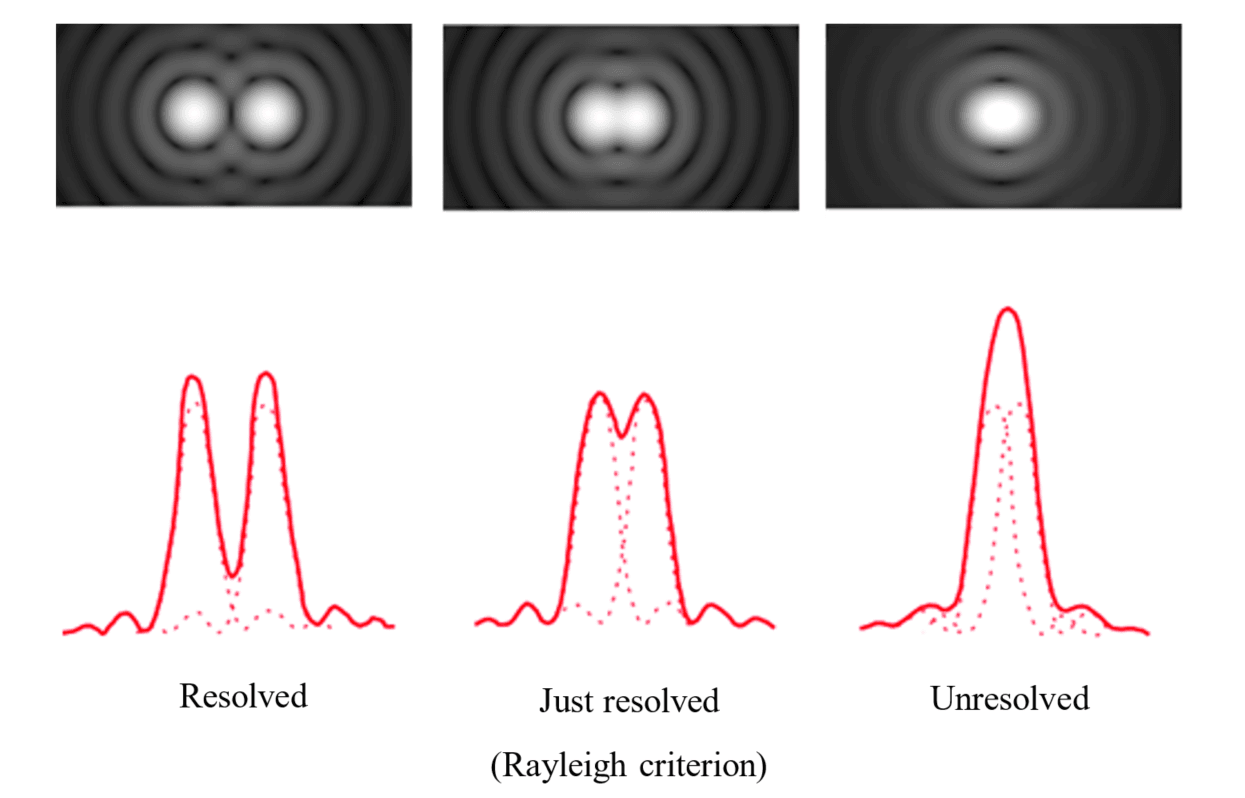
The two airy discs are just resolved if the central maximum of one of the Airy discs is over the first minimum of the other Airy disc.
Rayleigh Criterion formula:
Says that two point objects can be resolved if the minimum angular resolution is given by:
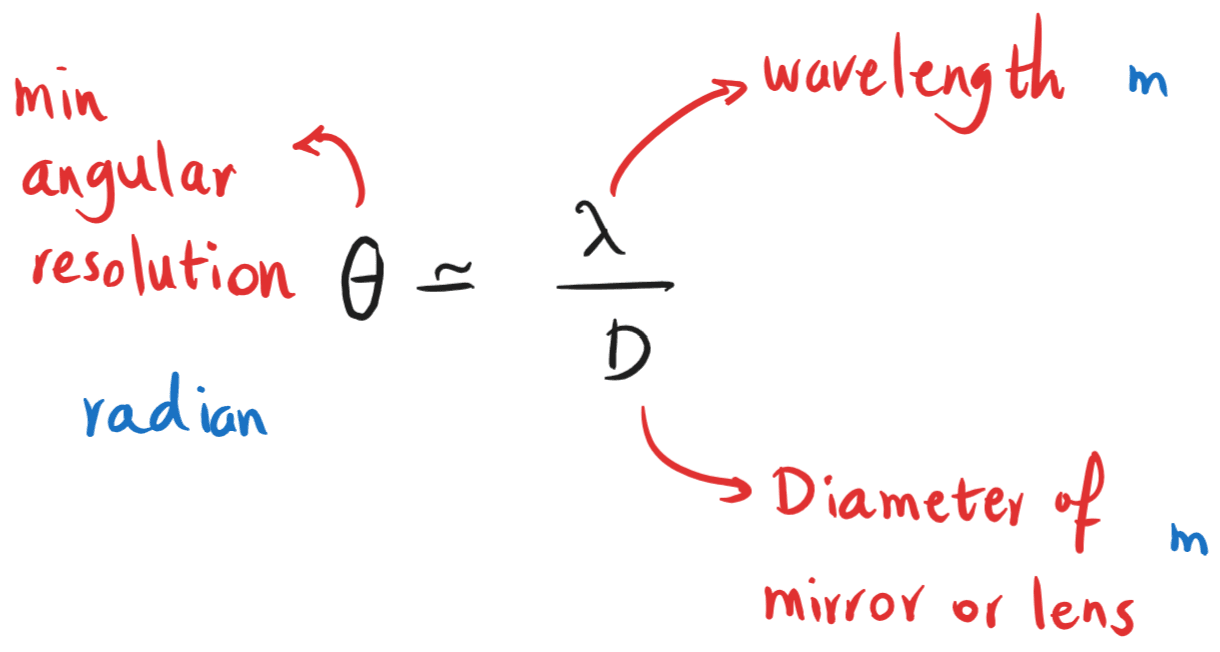
It shows the larger the diameter (aperture), the higher the (angular) resolution.
9.1.4.2 Angle measurements
Arcminute: an angle equal to 1/60 of a 1 degree. 1’ =  1o
1o
Arcsecond: an angle equal to 1/60 of an arcminute. 1” =  1o
1o
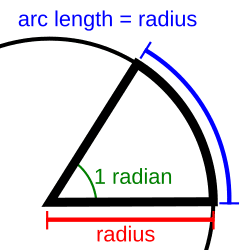
Radian: A radian is the angle at the centre of a circle that subtends an arc equal in length to the radius.
9.1.4.3 Collecting power
The ability to collect EM radiation!
Collecting power of a mirror or lens is proportional to its area (dimeter squared!).

9.1.4.4 Challenges
We saw the bigger the diameter of the primary the better the resolving and collecting powers!
But it be true that bigger is better, it comes with some draw backs:
Hard to make a primary mirror from a single piece of glass;
The large mass will cause the glass to deform under its own weight;
The supporting structure will be complex and costly.
The largest Cassegrain optical telescope is called Subaru in Hawaii and has a diameter of just 8.2 m.
Segmented mirrors:
These mirrors are made from smaller pieces that are aligned actively with a computer and the largest built is in the Canary Islands with a diameter of 10.4 m.
Radio interferometers: Are devices to enhance the angular resolution of a radio telescope.
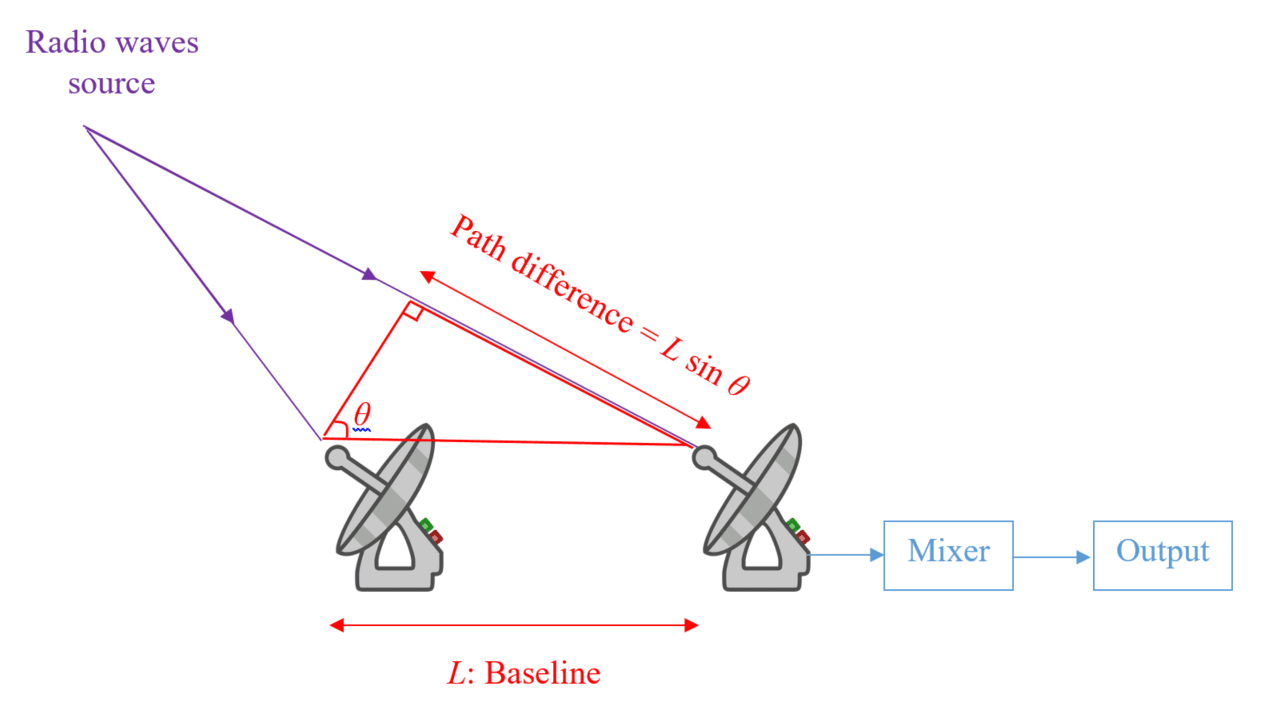
Two identical dish antennas separated by a distance L (the baseline) combine their signals, including phase and amplitude.
When a radio source moves in the sky, the signals received alternate between in phase and out of phase, which creates constructive and destructive interference pattern respectively; just like a double-slit pattern.
The angular separation between two successive maxima — the angular resolution — is approximately:

This is as if we had a telescope with diameter of L (Rayleigh criterion).
And we can make L very large, even on two different continents!
Interferometer can have two or more radio telescopes! The more the higher the resolution!
Optical telescopes can also be connected with interferometer arrangement!
9.1.4.5 CCD: Charge-Coupled Device
A CCD (charge-coupled device) converts light directly into digital data.
It consists of millions of tiny regions called pixels, arranged in rows and columns.
When light hits a pixel, it builds up an electric charge proportional to the brightness.
This linear response allows accurate measurement of photon number and object brightness.
Unlike photographic film, CCD images are stored digitally, allowing image processing, transmission, and archiving.
Especially important for space telescopes, where image needs to be transferred to the Earth.
Quantum efficiency (QE):
Shows how well a CCD can absorb photons and use them for imaging:

Detector | QE |
Human eye | 4-5 % |
photographic film | 10 % |
CCD | 80% |
The higher the QE, the lower the exposure time needed to form an image with same brightness.
Collecting power of a smaller telescope equipped with a CCD would be same as much larger telescope using a detector with a lower QE.
Resolution:
Resolving power of CCDs is based on number of pixels and size of pixels.
The smaller the pixel size the higher the resolution.
CCDs can be sensitive to large range of wavelengths, and adjusted to sense a particular range better.
In theory the human eye resolution can be determined with Rayleigh criterion, but in practice the number of sensitive cells in retina determines eye’s resolution.
Human eye resolution is about 12 acrminutes.
.
Revise and Get Paid!
If you like taking summary notes of lessons and solving past papers, see the Join Us page!