AQA Physics
Discovery of Electron
12.1.1 Cathode Rays
According to ElectroBoom: High voltage always finds a way!
This is also true for gas at low pressure in a glass tube, which is called the discharge tube.
When high PD is applied across the discharge tube, the gas emits light.
This happens because:
The high voltage applied at both ends of the glass tube, ionizes the gas. This strips electrons from atoms, creating a plasma of positive gas ions and free electrons.
The low pressure of gas provides enough space for the positive ions to move towards the negative electrode (cathode).
Collision of positive ions with cathode, releases electrons from its metal surface.
The newly freed electrons from cathode, move towards the positive electrode (anode), and collide with gas atoms on the way, exciting their electrons to higher energy levels. When these electrons drop back, they emit photons (light) of specific wavelengths.
Neon emits red-orange; other gases/coatings produce different colours.

Later scientists managed to lower the gas pressure even more.
This meant the gas remained dark while PD was applied.
But now the glass glowed at one end only, behind the anode!
They thought there must be some ray emitted from the cathode which is attracted to the anode and when strikes the glass behind the anode, it glows!
Hey called these rays’ cathode rays.
Now we know:
The electrons freed from cathode accelerate more towards anode, in lower gas pressure;
Because of low pressure, electrons can travel faster and in straight lines, some go past the anode and collide with the glass behind it, which excites the glass atoms;
The de-excitation of glass atoms produce photons which were called cathode rays.
12.1.2 Thermionic emission
Thermionic emission: When a metal is electrically heated and electrons are freed.
Work functionof the metal is the minimum energy required to remove an electron to just beyond the surface of the metal.
The values of work function for thermionic emission and the photoelectric effect are not the same, but very similar.
12.1.2.1 CRT: Cathode Ray tube
CRT is an evacuated tube that creates a high-speed beam of electron, using thermionic emission.

Hot cathode produces a beam of electrons with thermionic emission;
Electrons accelerate towards the anode;
Some pass through the hole in the anode;
After that they continue with constant velocity till they hit the fluorescent screen
Two types of heated cathode:
Direct heat: it’s a tungsten filament mixed with zirconium dioxide which decreases tungsten’s work function;
Indirect heat: an electric filament heats a separate cathode made from nickel, which has a lower thermal work function than tungsten.
Increasing the PD across cathode and anode, increase the electrons speed.
Increasing the current in cathode, increases the number of electrons released.
12.1.2.2 Speed of electrons:
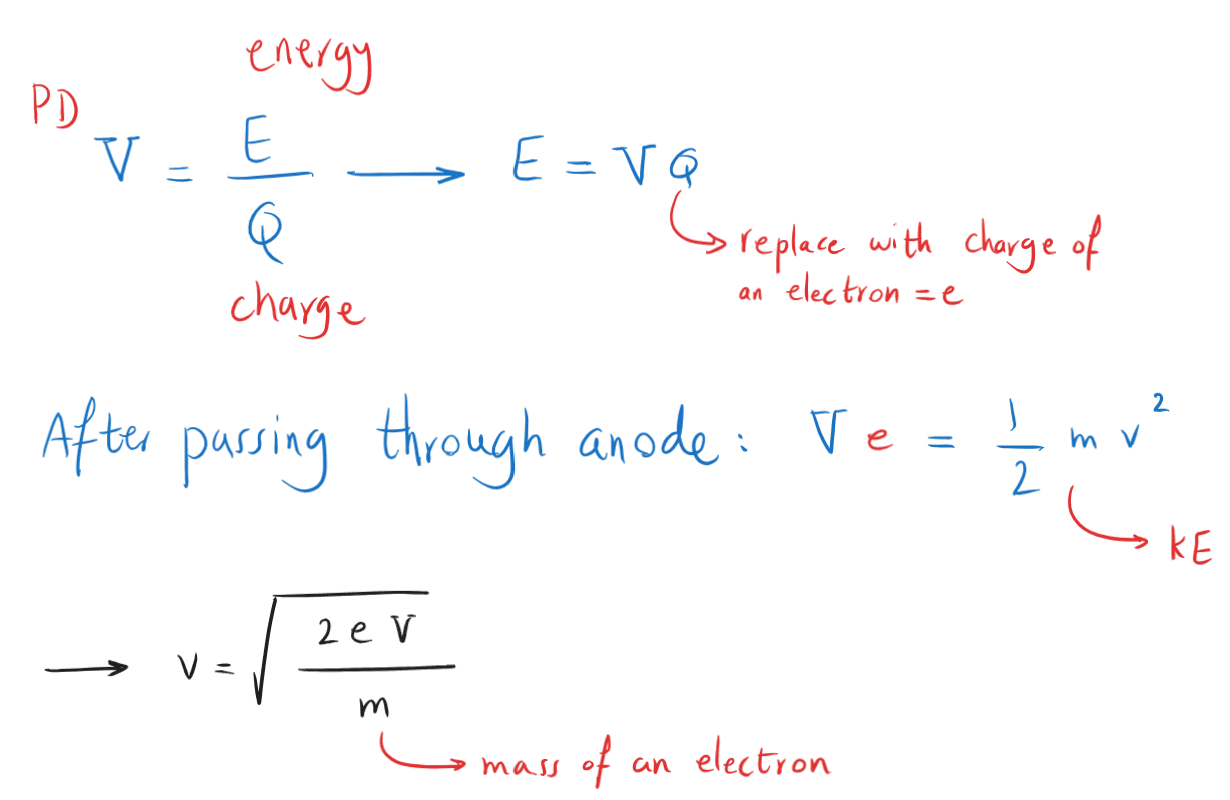
Using CRT we can calculate the electron’s speed gained in a PD across the anode and cathode:
This is the speed after they leave the anode.
12.1.3 Electron’s specific charge
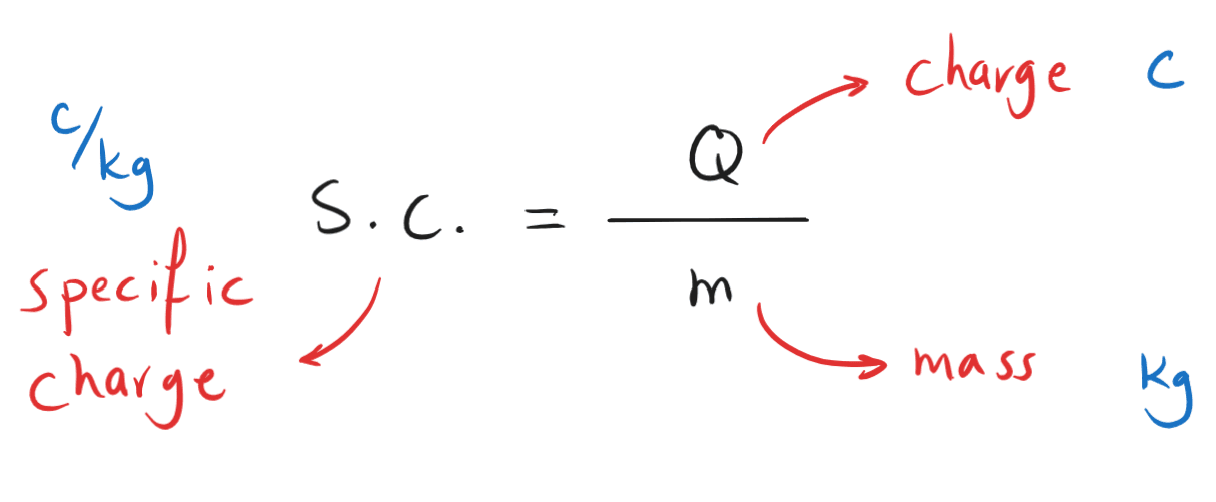
Specific charge formula:
12.1.3.1 Using CRT
Metal plates are installed over the CRT to create a uniform electric field which deflects the electron beam after leaving the anode.
In the diagram below the force from the electric field on the electrons is upward.
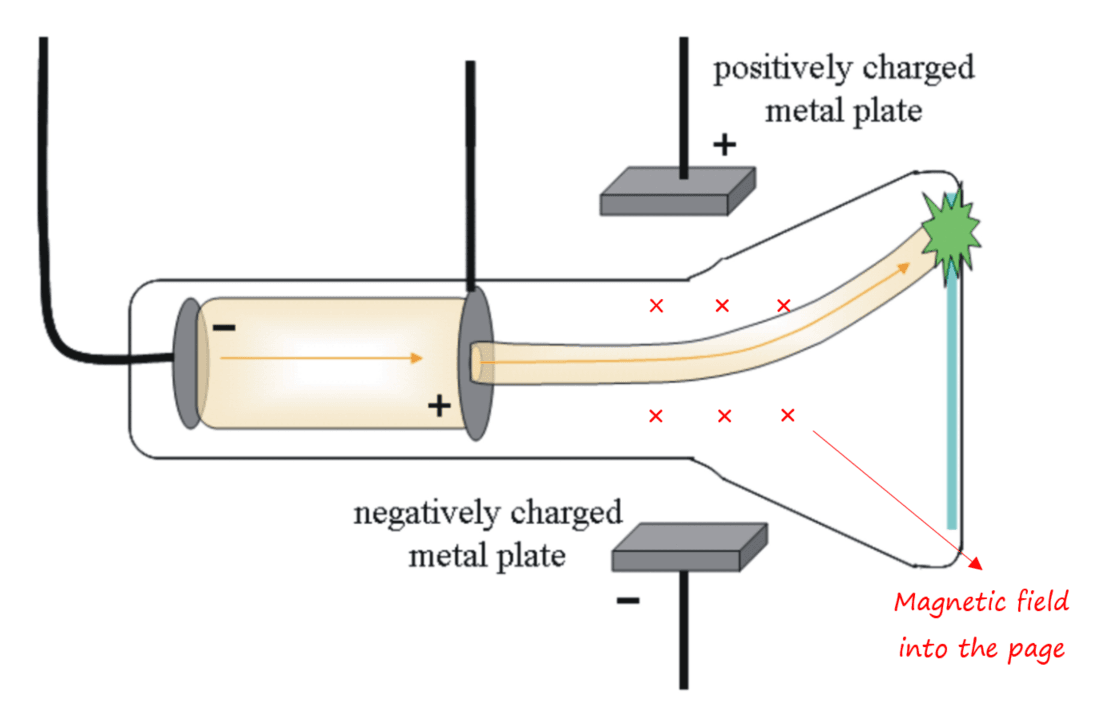
If we apply a magnetic field in to page, it will apply a downward force on the electron beam.
By adjusting the magnetic field strength we can make the electron beam to travel on a straight line again.
This means the force from the magnetic field is equal to the force from the electric field.
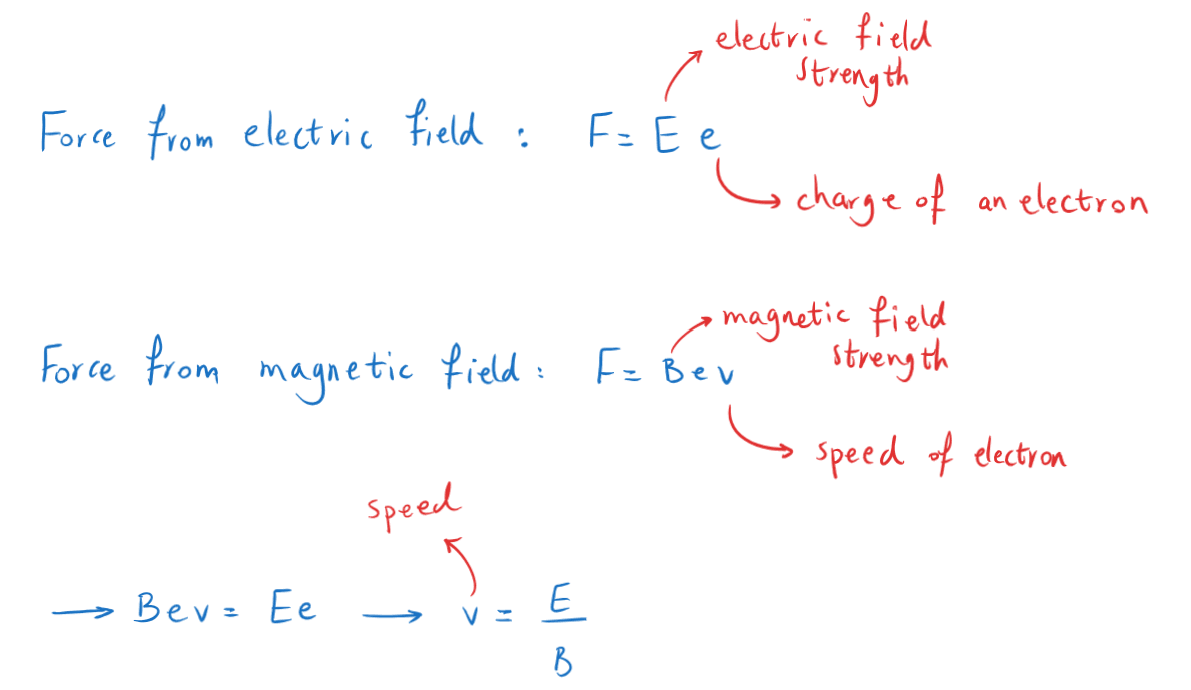
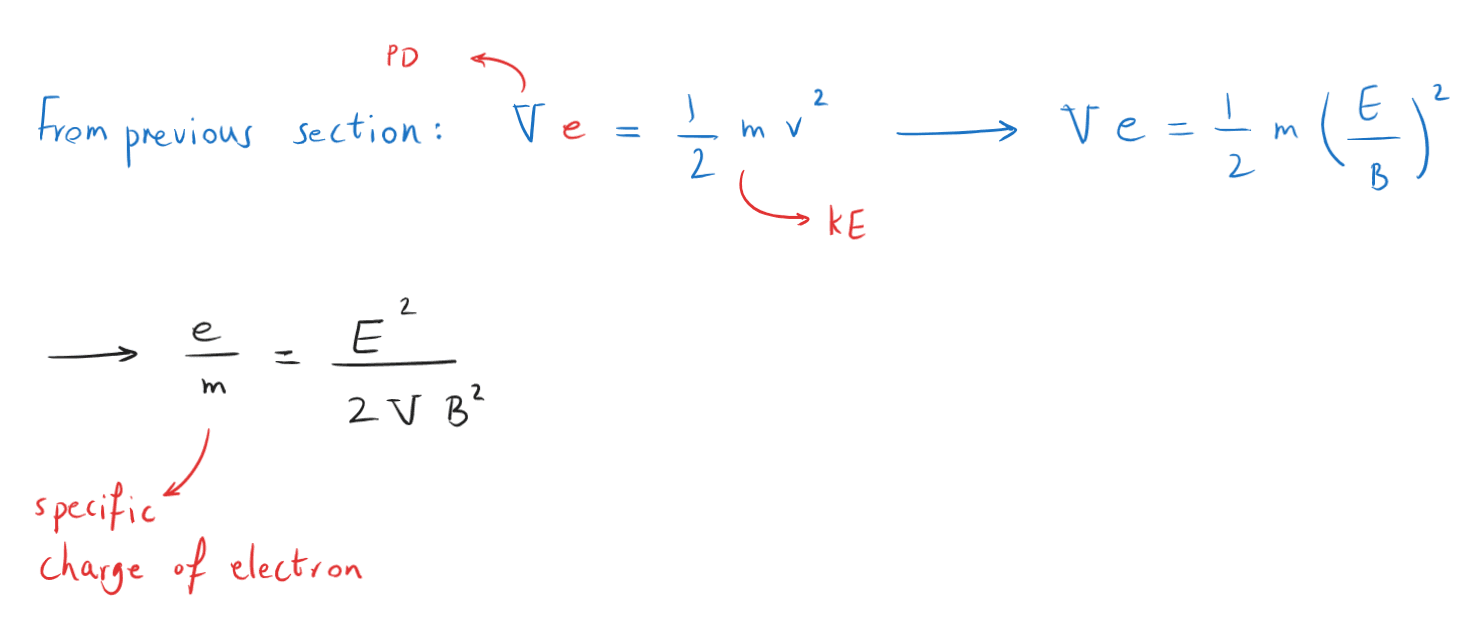
Using CRT, Thomson found the specific charge to be 1.7 × 10¹¹ C/kg.
He predicted:
electrons are charged and have mass;
They must a fundamental particle to all atoms, as they appear in all kinds of matter.
Before electron, hydrogen ion was known to have the largest specific charge, and it had been the most fundamental ‘piece of matter’ known.
Thomson’s calculation showed electron’s specific charge to be 1800 times more than that of hydrogen.
Later it was found that the charge of electron is the same as hydrogen ion, so its mass must be far smaller!
12.1.3.2 Fine Beam Tube
Electrons from an electron gun (hot cathode and anode with a hole!) enter a chamber filled with gas (usually hydrogen, helium, or neon).
Gas atoms colliding with electrons get excited (an electron in the gas atom goes to a higher energy level!).
Gas atoms de-excite immediately releasing a photon of visible light.
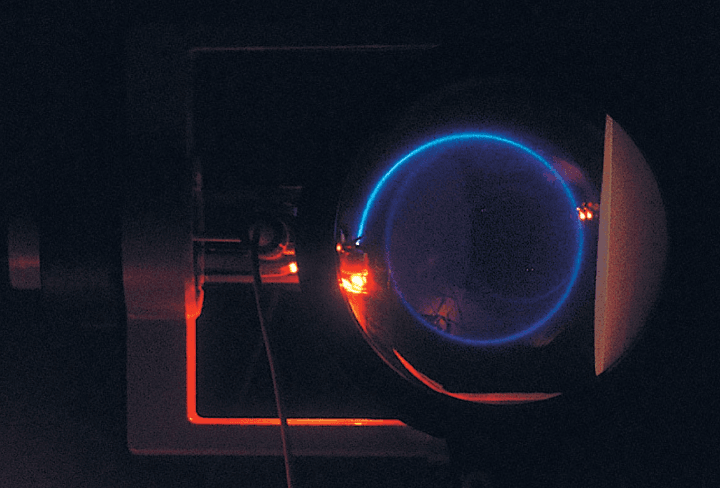
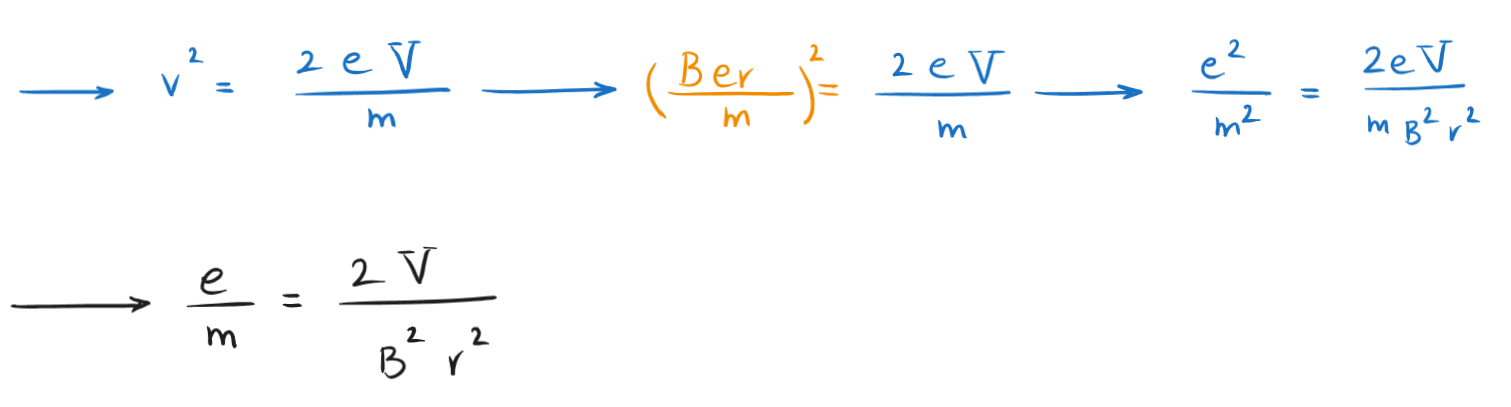
If the electron beam is subjected to a magnetic field at right angle to electron motion, we see a circle of light!
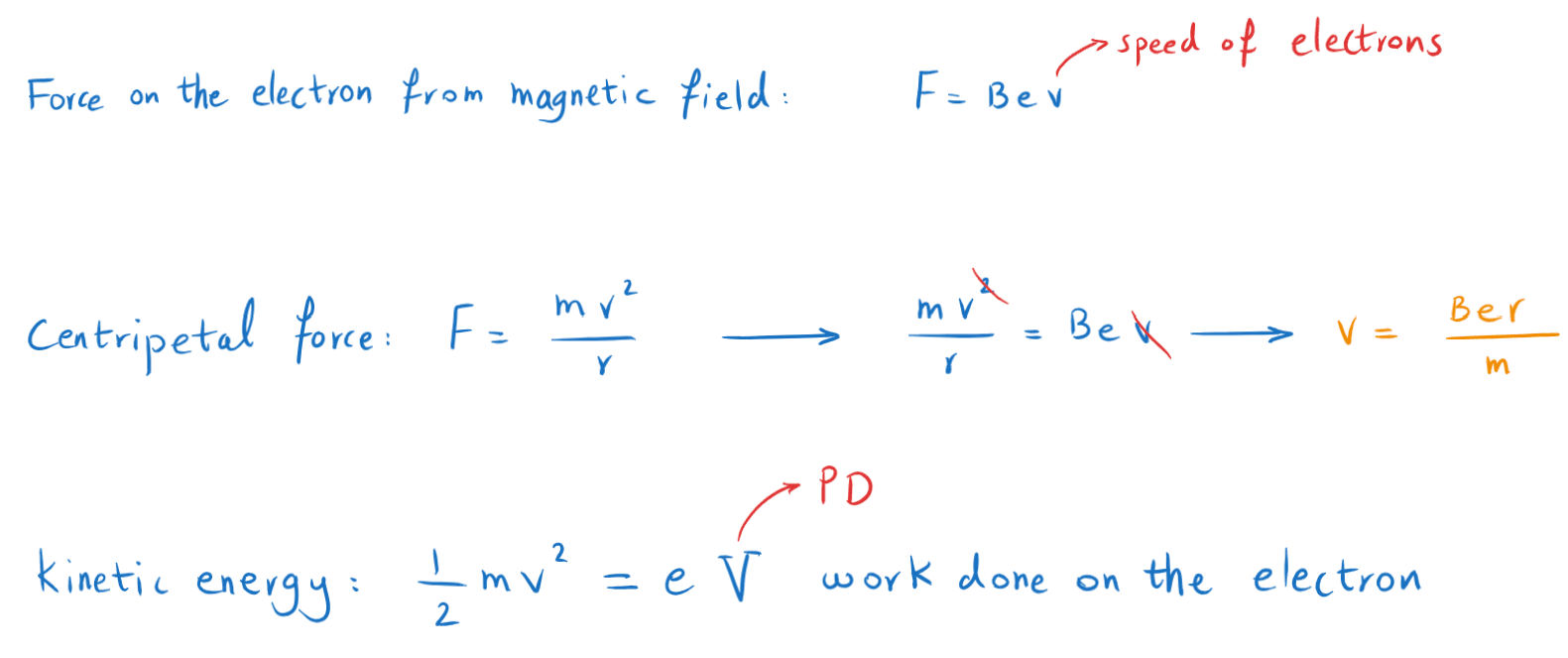
The force from the magnetic field is always perpendicular to the velocity of electrons, hence it acts as a centripetal force.
Because the force is perpendicular to velocity, it does not do any work on the electrons, and does not change their speed or energy.
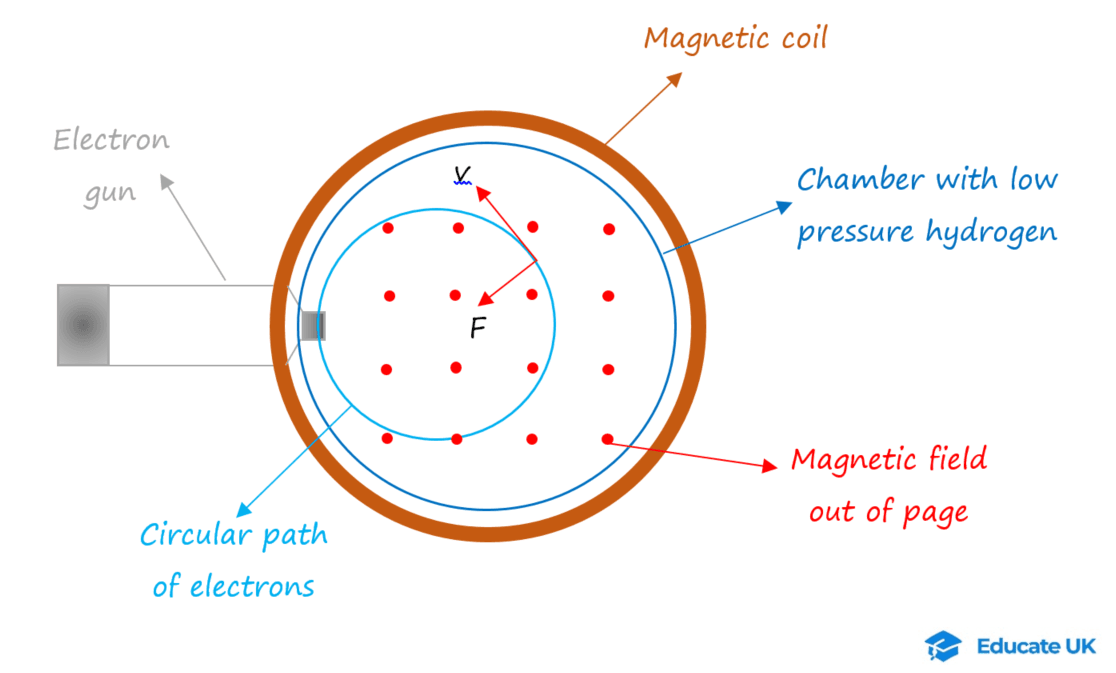
Picture below shows a real one in a dark room:

We can determine the S.C. this way:
12.1.4 Millikan’s determination of electron charge
Tiny oil droplets were sprayed into an electrically insulated chamber.
The spray was called an atomiser as produced very tiny droplets.
Droplets were negatively charged due to friction as they left the atomiser.
Some droplets would fall through a whole in top plate P1.
And enter a uniform electric field.
Top plate was positive, so force from electric field on electrons was upwards, counteracting the weight of droplet.
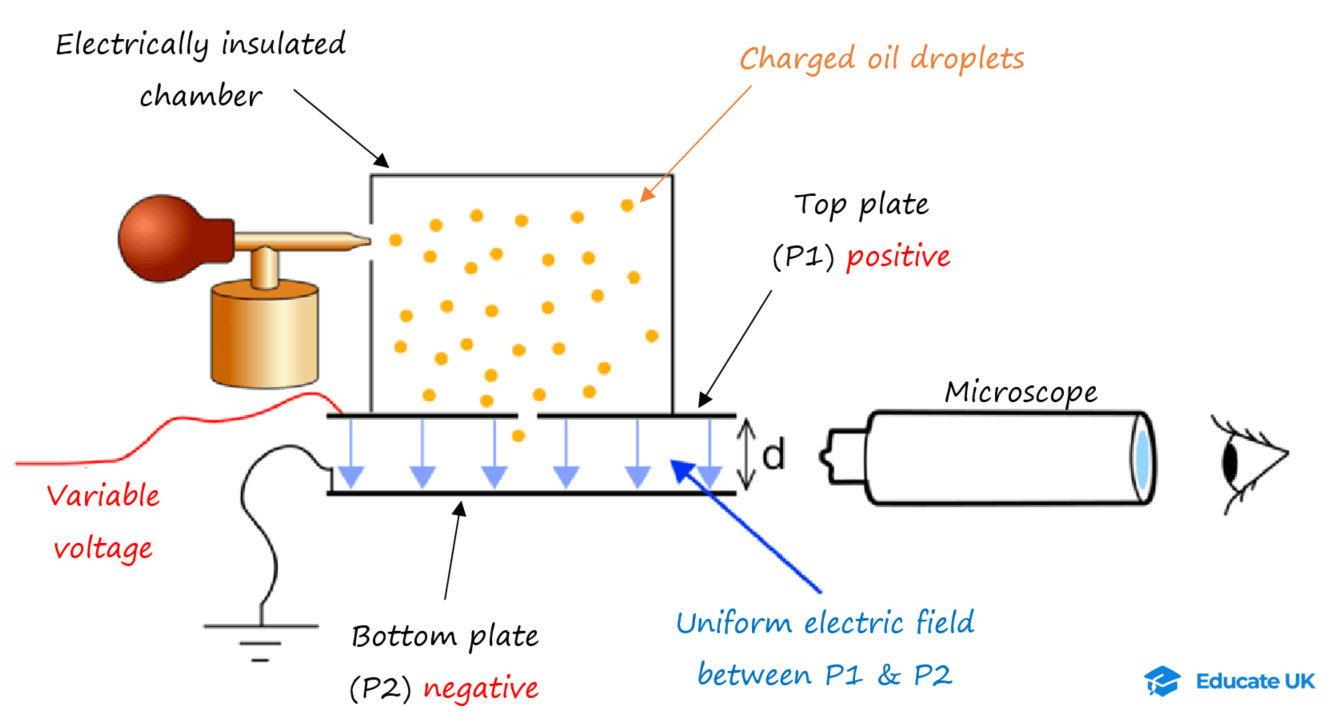
Millikan changed the PD until oil droplets became stationary.
So far we have:
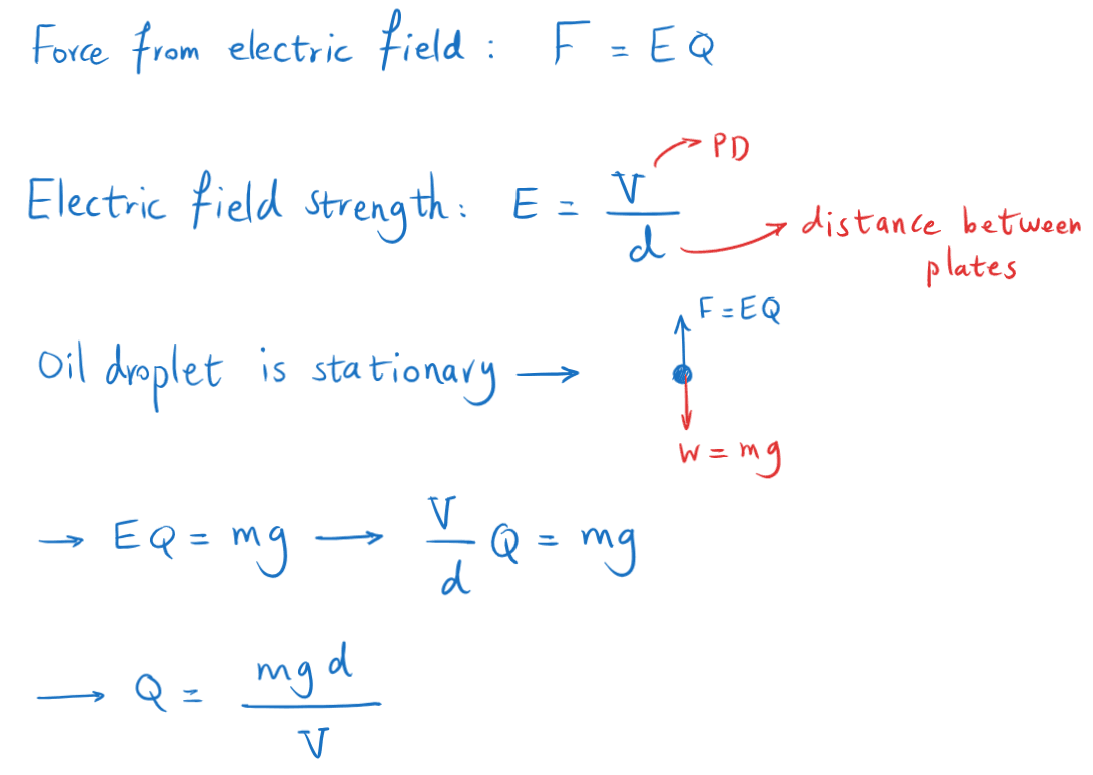
So to find Q (charge of droplet) we need its mass.
We know the oil’s density, but we need to find droplet’s radius to find its volume (assuming sphere) and then find its mass.
To do this Millikan turned off the electric field.
Droplets fall under gravity but reach terminal velocity shortly after.
At this point weight is equal to drag.
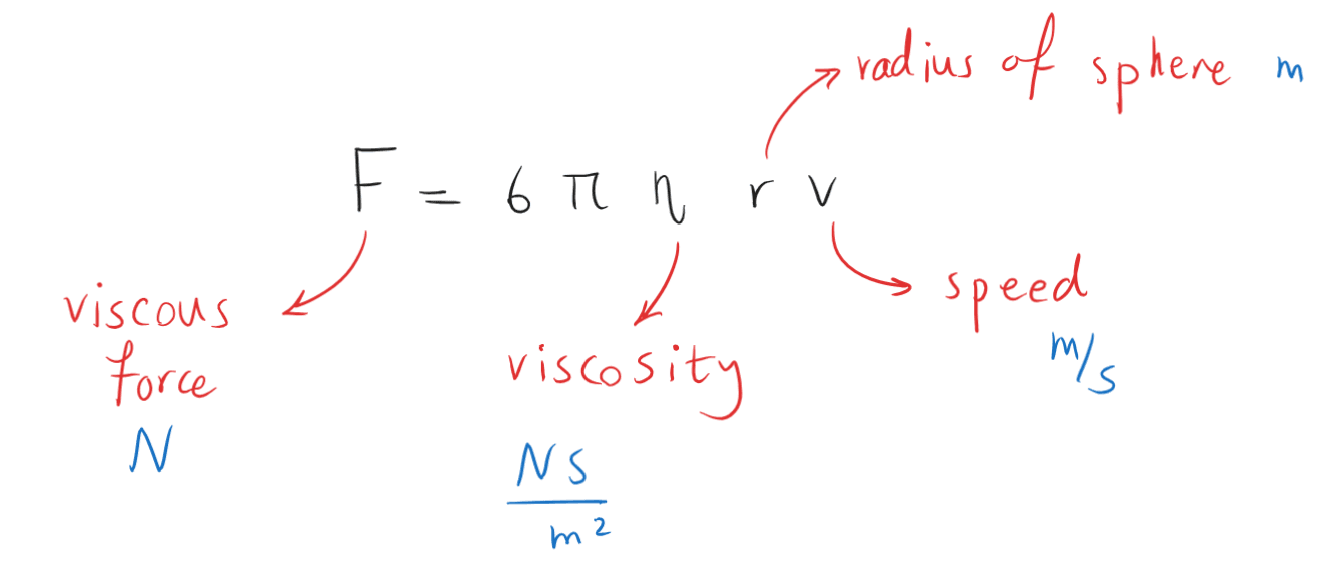
Drag on an object depends on object’s shape, size, speed; and viscosity of the fluid.
Viscosity (η: eta) tells us the amount of friction a fluid applies on an object moving in it.
Unit for viscosity: Nsm-2.
Formula for drag (viscous) force on a spherical object (Stokes law):
So now we can find a relationship for the radius of sphere of droplets:
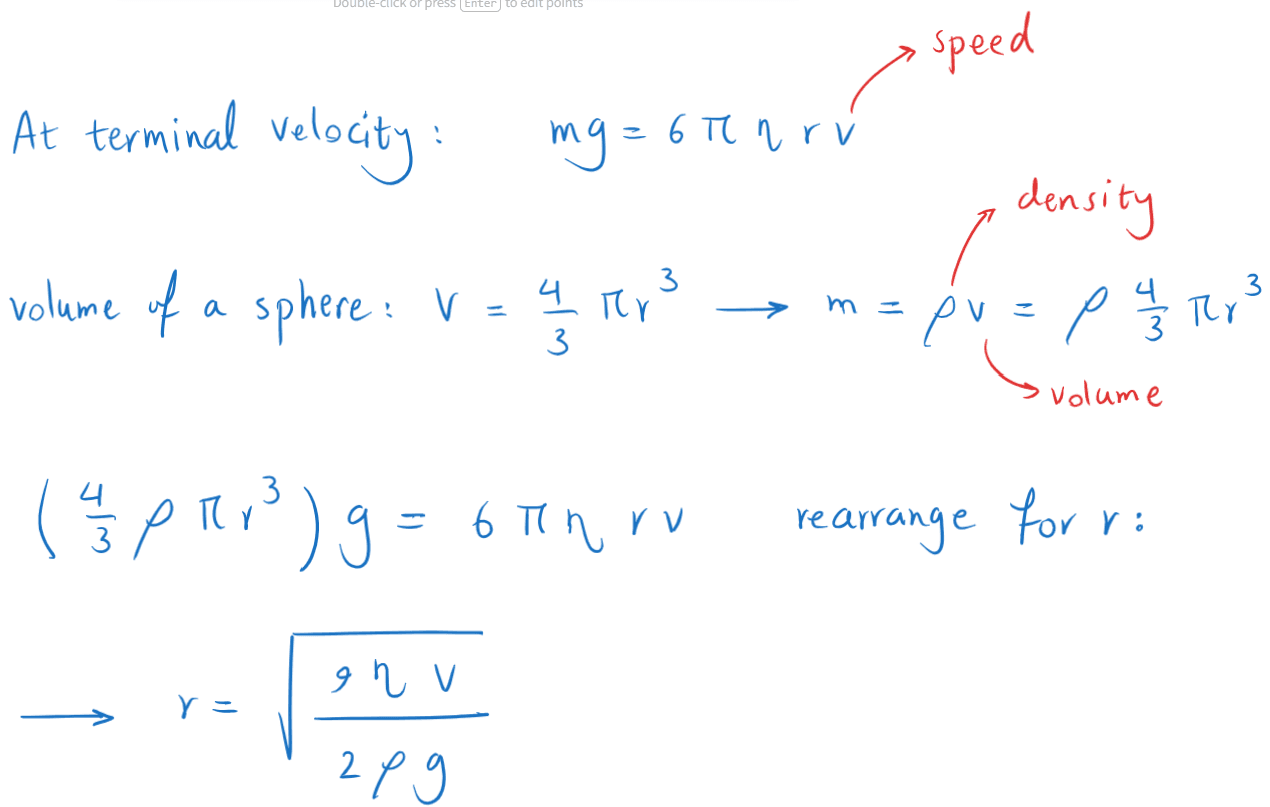
Now we have the radius, we can find the mass and put it in:

Millikan found that all values of Q he got were multiples of the value 1.6 × 10⁻¹⁹ C.
So he said the electric charge is quantised! And he assigned this charge to letter e.
So he said:

So value of charge e would never be smaller than 1.6 × 10⁻¹⁹ C.
Today we call e the elementary charge or charge of an electron!
Example 1:
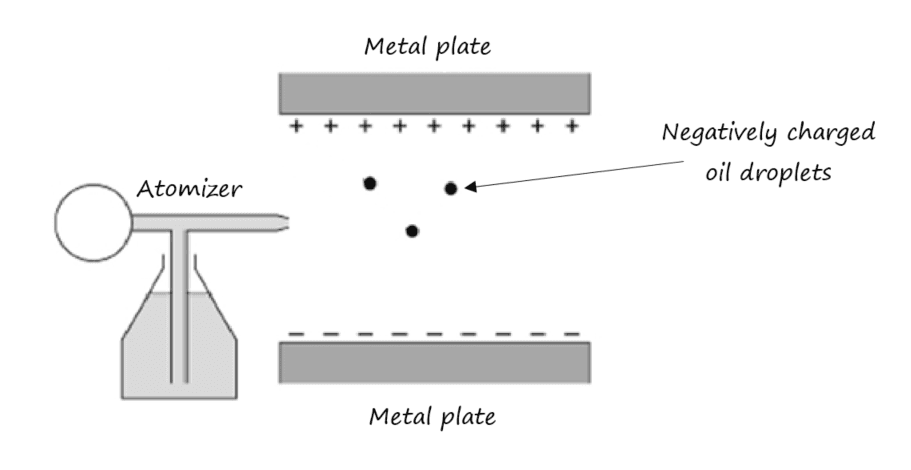
In an apparatus shown below charged oil droplets fall between two metal plates that are 1.2 mm apart. When there is no PD between the plates the droplets fall with a speed of 6.2 × 10⁻⁵ m/s.
Density of oil = 960 kg/m3;
Viscosity of air = 1.8 × 10⁻⁵ Ns/m2.
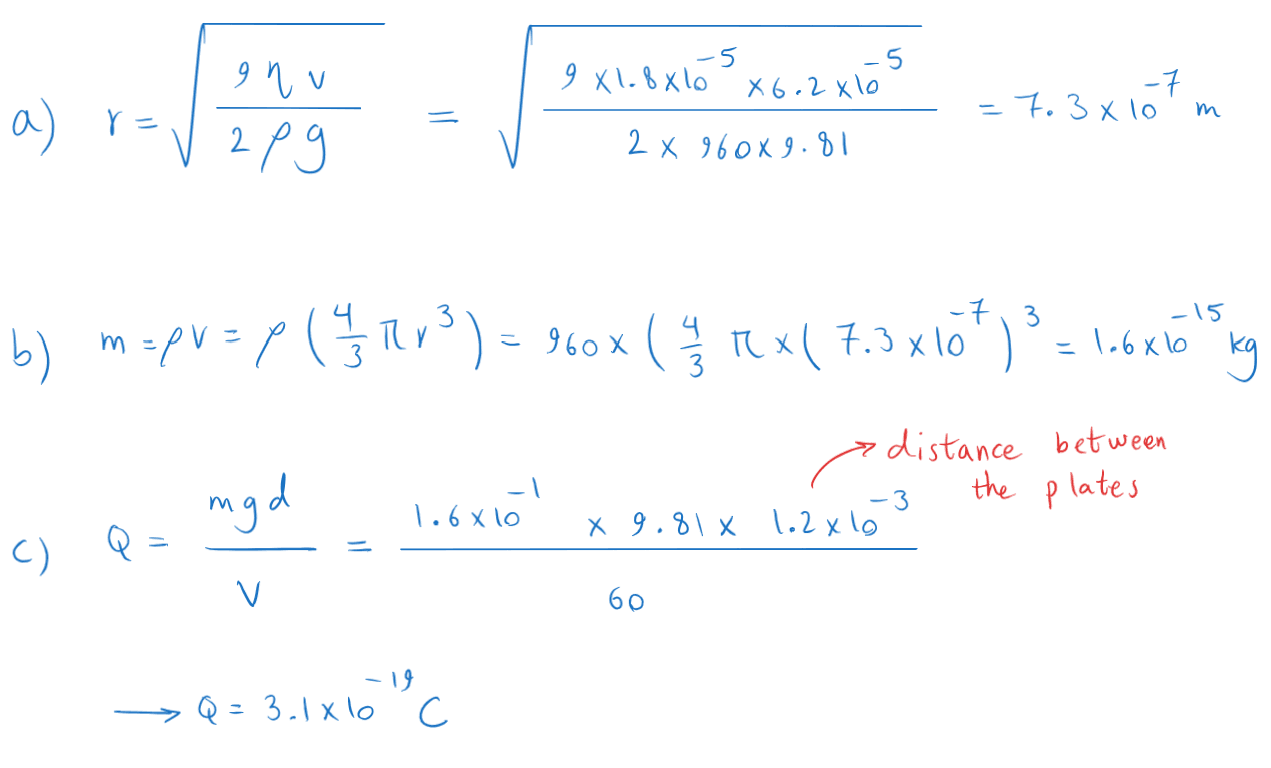
Find the radius of the oil droplet;
Find the mass of the droplet;
The droplet becomes stationary when a PD of 60 V is applied between the plates. Find the magnitude of the charge on the droplet and discuss its significance.
Solution:
.
.
.
.
.
.
.
Revise and Get Paid!
If you like taking summary notes of lessons and solving past papers, see the Join Us page!