AQA Physics
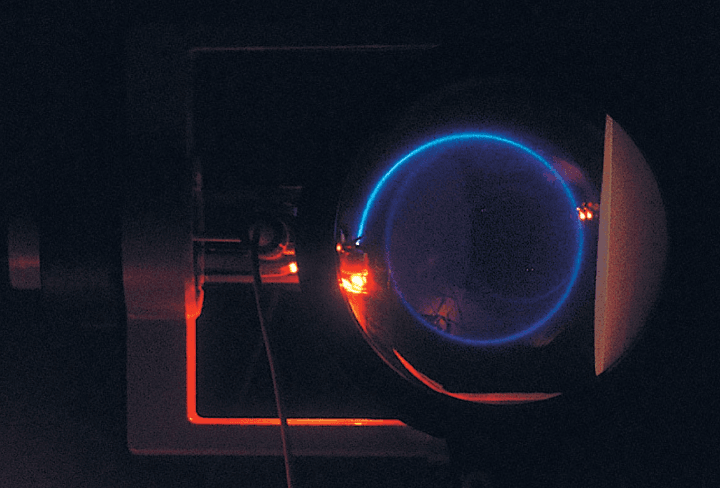
Special relativity
We will talk about invariance of light’s speed which leads to special relativity theory of Einstein.
12.3.1 Michelson-Morley experiment
Back in the old days (1880s) they thought light needs a medium to travel.
Just like sound does.
They called this invisible medium ether (or luminiferous).
So ether fills up the space between the Earth and the Sun too (as light travels there!).
They knew Earth orbits the sun, and assumed Sun was stationary in ether.
Hence, if light travels once parallel to the direction of earth’s movement in ether and then perpendicular, we should be able to measure different speeds for light.
And this difference would give us the absolute Earth’s speed in ether.
Two guys Michelson–Morley made a device called interferometer to test this.

The light first goes through the beam splitter, which is a partial mirror.
It reflects 50% of the light and let the rest to pass through (transmit) it.
The reflected ray is passed through a compensating plate, which is just a glass with the same thickness as the beam splitter.
This compensates for the speed reduction of the transmitted ray as it goes through the beam splitter.
The transmitted and reflected rays of light go on to hit two equally spaced plane mirrors, and get reflected, and reach a screen together. Mirrors are perpendicular to each other.
This creates an interference pattern.
Now if the Earth is moving in the ether, then one of the light rays is moving parallel to the Earth’s motion and the other one perpendicular.
So if we rotate the interferometer we should see a change in the interference pattern.
But they did not observe this, so they said there is no ether!
Bold, ha?!
That means speed of light is unchanged even if the observer moves towards or away from the source!
This is called ‘invariance of the speed of light’.
12.3.2 Einstein’s theory of special relativity
This theory talks about the relationship between inertial frames of reference:
Inertial frame of reference (IFR): a coordinate system that is stationary or moving at constant velocity.
Object in IFR continue to move with constant velocity unless acted upon by a force.
A non-inertial frame, by contrast, is one that accelerates (e.g., rotating frames or frames undergoing linear acceleration).
Special relativity has two postulates:
All physical laws (including those of electromagnetism and mechanics) take the same form in all inertial frames;
The speed of light in a vacuum is constant in all inertial frames, independent of the motion of the source or observer.
Special relativity consequences:
- Time dilation: time for a moving objects runs slower!
- Length contraction: moving object appears shorter.
For questions calculate only of the above, not both at the same time.
12.3.2.1 Time dilation
A clock in a moving IFR seem to run slower to an external observer.
Here is Epstein’s thought experiment to understand this:
Imagine a passenger sitting on the train has a laser and two mirrors held opposite each other, as shown below.
Train is moving at a constant velocity  . So it is an IFR.
Passenger points the laser perpendicularly towards one of the mirrors.
The laser will bounce off the mirrors which are a distance L apart.
The distance laser travels to hit the same mirror consecutively is: 2L.
So the time taken for this is  , where c is speed of light.
This is the time observed by a stationary observer (observer is in the same IFR as the event) and we call this proper time (t0).
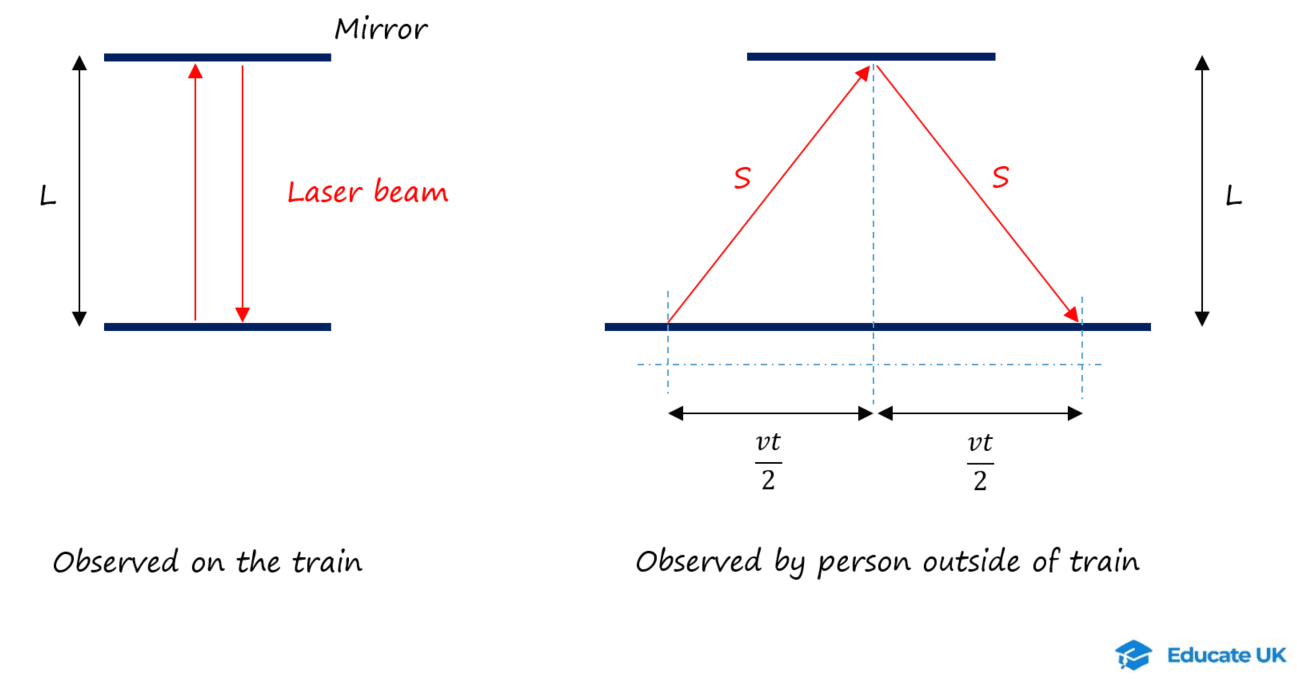
Now imagine another person is outside of the train watching the same thing.
They will see the light travelling a longer distance of S between the mirrors, instead of L.
So the time in their view is  .
.
This is based on the assumption that light speed is absolutely invariant.
We can say:
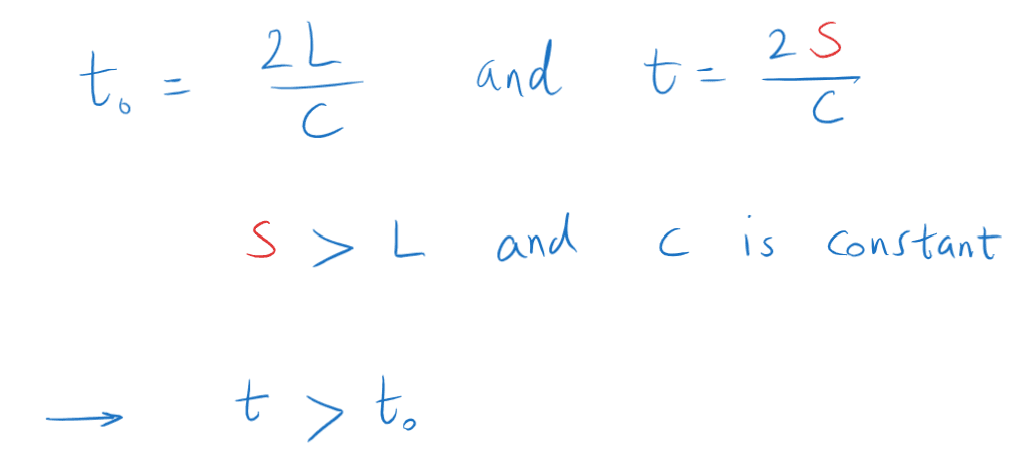
In other words in the eyes of an external observer, time runs slower!
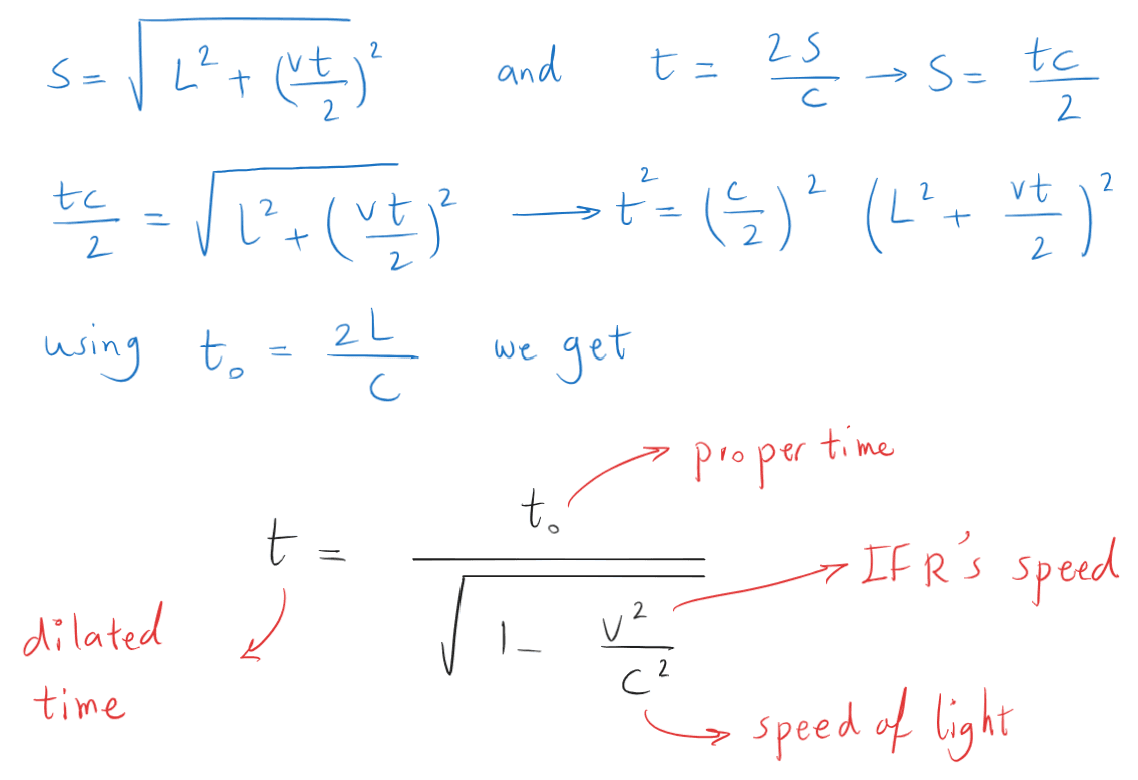
The distance of S between the mirrors can be calculated using Pythagoras, and we can write a formula for the time dilation:
What you read below is NOT part of your specification and is only my personal notes written on 27 March 2026:
My problems with this:
This all is based on the postulate that light speed is invariant.
Let’s say that’s right.
Now imagine instead of laser and mirrors, we had a ping pong ball and two boards, and we are in the international space station (ISS).
And we have made a vacuum chamber in there too!
I am inside the ISS and throw the ball perpendicular to one of the boards.
The ball bounces off the boards and time is .
The ISS moving by the way.
Now an astronaut is outside and watches the idiot (me) playing with ball like that. The time that they see is .
Can we say the speed of ping pong is invariant in this situation? No friction, no gravity, and if ping pong’s collision are elastic, so I guess the answer is yes.
Now imagine me and the astronaut both are timing the ball.
We see the ball hit the bottom board and start our stopwatch.
And when the ball hits the same board again, we stop the time.
I am pretty sure we will see the same time on out watches!
Actually any time difference will be because of delay in light travelling to where the astronaut is.
But if the astronaut is pretty close to the window of the ISS, our times will be identical.
But the astronaut does see a longer path travelled.
So the time is the same, but distance appears longer to the astronaut.
I don’t think we even need to consider this experiment in the space.
The bottom line is that the astronaut and I see the ball hit the boards simultaneously. So if I have a watch and astronaut has the same watch we will measure exactly the same time for each cycle of ball hitting the board.
This is even accepted in Einstein’s experiment.
Because this is also true for laser. The observer inside the train and the one outside, they both see the light pulse hitting the mirrors simultaneously. So time as a manmade concept that goes each second like 1..2..3.. (think of a metronome) does not change.
The distance for the external observer appears longer, hence the speed appears faster.
And this has got nothing to do with ether and Michelson-Morley experiment. What they showed was there is no ether. Good for them!
How does that affect the speed of light observed in a moving IFR?!
Speed of anything depends on how you look at it.
Anyway I am sure more brilliant minds have spent hours on this and this is the accepted theory for now. It will be appreciated if someone can enlighten me.
Another problem that I have with one of the proofs of this theory is decay of muons arriving at the Earth.
We assume light speed is invariant but in those examples we say the speed of muons is invariant too! I can extend this to the ping pong ball!
Back to the AQA specification:
Example 1:
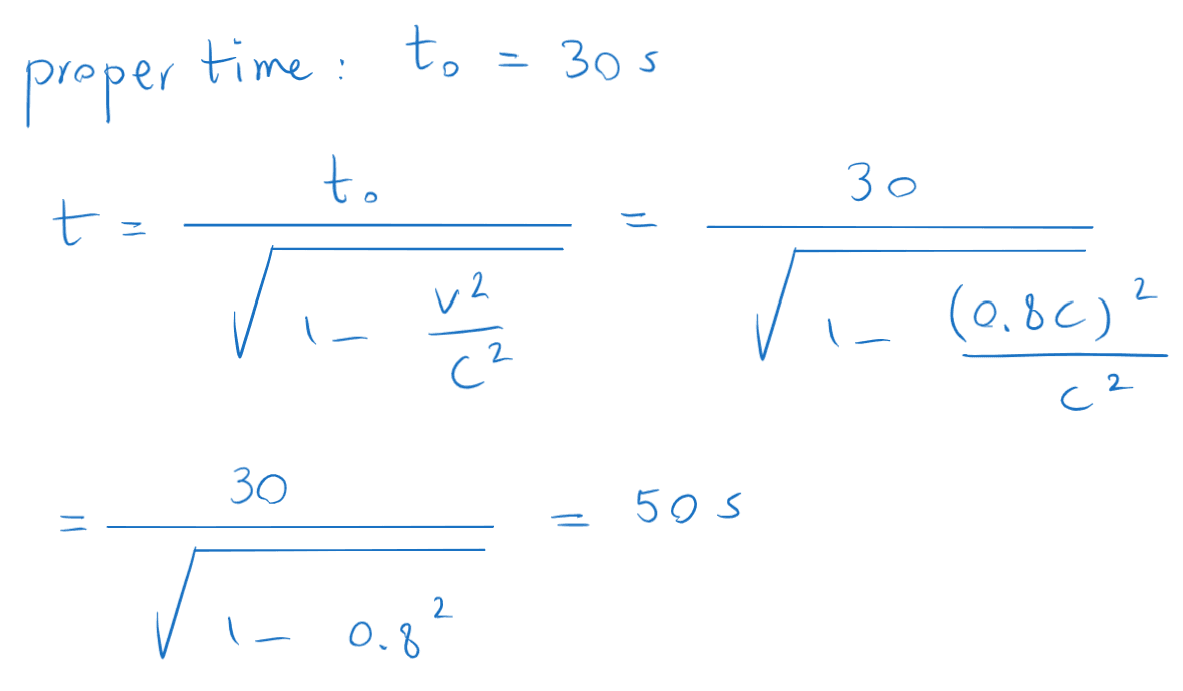
Mina is travelling on a spaceship moving at 80% of speed of light. She measures time of an event to be 30 seconds.
Calculate how long the same event appears to take if observed from the earth.
Answer:
Mina’s time is the proper time because is measured in the same IFR as the event.
12.3.2.2 Length contraction
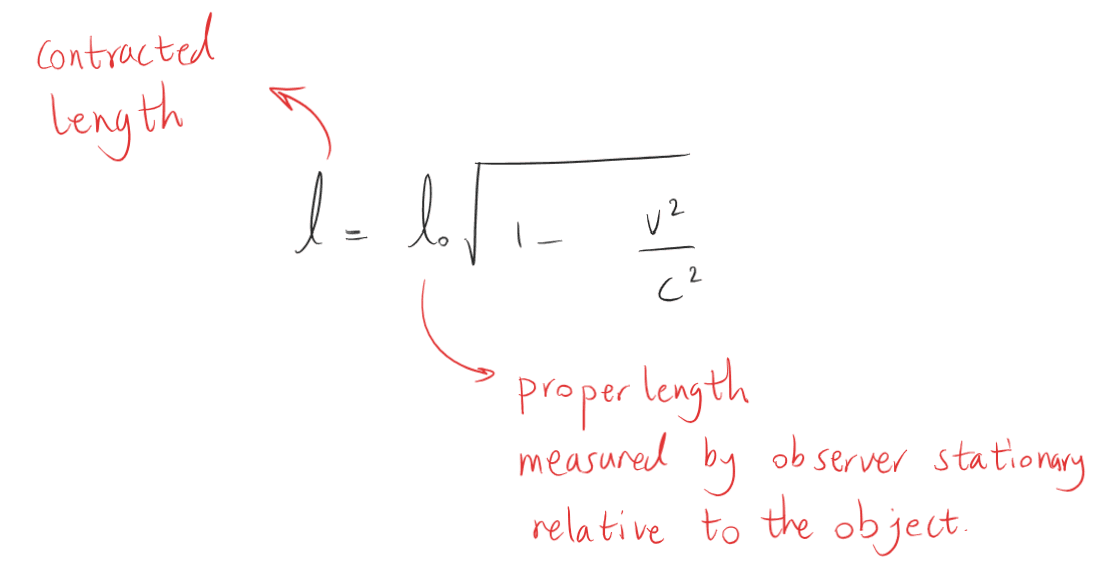
Object in a moving IFR seem shorter to an eternal observer.
12.3.2.3 Muon Decay
Muons enter the earth from space. We call them cosmic muons.
Muons are unstable and decay into other leptons.
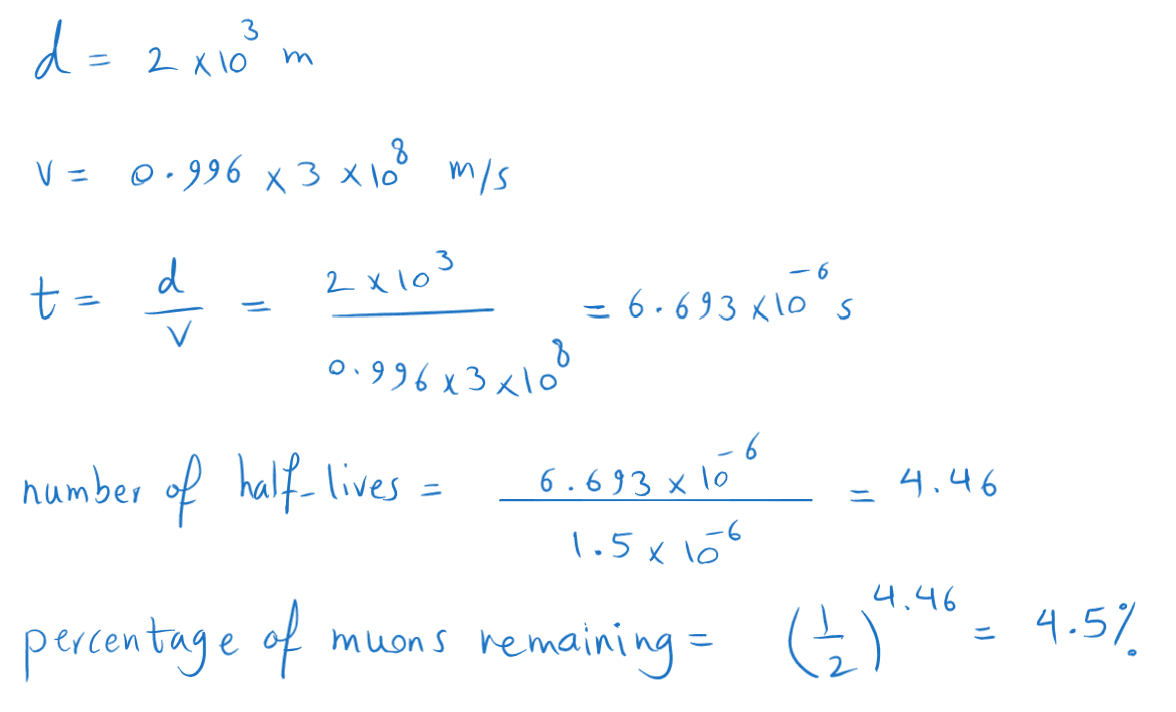
Half-life of muon observed in the lab is 1.5 μs.
Muons enter the earth atmosphere with a speed of 99.6% of c (light’s speed).
So if we put one detector 2 km above the sea level, and another at the sea level, we expect the following percent of the muons to remain undecayed:
But measurements show that about 80% reach the sea level.
This is explained by time dilation:
Meaning if we strap a watch onto the muons, it would measure the proper time: t0.
The time we found (6.693 × 10⁻⁶ s) was measured from the Earth.
t0 is always less than t, because the denominator is always less than one.
But since muons are moving fast, they feel less time and decay less!
Here we want to find how much time the muons feel in the 2km distance:
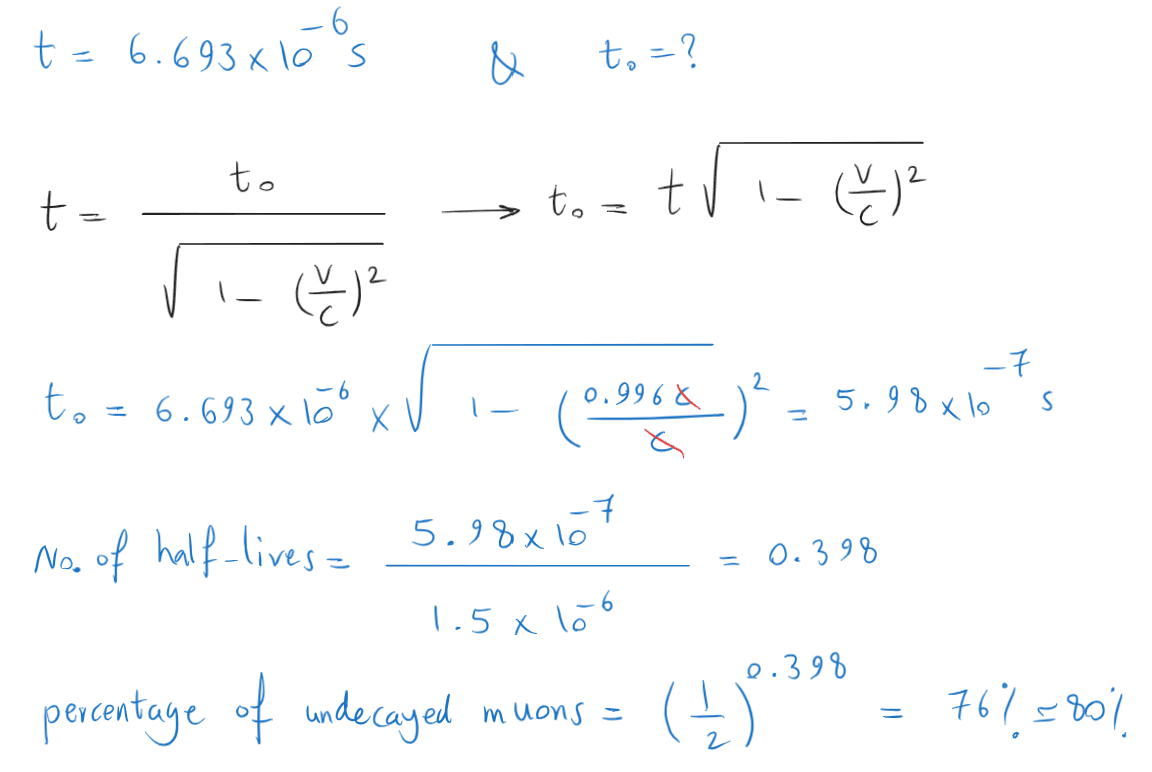
Which is much closer to the measured value!
We could also look at this from another angle:
We could adjust the half-life itself:
Half-life measured on Earth in the lab by a person in the same IFR = 1.5 μs.
So that is the proper time for half-life.
But how much is the half-life for a fast moving muon?
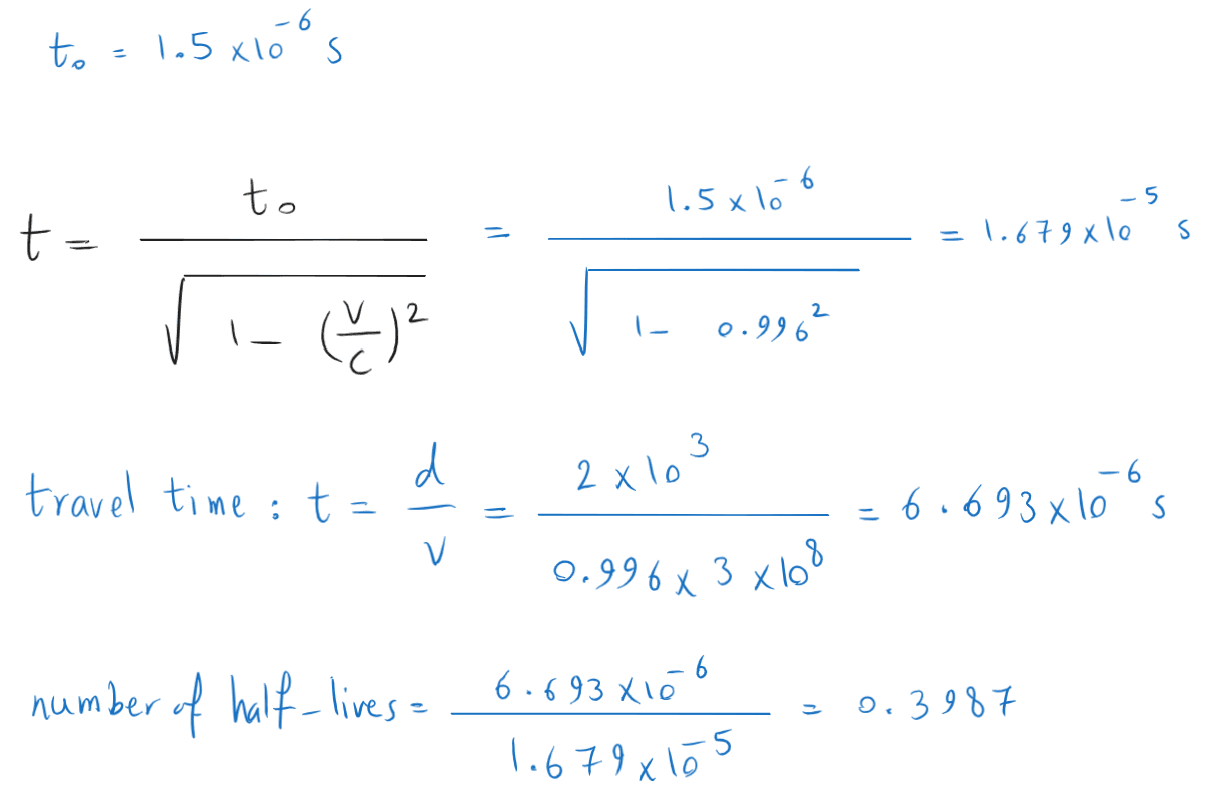
Which is the same number of half-lives as when we corrected the travel time.
Here is the story:
Because muon travels fast, it feels a longer half-life (1.679 × 10⁻⁵ s).
But muon speed is invariant!
Hence the travel time in distance of 2 km stays the same value of 6.693 × 10⁻⁶ s.
We could look at it yet from another angle:
If we were sitting on the muon and travelling with 0.996c towards the second detector at the sea level, the 2 km distance would look shorter to us!
In other words we would see the detector coming towards us with a speed of 0.996c.
How shorter the 2 km length would appear in the eye of the muon?
Here the 2 km is measured on the Earth by a person in the same IFR.
Hence L0 = 2 km.
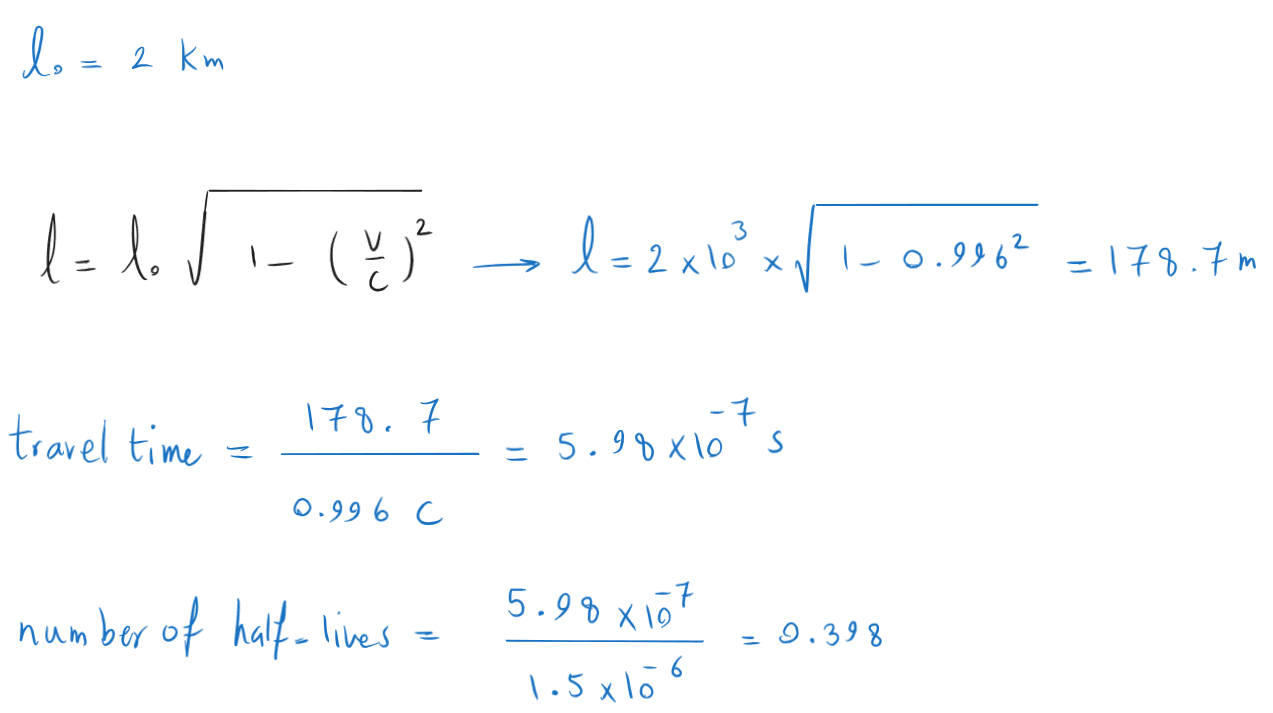
Which again is the same number of half-lives!
Crazy, innit?!
So here again because the muon’s speed is invariant, the travel time is shorter, but because we are sitting on the muon itself, the half-life stays as 1.5 μs!
12.3.3 Mass = Energy
Mass and energy are equivalent!
As energy increases so does mass.
Means if a particle moves fast, its mass increases.
This does not mean the amount of matter increases, just means it has more inertia, hence more force is needed to change its velocity.
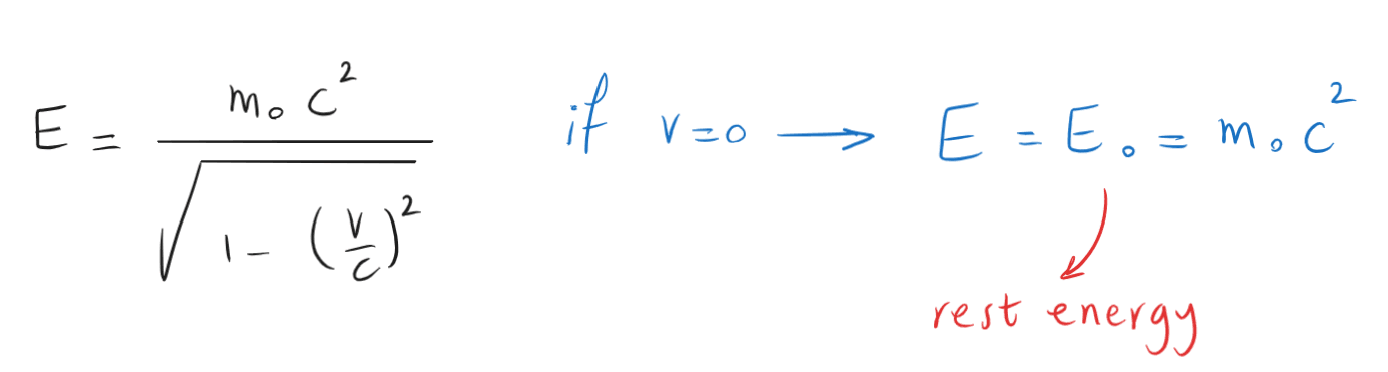
Mass measured in the same IFR = m0, which we call rest mass.
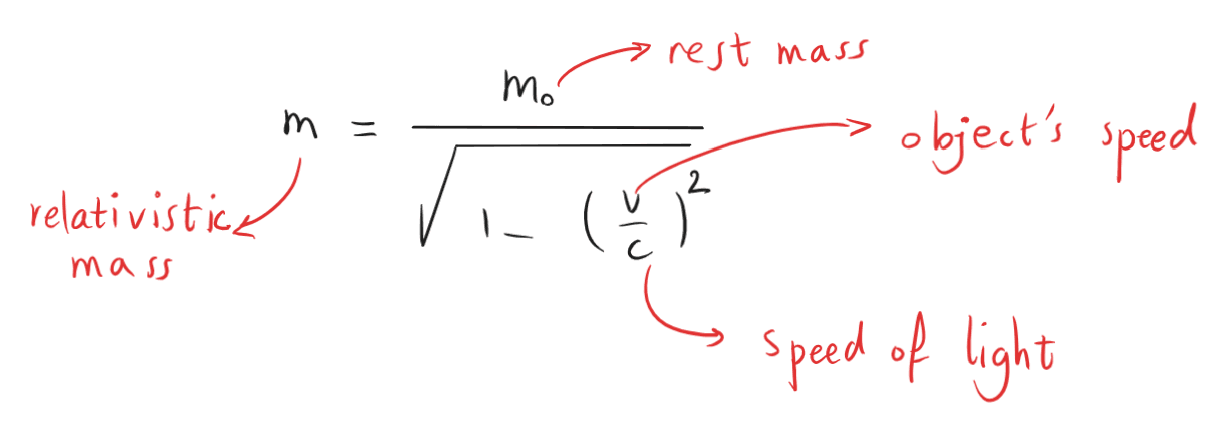
Change of relativistic mass is shown by this graph:
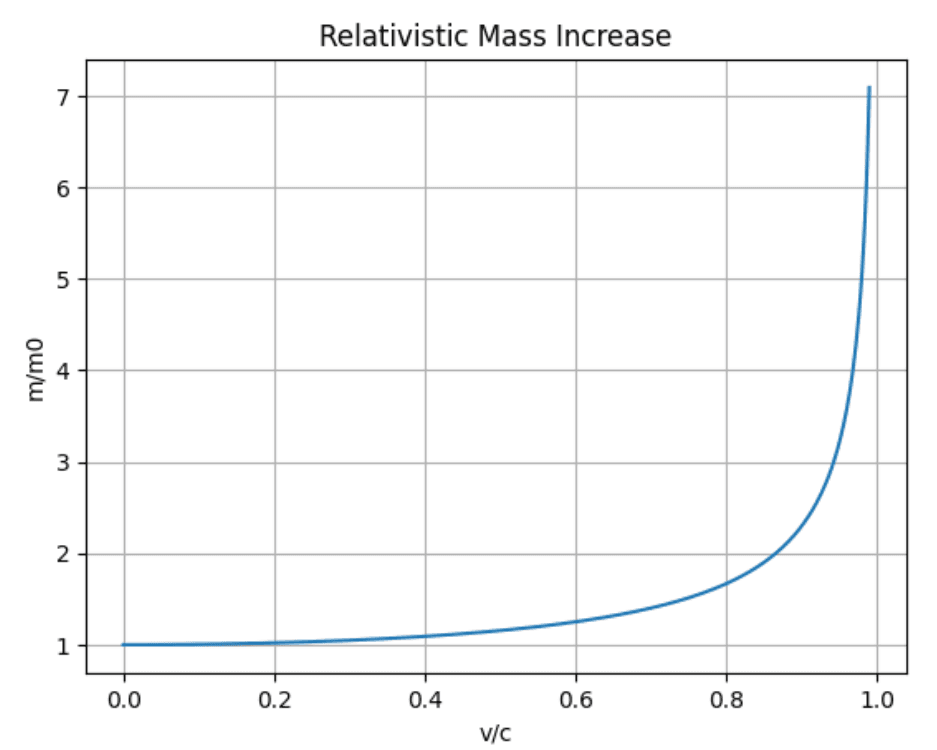
Key features:
At low speeds (v≪c), m/m0 ≈ 1;
As v approaches c, the curve rises very steeply;
m/m0 → ∞ as v→c.
This shows why objects with mass can never reach the speed of light.
In tests electrons were accelerated to very high speeds, and it was shown their mass increases.
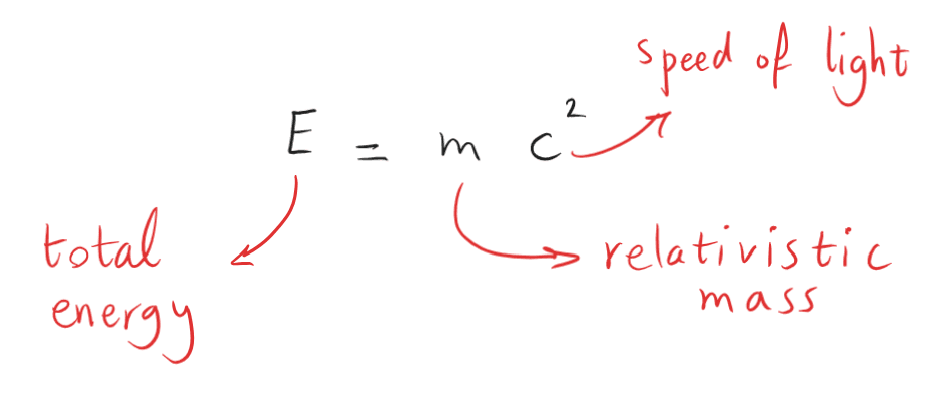
The Einstein came up with this famous formula:
Substitute the formula for relativistic mass:
And we can say:
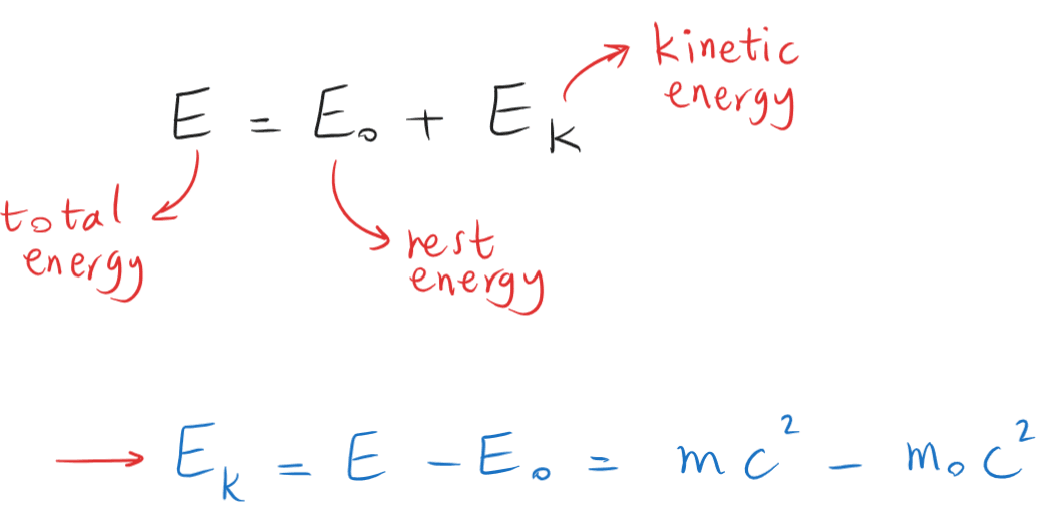
Diagram below shows how Ek changes according to Einstein vs what Newton thought:

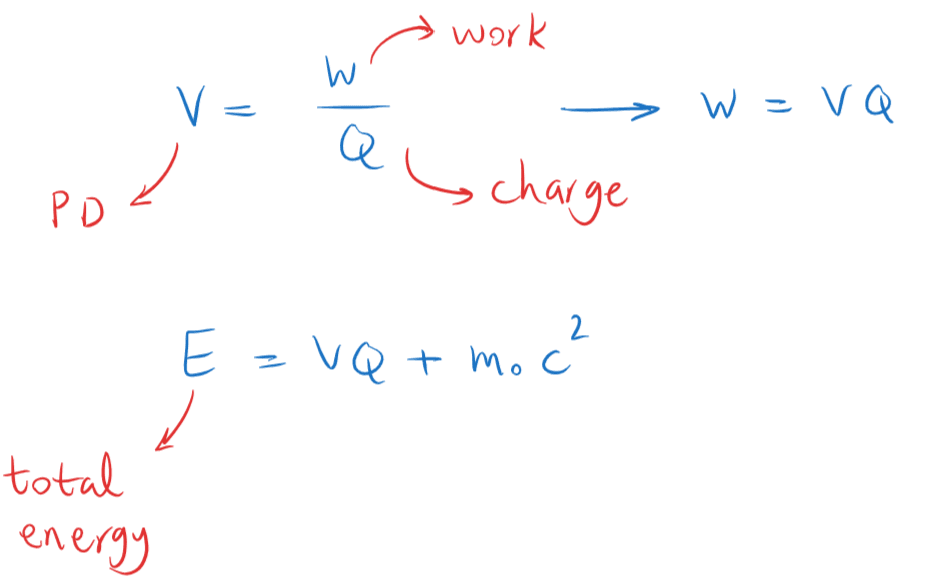
If a particle with charge Q is accelerated in a PD of V, its total energy is:
12.3.3.1 Bertozzi’s ultimate speed
He did experiments to find the relation between velocity of an electron and its Ek.
Accelerated electrons would hit an aluminium disc and their Ek was found by the heat created in this collision.
His results vindicated Einstein’s theory.
It was also shown electrons speed was limited to near speed of light!

.
.
.
Revise and Get Paid!
If you like taking summary notes of lessons and solving past papers, see the Join Us page!