OCR Physics

Astrophysics
Some definitions:
Planet: an object orbiting a star, which:
- Its mass is large enough to give it a round shape;
- No fusion occurs on it;
- Its orbit is cleared of other object.
Planetary satellite: an object orbiting a planet.
Comet: irregular shaped objects orbiting the sun in eccentric elliptical orbits. Usually made of dust, ice, and rocks. Their size can be from few hundred metres to tens of kilometres.
Solar system: a star and all objects orbiting it.
Galaxies: a collection of stars and all objects between them, including the interstellar dust and gas. On average a galaxy has 100 billion stars. Many of those stars have their own solar system.
Universe: a collection of all objects and energy that we know of!
5.5.1 Life Cycle of Stars
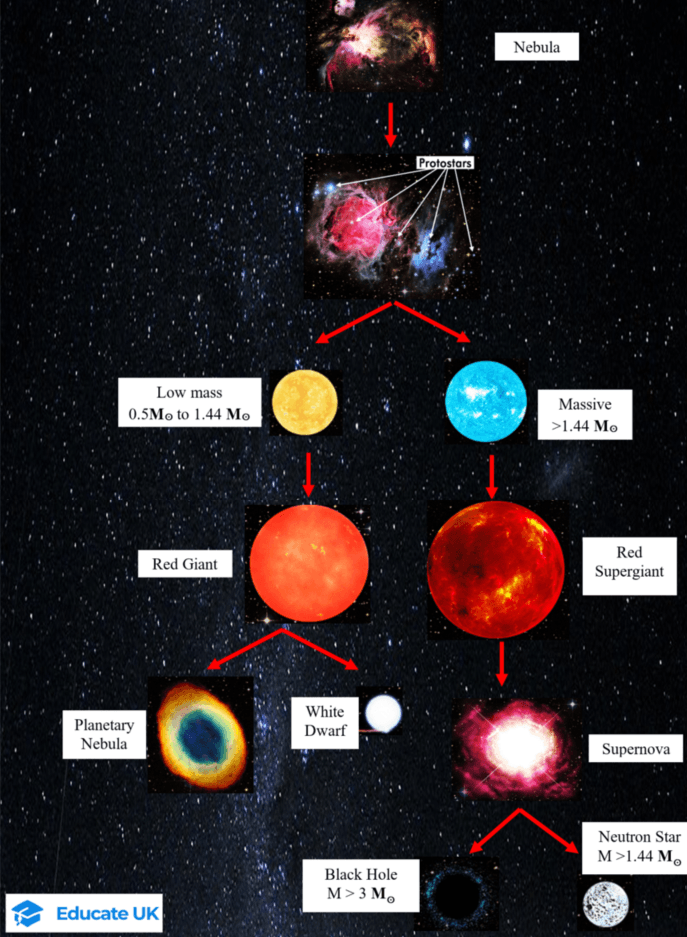
Nebula: cloud of dust and gas, they are the birthplace of stars!
They take millions of years to form and are many hundreds of times larger than our solar system!
The gravitational force between particles in a nebula attracts more dust and gas (mostly hydrogen), that forms denser central parts, which in turn attract more dust and gas, and as these clumps of material fall under gravity, the friction between them causes heat.
Protostar: a very hot, and dense part of a nebula.
If large enough mass is attracted to the protostar, and its core gain enough temperature (causes KE) and pressure to overcome the electrostatic repulsion between the hydrogen nuclei, fusion starts, and a star is born!
Main sequence: When a star will maintain its shape and size through balancing forces of contracting force of gravity on one side, and expansion of heat and pressure from fusion on the other.
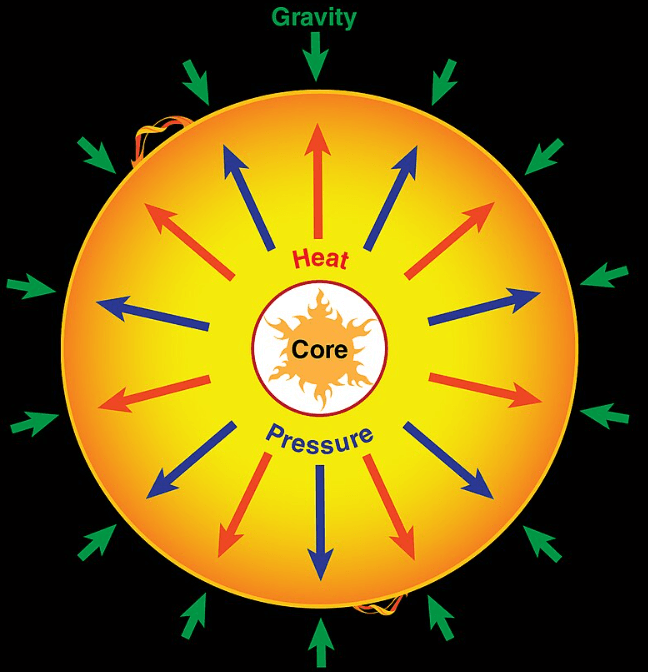
Mass of the sun: M☉.
5.5.1-1 Low Mass stars
Low mass stars (0.5 M☉ to 1.44 M☉) stay on their main sequence longer.
(Oxford university press book says up to 10 M☉, but I don’t think that’s correct. See section 5-5-1-3: side note on star mass).
Because their core is cooler and hydrogen fusion does not happen as fast as massive stars.
Any star will eventually run out of hydrogen fuel.
At the end of main sequence, fusion decreases and contraction from gravity will be more than expansion of fusion, then the core shrinks, and fusion will be limited to a shell around the core. At this point we call the star a red giant.
The red giant’s core is not hot enough to fuse helium, but fusion of hydrogen continues in the shell around the core and this causes the star to expand as layers move away from the core and at the same time they cool down giving the red giant its red colour!
Majority of the layers will be released into the space and form a planetary nebula, which may form its own solar system and planets.
The core will be left behind as a white dwarf! It is very dense, and no fusion happens in it. It only emits energy (photons) trapped in it from previous fusion. Its surface temperature can be about 30’000 K.
Electron degeneracy pressure:
According to Pauli Exclusion Principle, we cannot have more than one electron in the same energy state.
So when gravity contracts the core, the electrons refuse to be compressed anymore and they produce a pressure, resisting the contraction. This is called Electron Degeneracy Pressure.
Chandrasekhar limit:
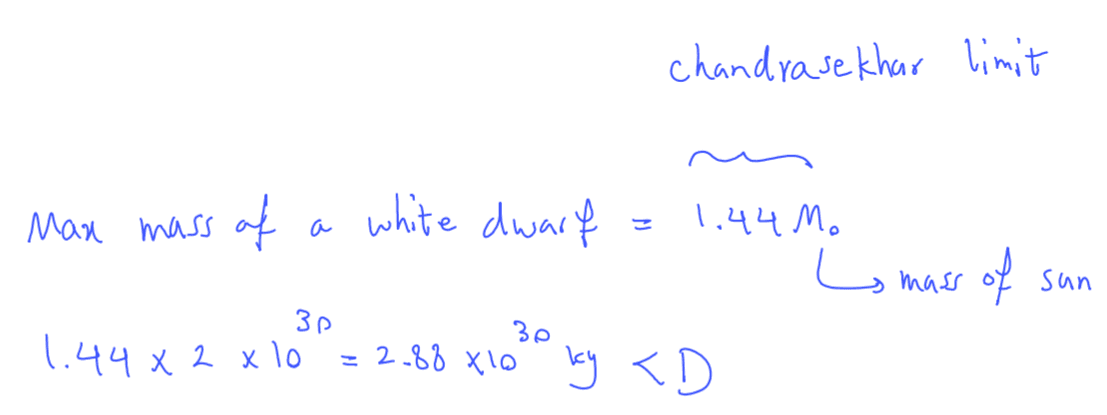
The electron degeneracy pressure is only effective to prevent gravitational collapse for stars which the mass of their core is less than 1.44M☉. This mass is called the Chandrasekhar limit. Which means this is the limit for maximum mass of a stable white dwarf.
Example 1:
Which of the following cannot be mass of a white dwarf?
Take mass of the sun equal to 2.0 × 1030 kg.
- 1.2 × 1030 kg
- 2.0 × 1030 kg
- 2.7 × 1030 kg
- 3.2 × 1030 kg
Solution:
5.5.1-2 Massive stars
Stars with mass more than 3 M☉ have a hotter core and run through hydrogen fuel much faster (book says more than 10 M☉. See section 5-5-1-3: side note on star mass).
So after hydrogen runs out, the core is actually hot enough to fuse helium, and create elements as heavy as iron! At this stage they are called Red Supergiant!
As a result the red supergiant’s core is made of different layers:
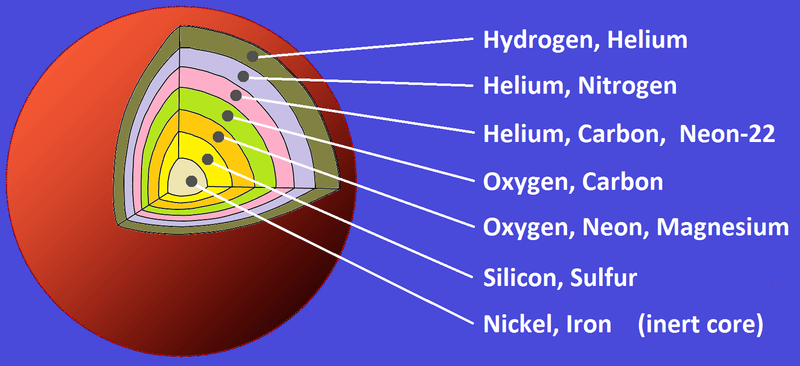
Iron is stable and cannot be fused. Fusion of iron does not release energy anymore!
So other layers implode and bounce of the solid iron core, which causes a shockwave ejecting the core material into the space. This is called a supernova!
Supernovas create elements heavier than iron, such as gold and copper.
Following the supernova two things two things can happen:
- If mass of the core is more than Chandrasekhar limit (1.44 M☉), the gravitational contraction creates a neutron star, which almost entirely is made of neutrons, with a typical diameter of 10km and mass of 2 M☉. Its density is as high as a nucleus!
- If mass of the core is more than 3 M☉, the gravitational contraction creates a core with a massive gravitational field that if an object will want to escape this field it will have to have a speed more than that of light! This core is now called a black hole! Nothing can escape the gravity of a black hole, even light (photons)! Most galaxies have black holes at centre with mass of several million M☉!
5.5.1-3 Side note on star mass
The authors of the OCR A-Level physics book Graham Bone, Gurinder Chadha, and Nigel Saunders (Oxford university press) seem to have a little mistake here. The book mentions stars with mass between 0.5 M☉ to 10 M☉ evolve into red giants.
To be best of my knowledge we have three routs:
- Low mass: M < 1.44 M☉ à red giant à planetary nebula + white dwarf;
- Medium mass: 1.44 M☉ to 3 M☉ à red giant à supernova à neutron star;
- Massive: M > 3 M☉ àred supergiant à supernova à black hole.
What they have written for Chandrasekhar limit, confirms this. Because they say stars with core up to 1.44 M☉ can form a stable white dwarf!
And again what is written under Supernova and beyond is inconsistent with the 10 M☉ being the limit for formation of red giant.
Unless they were referring to the mass of the core only! But they have written it a bit confusing!
Anyway I have hardly seen questions asking about mass of the star exactly in OCR. You will be fine just remembering that low mass stars develop red-giants and white dwarf + planetary nebula.
And then massive stars develop red supergiant and then go on to supernova and then neutron star or black hole.
5.5.1-4 Hertzsprung-Russel Diagram
This graph classifies stars based on their luminosity and their surface temperature.
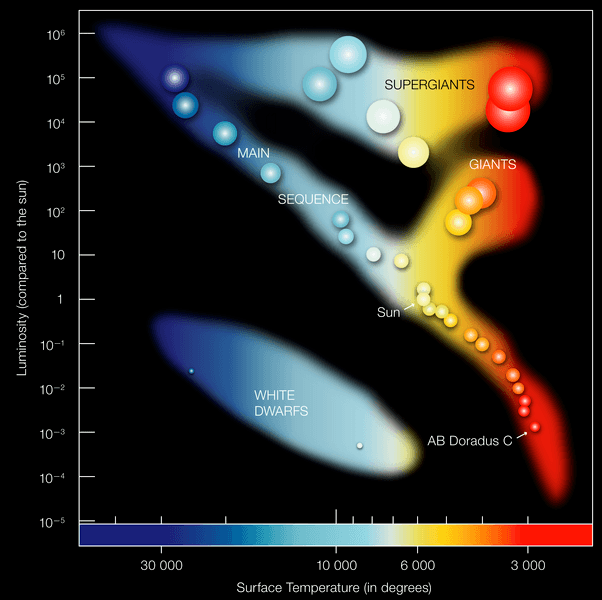
Luminosity is the total power radiated from a star.
Luminosity on the vertical axis is shown relative to that of the Sun.
Luminosity of the sun: 1L☉ = 3.85 x 1026 W.
Temperature decreases from left to right.
5.5.2 Electromagnetic radiation from stars
Electrons are in separate energy levels around the nucleus.
No electron is between these energy levels.
We show the energy levels with a negative sign, because:
- External energy is needed to move an electron up an energy level.
- Negative value shows the electrons are bound to the positive nucleus.
The closer the energy level to the nucleus the more negative its value. (It is like an energy well!).
The energy level closest to the nucleus is called the ground state (or ground level).
An electron at zero energy level, is free from the nucleus.
If an electron gains energy and goes up in energy levels, we say the atom is excited. This can happen by:
- Electron absorbing a photon of a specific energy (energy equal to difference in energy levels);
- Heat energy;
- Electrical energy (PD).
5.5.2-1 Energy of a photon
When an electron goes down in energy levels, we say the atom is de-excited.
Because of conservation of energy, energy is released from the atom, in the form of a photon.
The energy of the photon released is equal to the difference in energy levels!
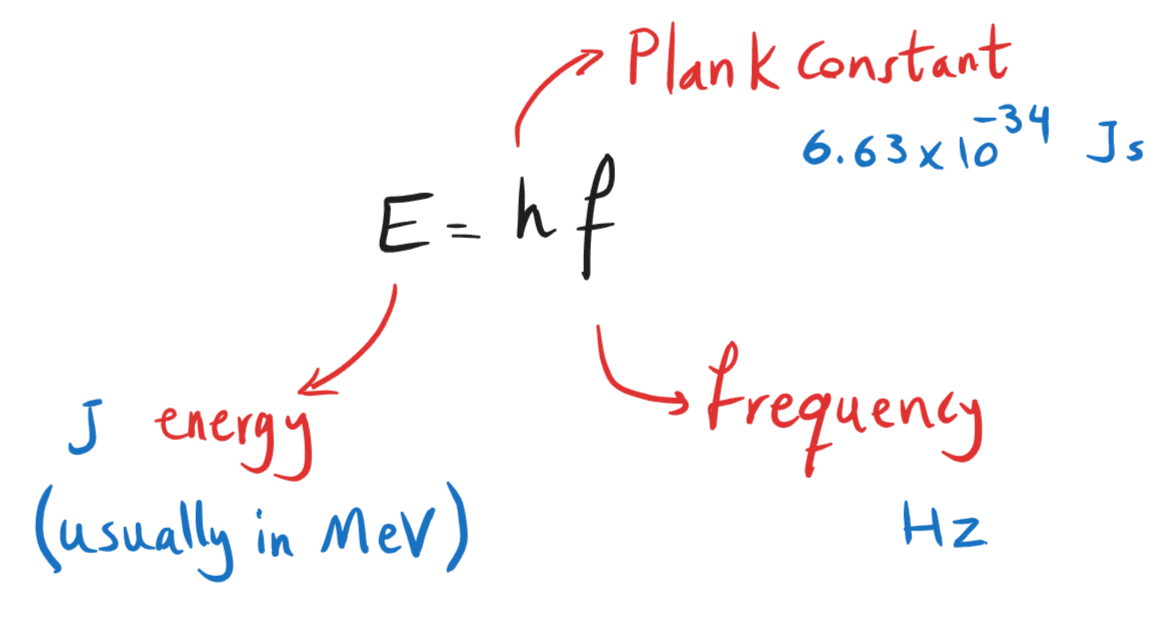
Frequency and energy of a photon are related by this formula:
ΔE = h f
Remember:
1 eV: energy required to move an electron in PD of 1 volt.
Example 2:
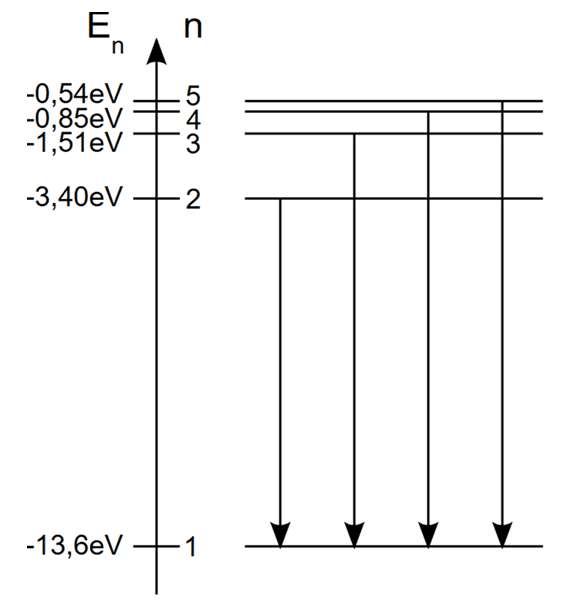
Diagram below shows energy levels in a hydrogen atom.
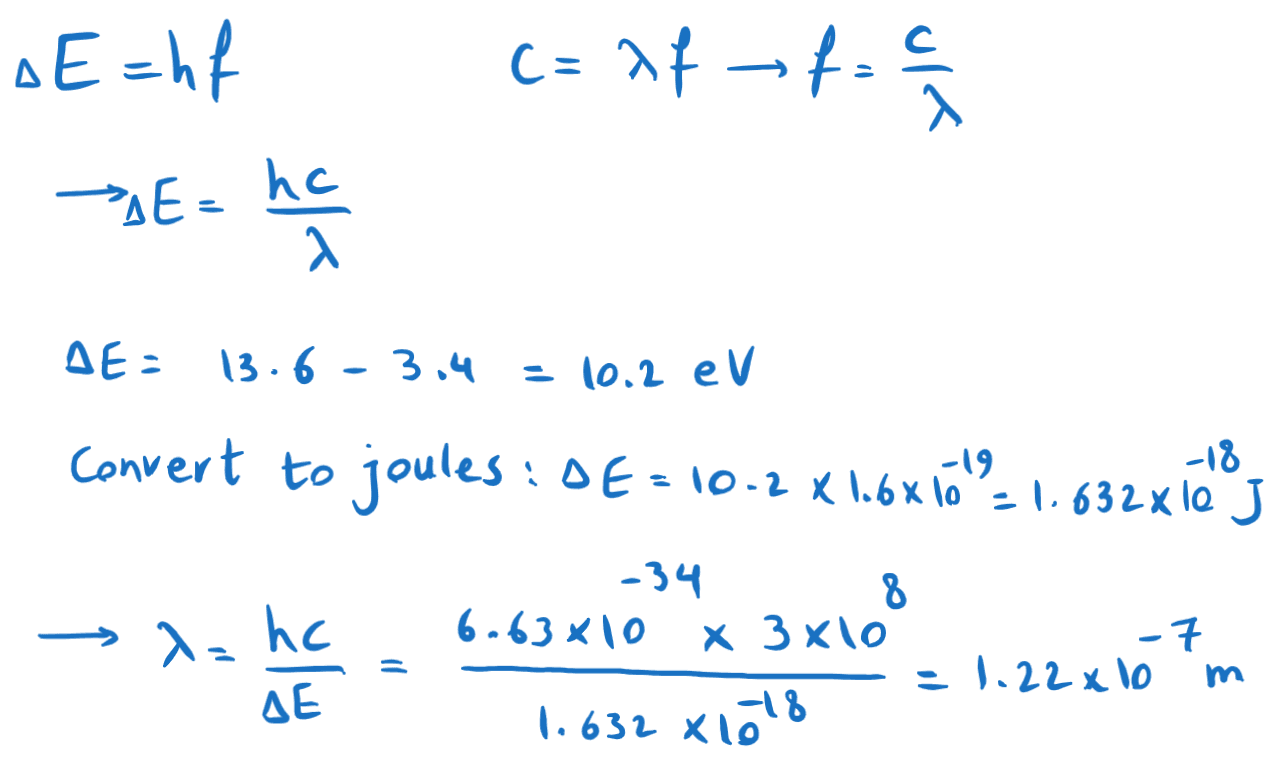
If an electron drops down from n = 2 (3.4 eV) to n = 1 (13.6 eV), calculate the wave length of the photon released.
We ignore the negative sign as frequency cannot be negative.
Solution:
5.5.2-2 Spectra
Light emission from gas:
If we connected a high PD to a glass tube filled with a noble gas at low pressure, the gas emits light!
This happens because:
- The high voltage applied at both ends of the glass tube, ionizes the gas. This strips electrons from atoms, creating a plasma of ions and free electrons.
- The free electrons collide with gas atoms, exciting their electrons to higher energy levels. When these electrons drop back, they emit photons (light) of specific wavelengths. Neon emits red-orange; other gases/coatings produce different colours.
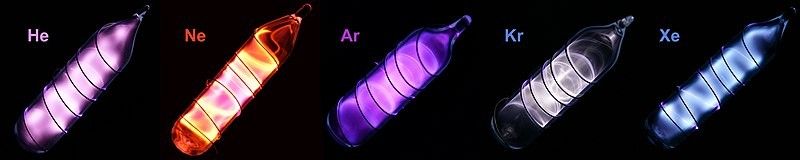
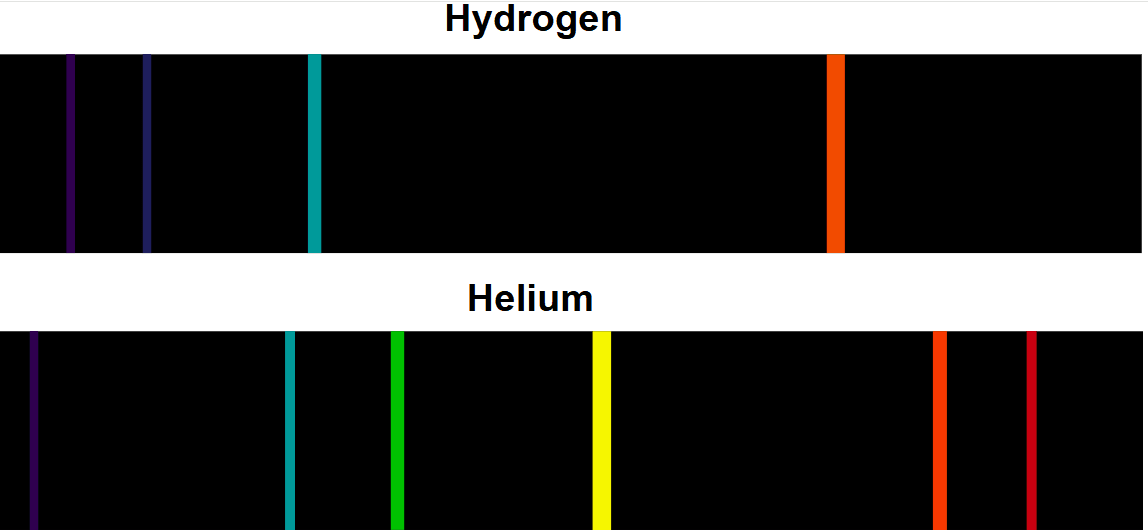
Depending on the number of energy levels, each atom produces different wavelength of light (colour). By printing the colours and their corresponding wavelength we produce spectral lines. Each atom has its own unique spectral lines.
There are three types of spectra:
- Continuous spectra: from white light, including all frequencies of visible light. It can be created by light from a hot metal (e.g. filament lamp);
- Emission spectra: a series of coloured lines representing light frequencies;
- Absorption spectra: a series of dark lines on the background of continues spectra. It is made by passing white light through a cooler gas. The atoms of gas absorb photons with energy equal to ΔE of energy levels of the atom.
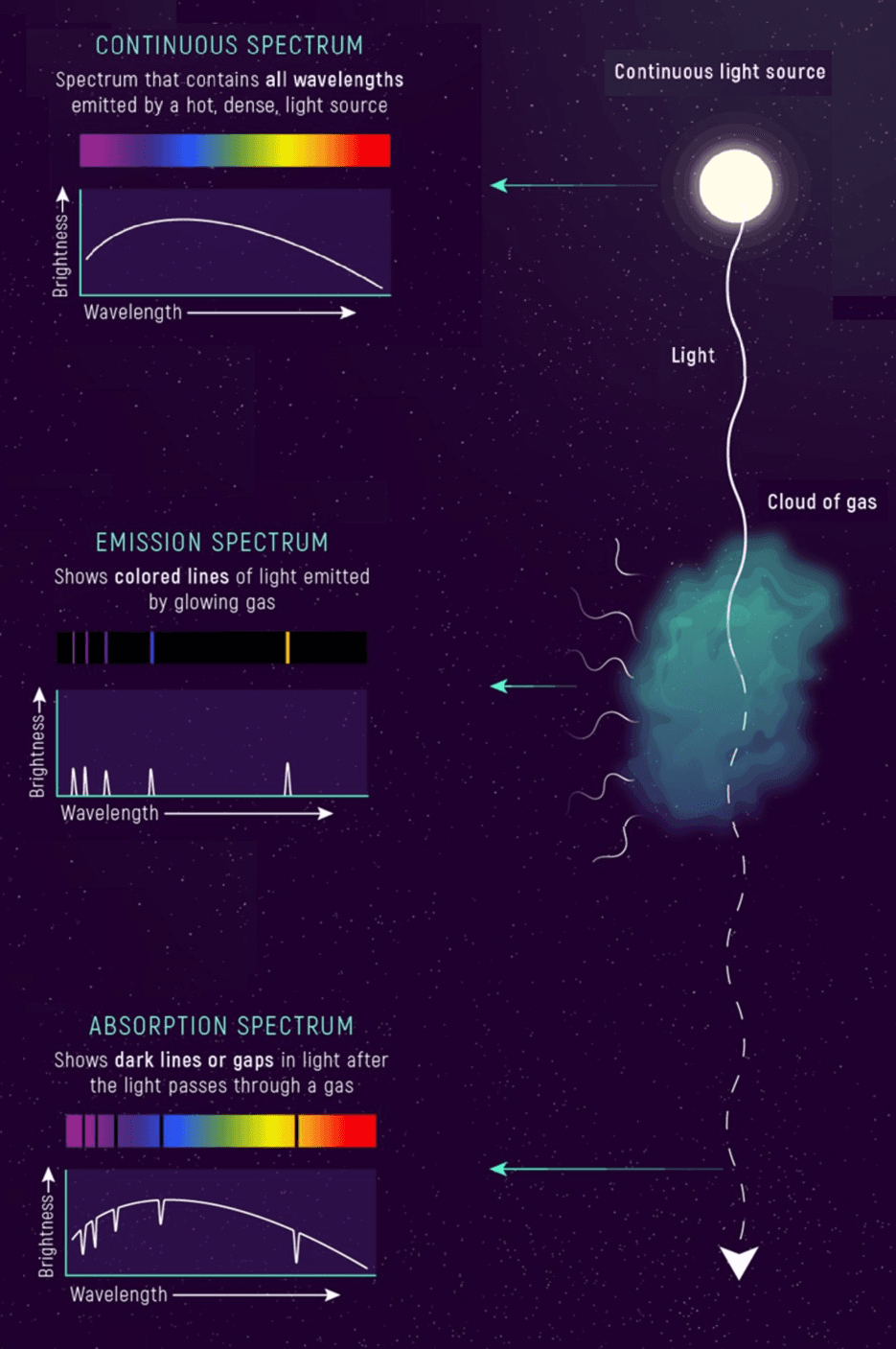
If we put an emission and absorption spectra on each other, they give us the continuous spectra!
Figure below shows the emission spectrum of hydrogen and helium:
Light from a star is white. But before it gets to us, it has to pass through cooler gas around the core of the star.
This means we get an absorption spectra from the star.
By comparing the wavelength of the light from the stars, with emission spectra obtained in lab, we can deduce the elements that the star is made of.
5.5.2-3 Diffraction grating
Light spreads out (diffracts) when it passes through a slit.
You have seen the diffraction pattern from a double slit before.
The boundary between bright and dark fringes from a double slit is not clear, which makes it hard to measure the fringe spacing and hence to calculate the wavelength of the light.
But if we pass light through more slits, like 1000 per mm, the diffraction pattern will be sharper and their brightness is more uniform.
Figure below shows diffraction pattern from a red laser.
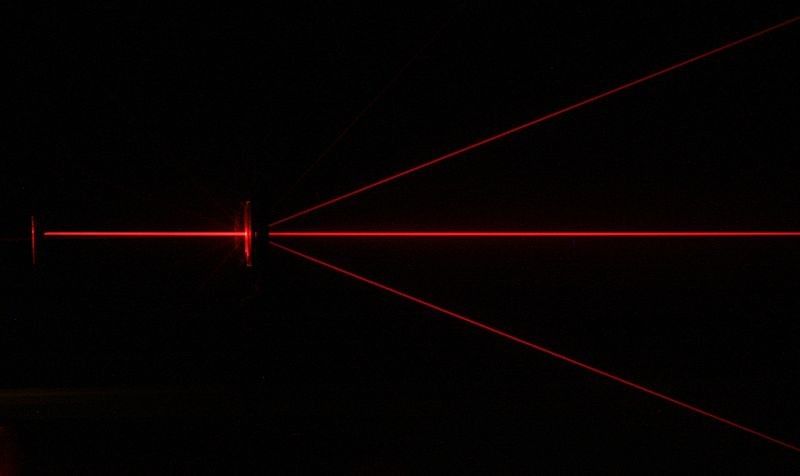
If we pass white light through the diffraction grating, the central maxima (zero order, n = 0) will be white, but other maxima on either side, will have a colour separation.
This happens because different colours of light, have different wavelengths! And for each constructive interference they travel a different disctance.
Blue is closer to the centre, and red is further.
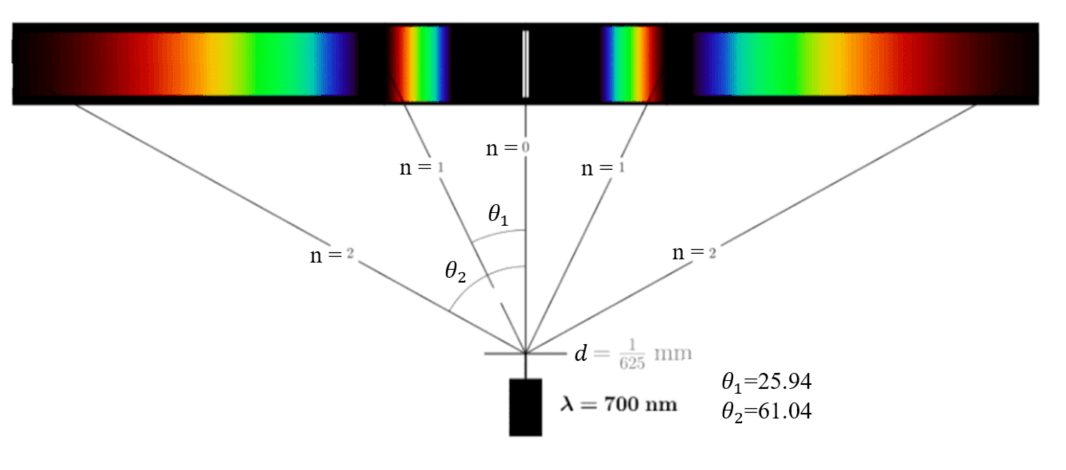
In figure above:  , means there are 625 slits per millimetre of the material!
Diffracting grating formula:
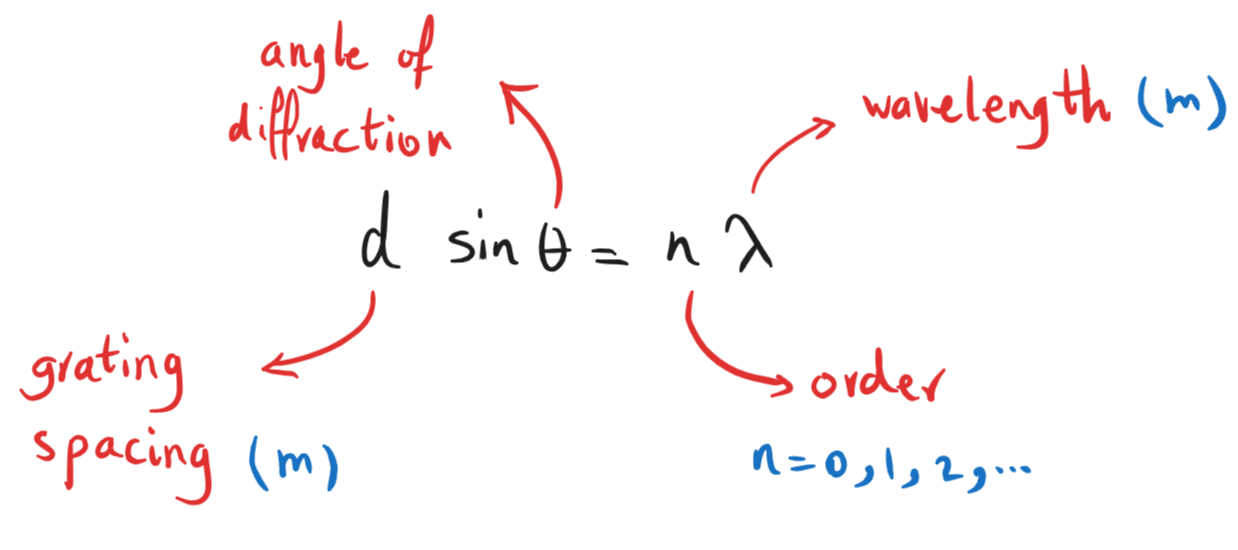
The angle is always measured from n = 0.
If the angle is more than 90o, the maxima cannot be seen on the screen!
Derivation of the formula:
In the diagram below the diffracted arrows show the direction for 1st order maxima.
The path difference for any two adjacent slit is λ.
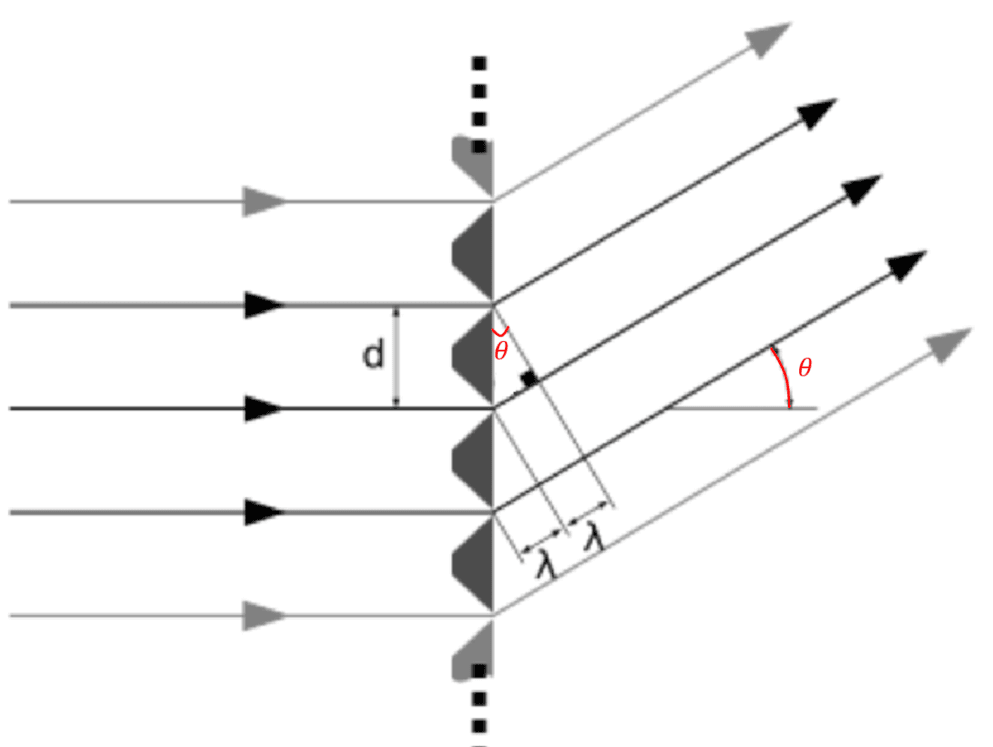
If we consider the “nth” order maxima, the path difference for any two adjacent slits is “nλ”.
Looking at the right-angle triangle where d is the hypotenuse:
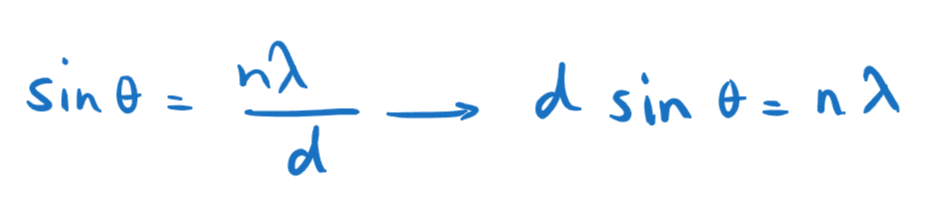
We always round down the order of maxima. For example if you set θ = 90o, and then calculate n = 4.3, this means the highest order is 4.
5.5.2-4 Star temperature & luminosity
Black body: A black body is an idealized object that absorbs all electromagnetic radiation (light, heat, etc.) that falls on it, without reflecting or transmitting any of it. It is also a perfect emitter of radiation based only on its temperature.
Examples of black body:
✅ The Sun – Closely behaves like a black body, emitting a spectrum that peaks in visible light.
✅ Incandescent Light Bulbs – The filament glows due to black-body radiation.
✅ Cosmic Microwave Background (CMB) – The afterglow of the Big Bang follows a black-body spectrum.
A black body cannot emit all of its energy over all wavelengths at once.
Diagram below shows how intensity of radiation emitted from a black body changes with its temperature.
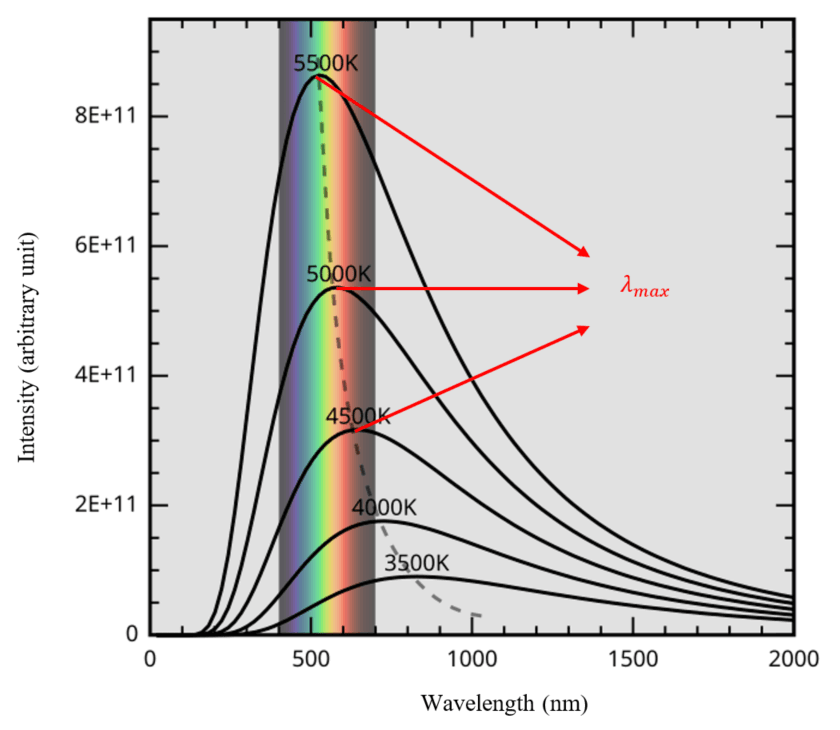
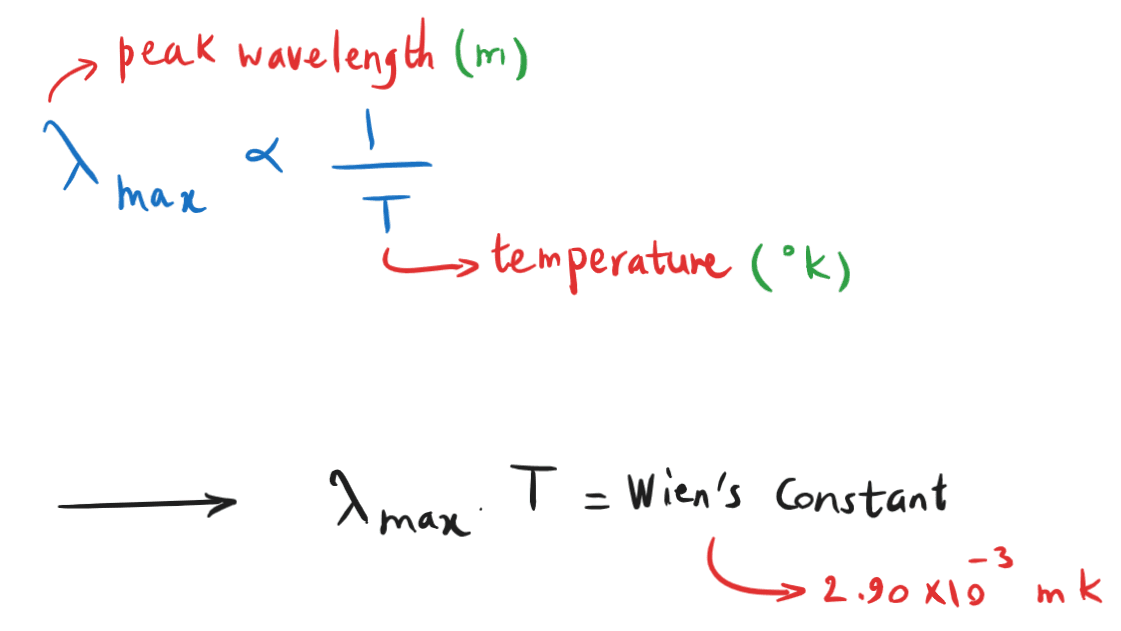
As it can be seen for every temperature, there is a wavelength for which maximum intensity of radiation occurs. We call this wavelength peak wavelength:  .
.
As the temperature of an object decreases, λmax increases, and the distribution of EM wave emitted changes.
This is called Wien’s displacement law.
5.5.2-5 Wien’s displacement law
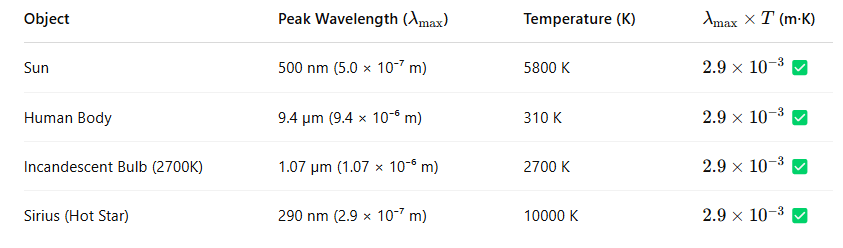
This law is used to determine the temperature of objects by analysing the EM waves they emit.
Examples of some objects’ temperature and their λmax.
5.5.2-6 Stephan’s Law
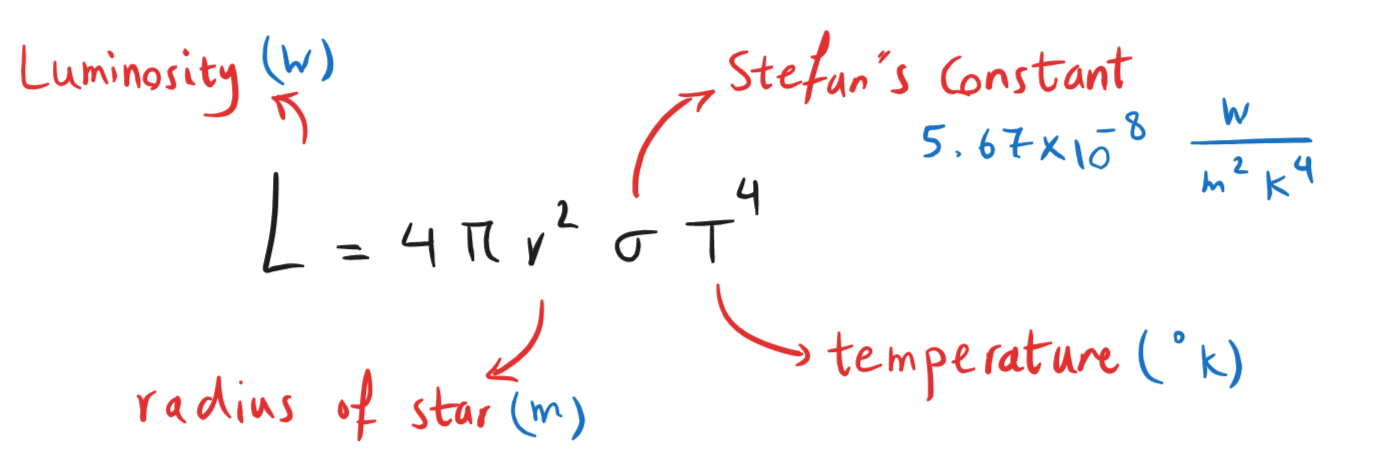
Luminosity: total power radiated from a star.
Example:
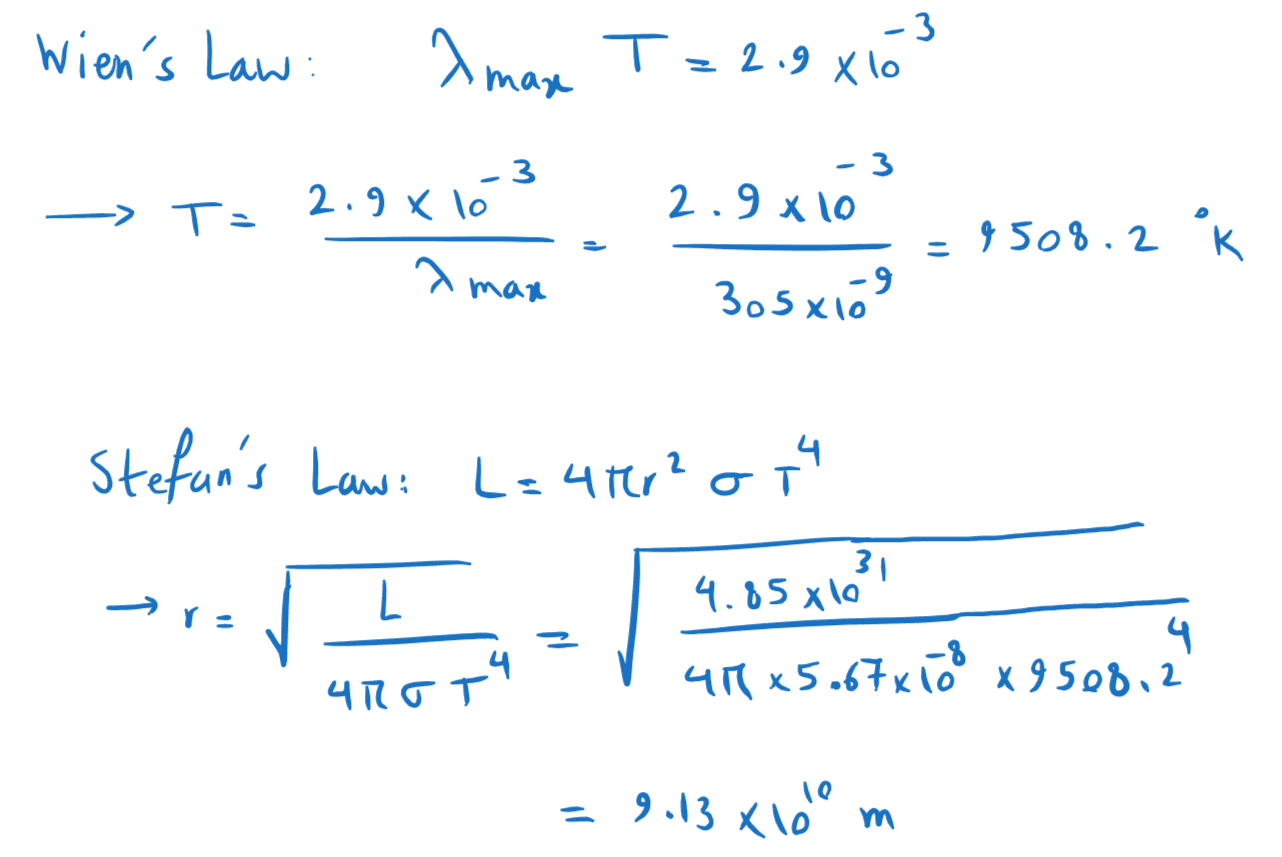
Peak wavelength from a star is calculated by diffraction grating to be 305 nm. The star has a luminosity of 4.85 x 1031 W. Calculate its radius.
.
.
.
.
Revise and Get Paid!
If you like taking summary notes of lessons and solving past papers, see the Join Us page!