OCR Physics

Cosmology
5.5.3 Cosmology
5.5.3-1 Some definitions
Arcminute: an angle equal to 1/60 of a 1 degree. 1’ =  1o
1o
Arcsecond: an angle equal to 1/60 of an arcminute. 1” =  1o
1o
Astronomical unit (AU): average distance between the Sun and the Earth = 1.50 x 10¹¹ m.
Light-year (ly): distance travelled by light in vacuum in one year = 9.46 x 10¹⁵ m.
Parsec (pc): the distance at which one astronomical unit (AU) subtends an angle of one arcsecond (1/3600 of a degree)
1 pc = 3.1 x 10¹⁶ m.
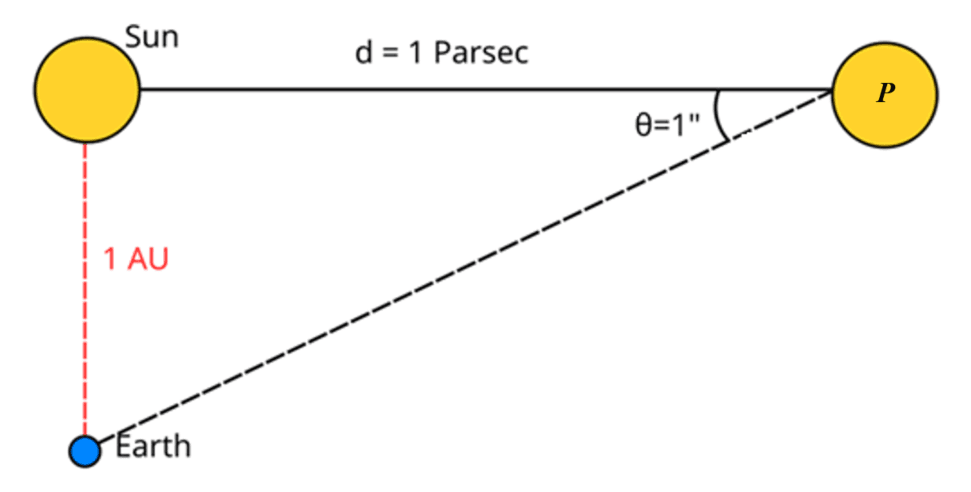
In triangle above:
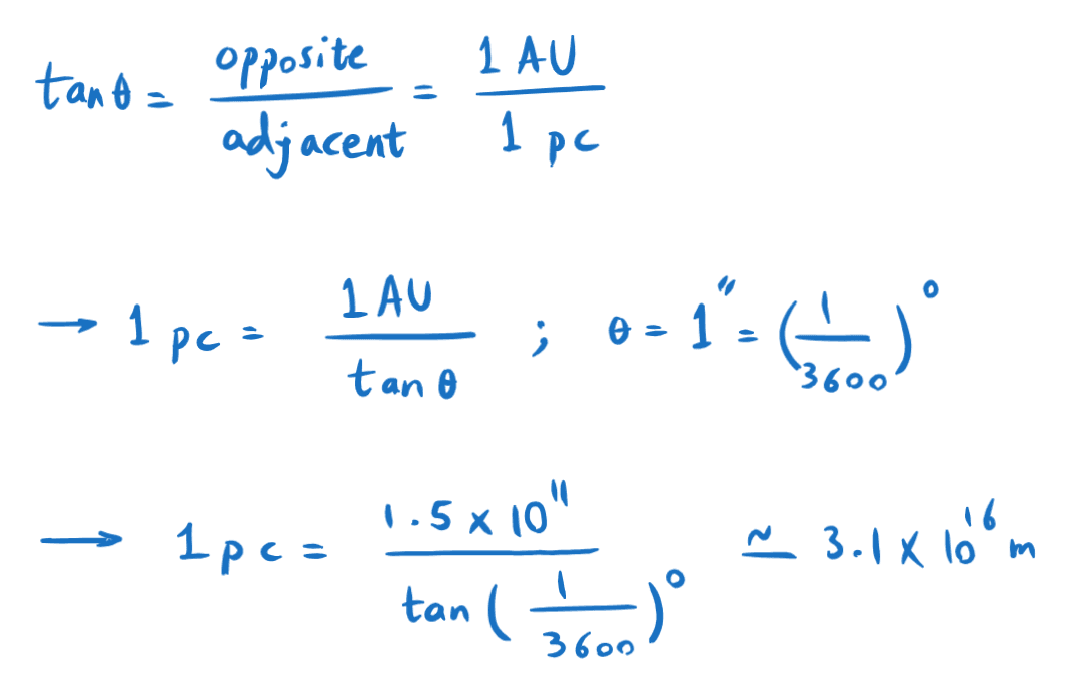
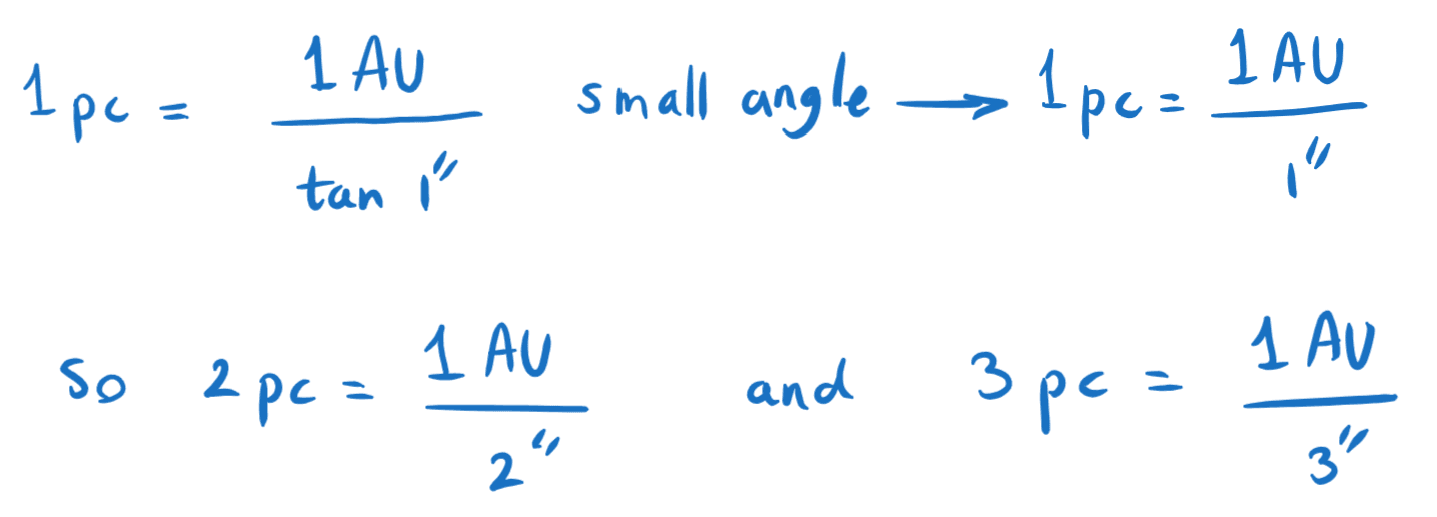
Small angle approximation: if θ is small, then we can say: tan θ = θ.
So, if θ = 1” the distance between the Sun and point P will be 1 pc.
If θ = ” the distance will be 2 pc.
If θ = ” the distance will be 3 pc.
And so on!
Reason:
Stellar parallax: imagine in June we are at position A and look at a star C as shown below. We will see it at position D.
Then when December comes (6 month later) we are at point B, and we will see the same star at point E.
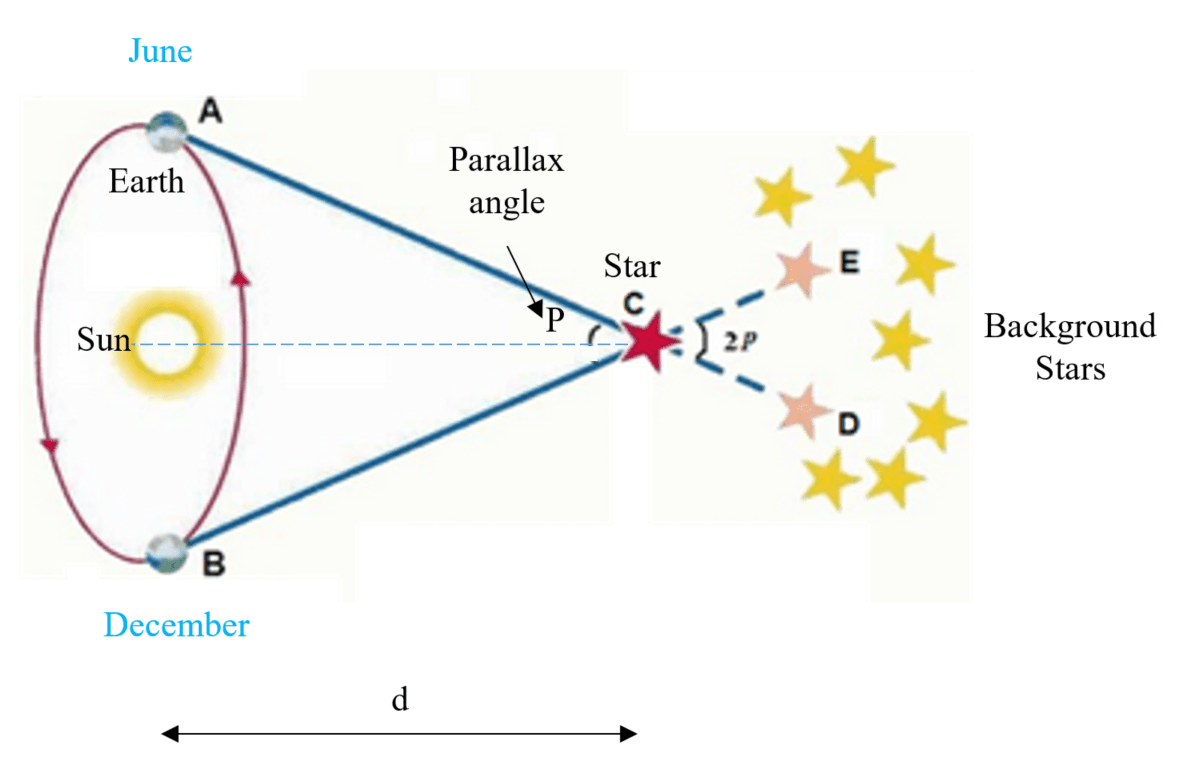
This change in location of star C is called the apparent shift. Because it appears it has shifted!
We can measure the angle P (parallax angle) shown above in arcsecond.
Then distance d of star C is given by:
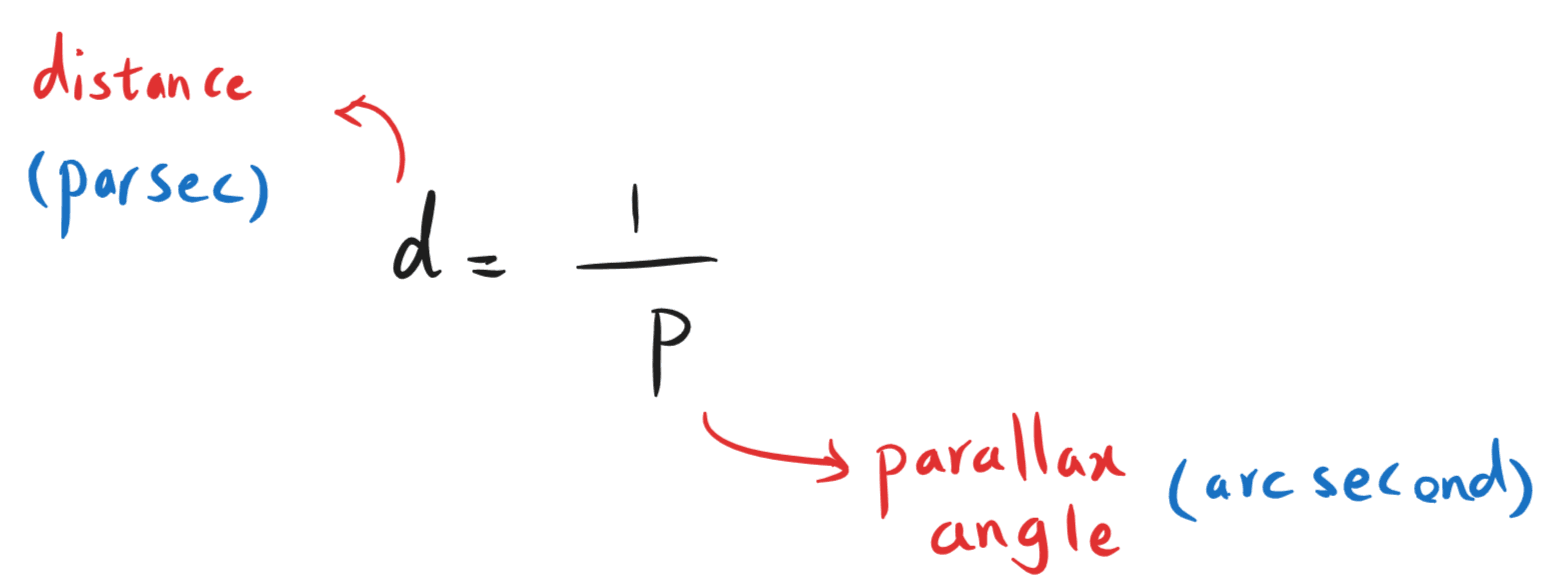
This formula is valid for distances less than 100 pc.
Because as the distance increases the angle P decreases and becomes impossible to measure with current technology.
Cosmological principle: universe is homogeneous, isotropic and the laws of physics are universal.
5.5.3-2 Doppler Effect
If a wave source moves relative to an observer, the observer will receive the wave with different frequency and wavelength, compared to hen they both are stationary.
If source and observer move closer to each other: f  , and λ
 .
.
If they move away from each other: f, and λ.
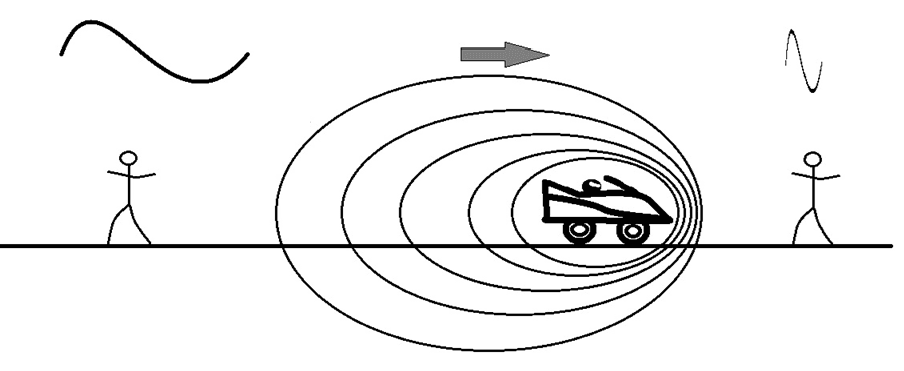
Note: wave speed stays constant as long as the wave is travelling through the same medium.
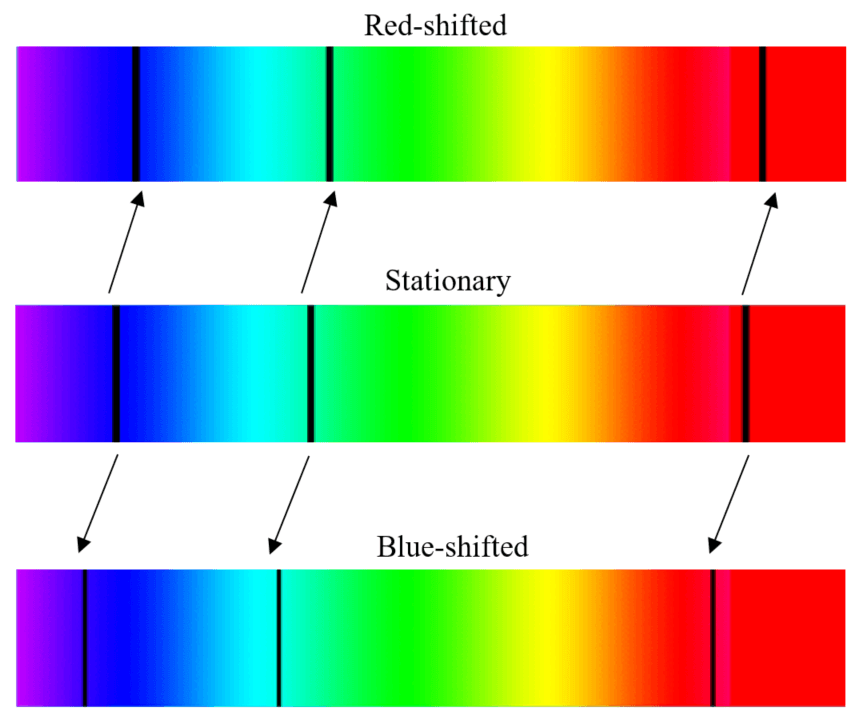
If a star is moving away from us the light coming from it shifts towards the red end of the visible light spectrum (red shift).
If is getting closer we see it moving towards the blue end (blue shift).
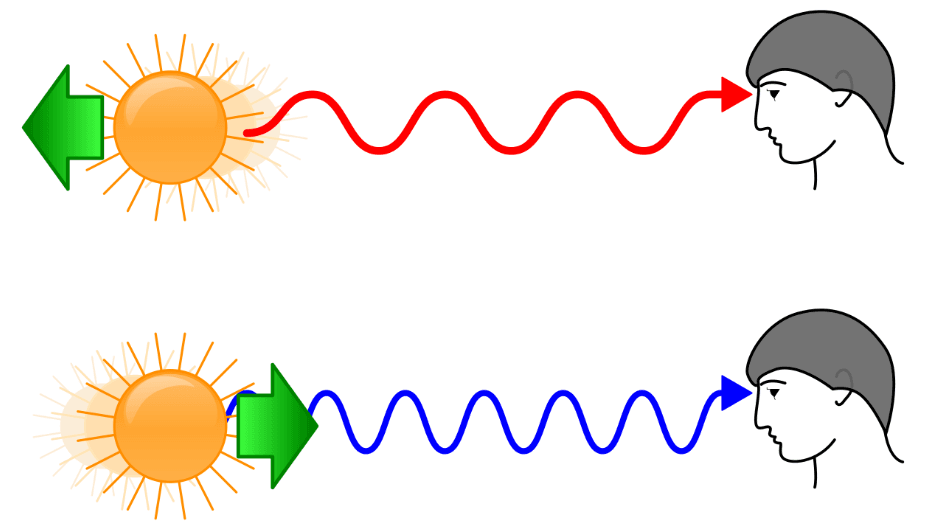
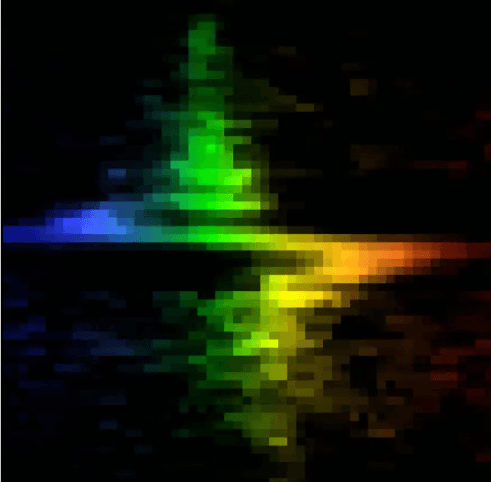
Figure below shows a cloud of dust and gas, just before being eaten up by the black hole at a centre of a galaxy (M84) whirling around at 880’000 miles per hour!
We can tell this because the left part of it is moving towards the Hubble telescope (blue shift), and the right part is moving away (red shift).
This also can be seen in the absorption spectrum:
To determine the relative velocity of a galaxy:
- The absorption spectrum of an element present in the galaxy is printed in the lab;
- The absorption spectrum of the element is obtained from the receding galaxy;
- The difference in wavelengths of the two spectra is used in the following formula to determine the relative velocity:
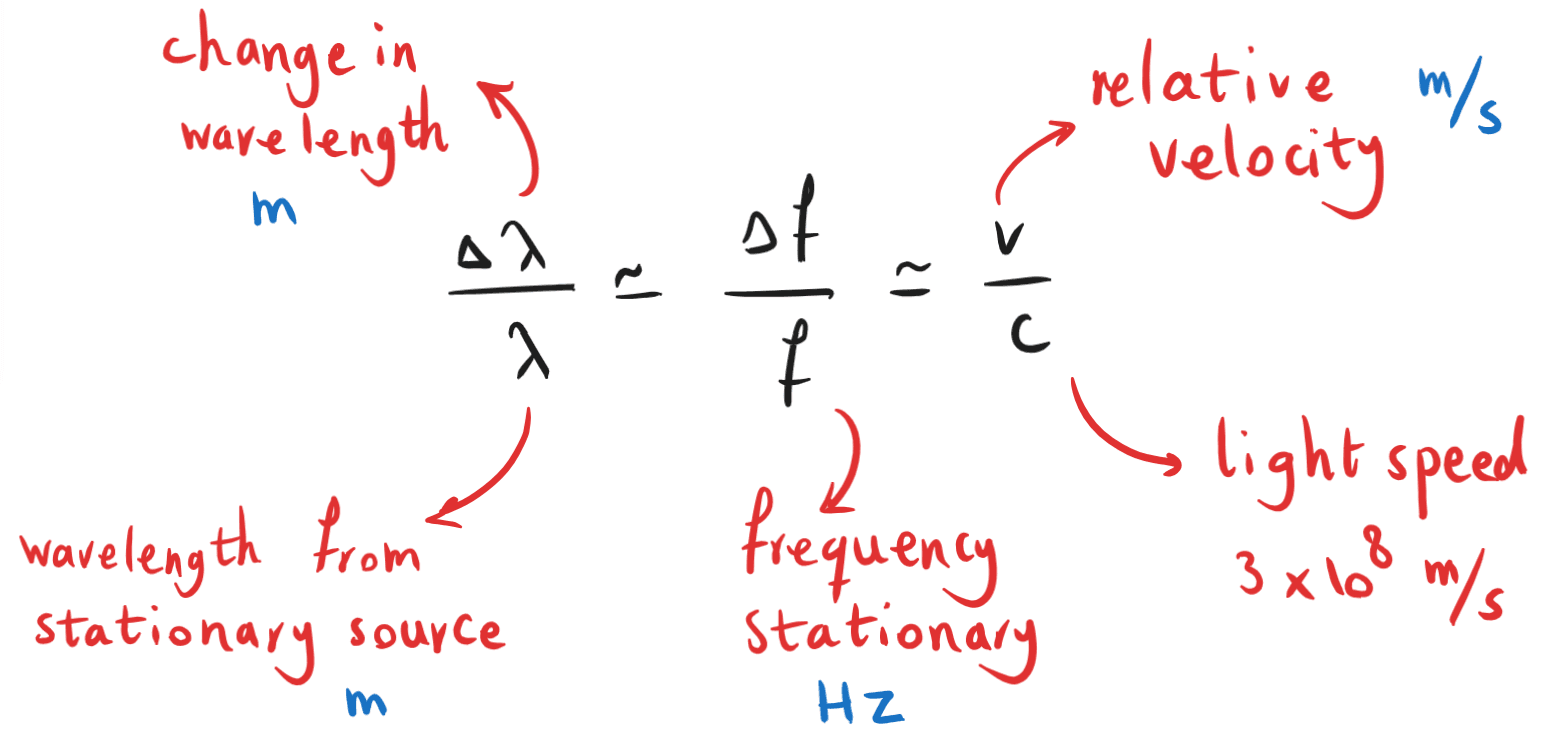
This called the Doppler Equation, and can be used only for galaxies moving far slower than speed of light.
Example:
Figure below shows some absorption spectral lines of the spectrum of calcium as observed from a source on the Earth and from a distant galaxy.
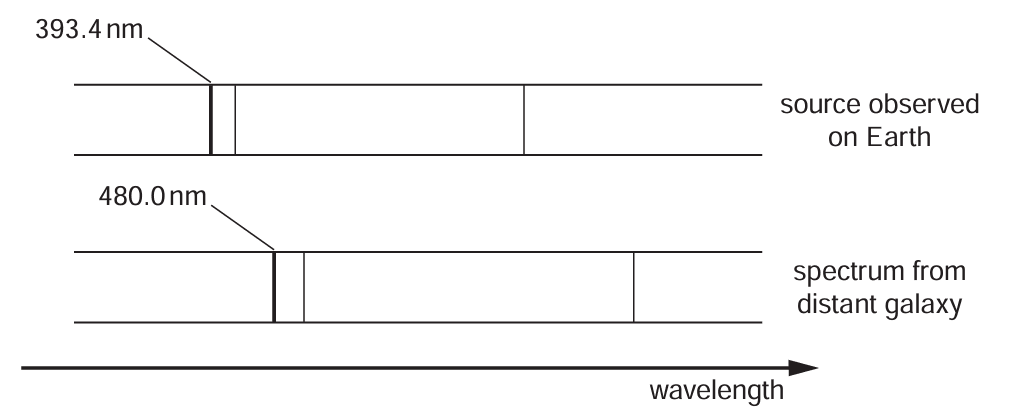
Calculate the speed of the galaxy and state whether it is moving towards or away from us.
Solution:
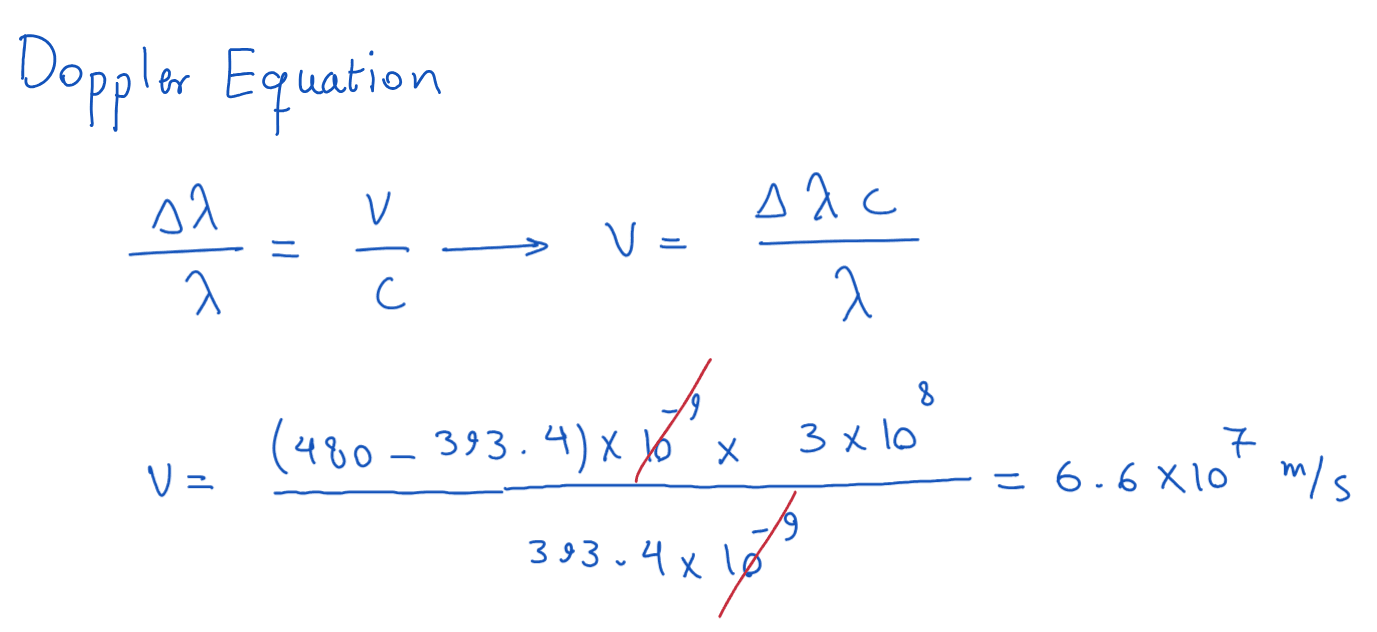
The spectrum from the galaxy has shifted towards higher wavelength. This means towards red. So the galaxy is moving away from the Earth.
Note: the longer the wavelength, the more it will shift!
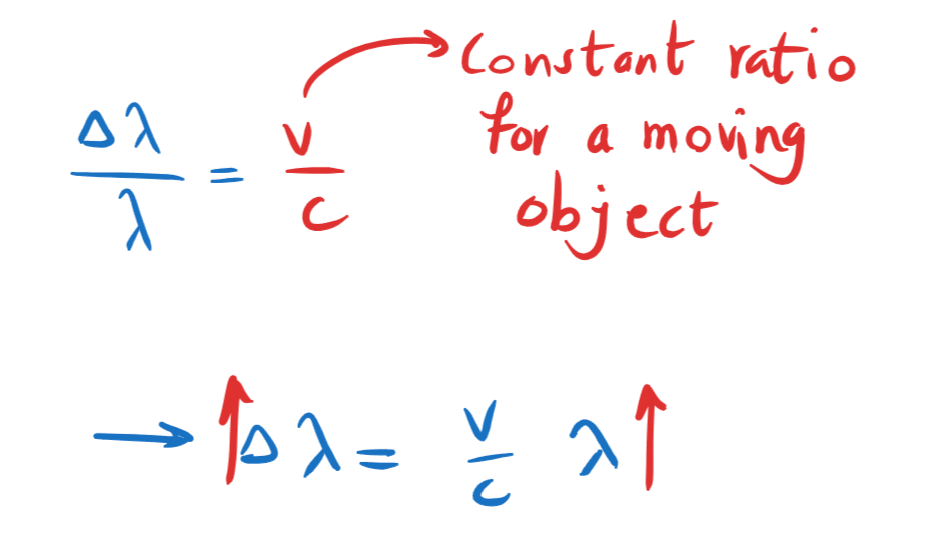
Suppose the star causes a 1% red-shift.
- A 400 nm line → shifts by 1% of 400 = 4 nm
- A 600 nm line → shifts by 1% of 600 = 6 nm
So the longer wavelength moves more.
Example:
Figure below shows part of an absorption spectrum from the Sun.
Which absorption spectrum shows light from a receding star most similar to the Sun?
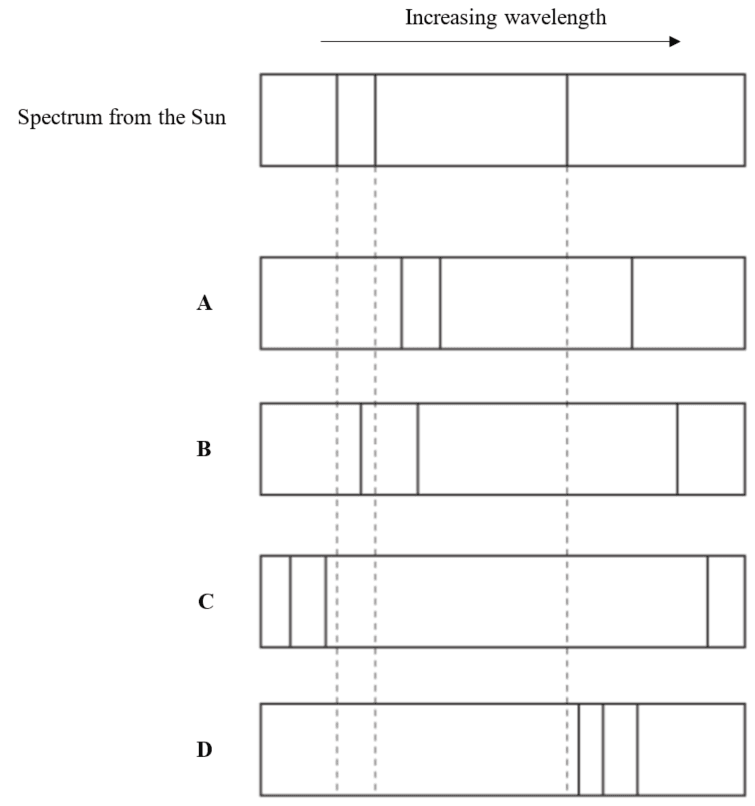
Source: OCR 2017.
Solution:
As the star is receding the wavelength should get longer (redshift).
Option A shows all spectral lines red-shifted but they all have moved by the same ratio.
Option B shows a redshift, but longer wavelength is shifted more, so it is the correct answer.
Also see real picture of shifts here.
5.5.3-3 Hubble’s Law
Hubble’s two main observations:
- Most galaxies are red-shifted; meaning they are going away from us;
- Farther galaxies are going away faster! So they are more red-shifted!
Plotting recessional speed vs. distance shows a linear relationship between the two.
Gradient of the best fit line is called the Hubble constant (H0).
However there the uncertainty for H0 is quite large!
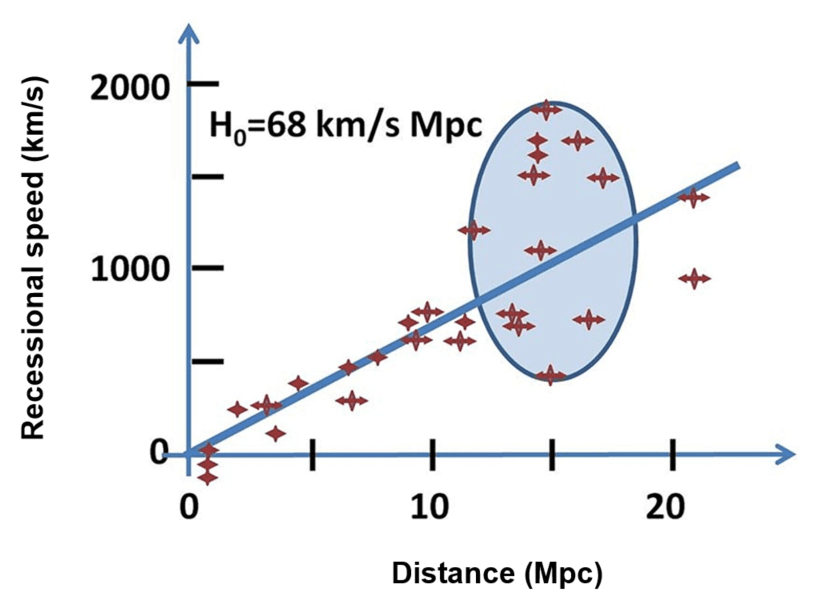
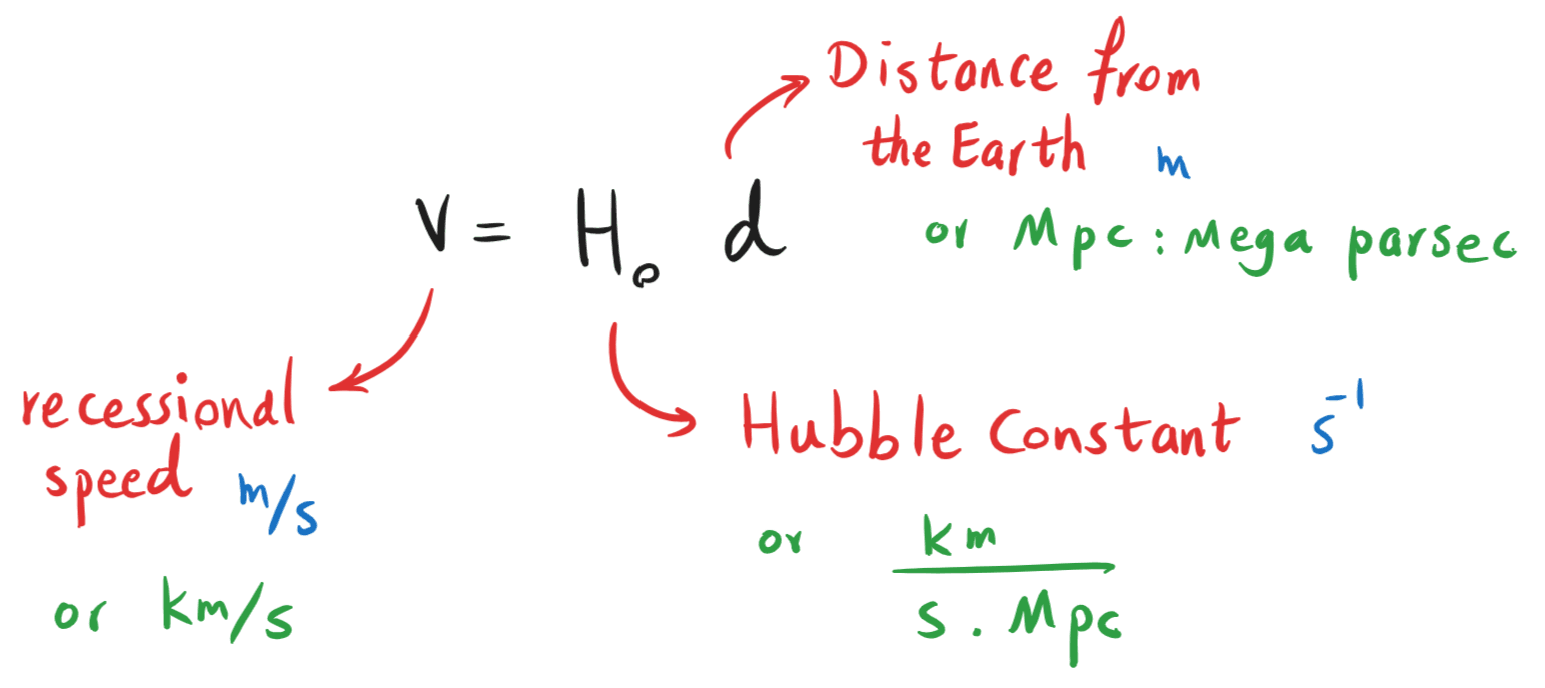
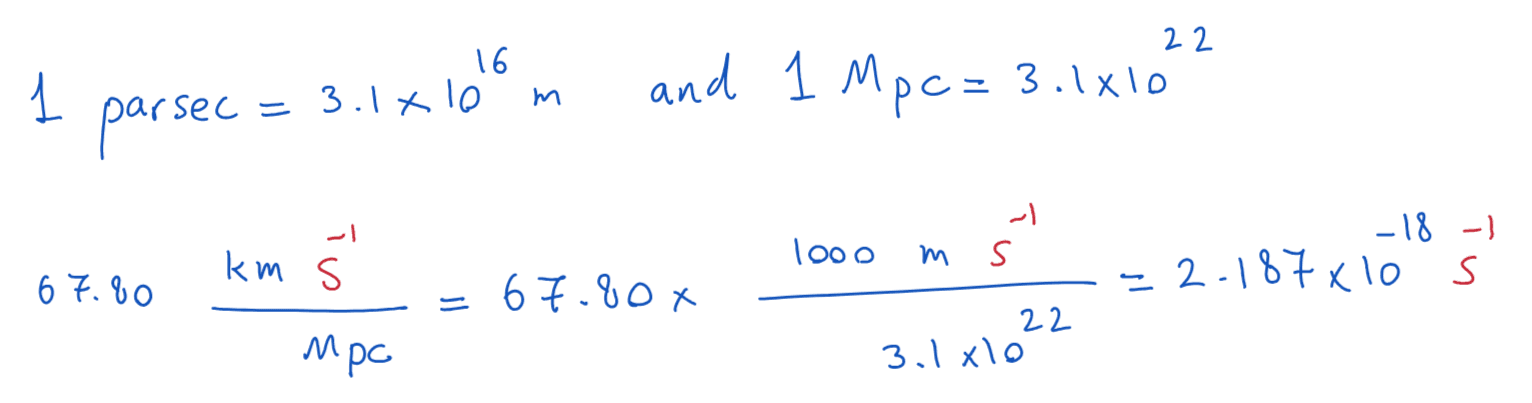
Latest figure for Hubble constant: 67.80 ± 0.77 kms-1 Mpc-1 or 2.2 × 10⁻¹⁸ s-1.
Example:
Convert Hubble constant: 67.80 kms-1 Mpc-1 to s-1.
Solution:
5.5.3-4 Cosmological principle
Says that, on a very large scale:
- the Universe looks the same in every direction (isotropic), so universe has no centre or edge;
- the distribution of matter is uniform in every place (homogeneous), so density of universe is uniform;
- And the laws of physics are universal over all time and space.
5.5.3-5 The Big Bang Theory
The Big Bang theory says the Universe began as a very hot, very dense point and has been expanding and cooling ever since. This point is the birthplace of time and space!
Two key pieces of evidence:
- Red-shift of galaxies (Hubble’s law) – almost all galaxies are moving away from us, showing the Universe is expanding.
- Cosmic microwave background (CMB) – faint microwaves coming from all directions, leftover heat from the early Universe.
The existence of CMB was predicted by the big bang even before its discovery by following explanations:
- At birth, the universe was very hot, and space was full of high energy gamma photons. As universe expanded so did the space, and this caused the wavelength of high energy EM wave to expand as well. And CMB we see today is the expanded version of the early gamma photons!
- It is estimated the temperature of the universe was 1028 K at birth! After expansion, the temperature drops to current 2.7 K. Using Wien’s displacement law, this temperature corresponds to a wavelength of about 1mm. Which is in the range of microwave.
5.5.3-6 Age of Miss Universe
Expansion of universe is not uniform, and it is getting faster!
But assuming universe has expanded uniformly since the big bang, using Hubble’s law we can roughly estimate the age of the universe:
- Assume our galaxy and a distant one were next to each other at the big bang;
- Because of expansion of universe, assume the distant galaxy is now moving with a constant speed of v since the big bang;
- If the distance of galaxy from us is d now, the time since we were next to each other is d/v.
Using Hubble’s law we get:
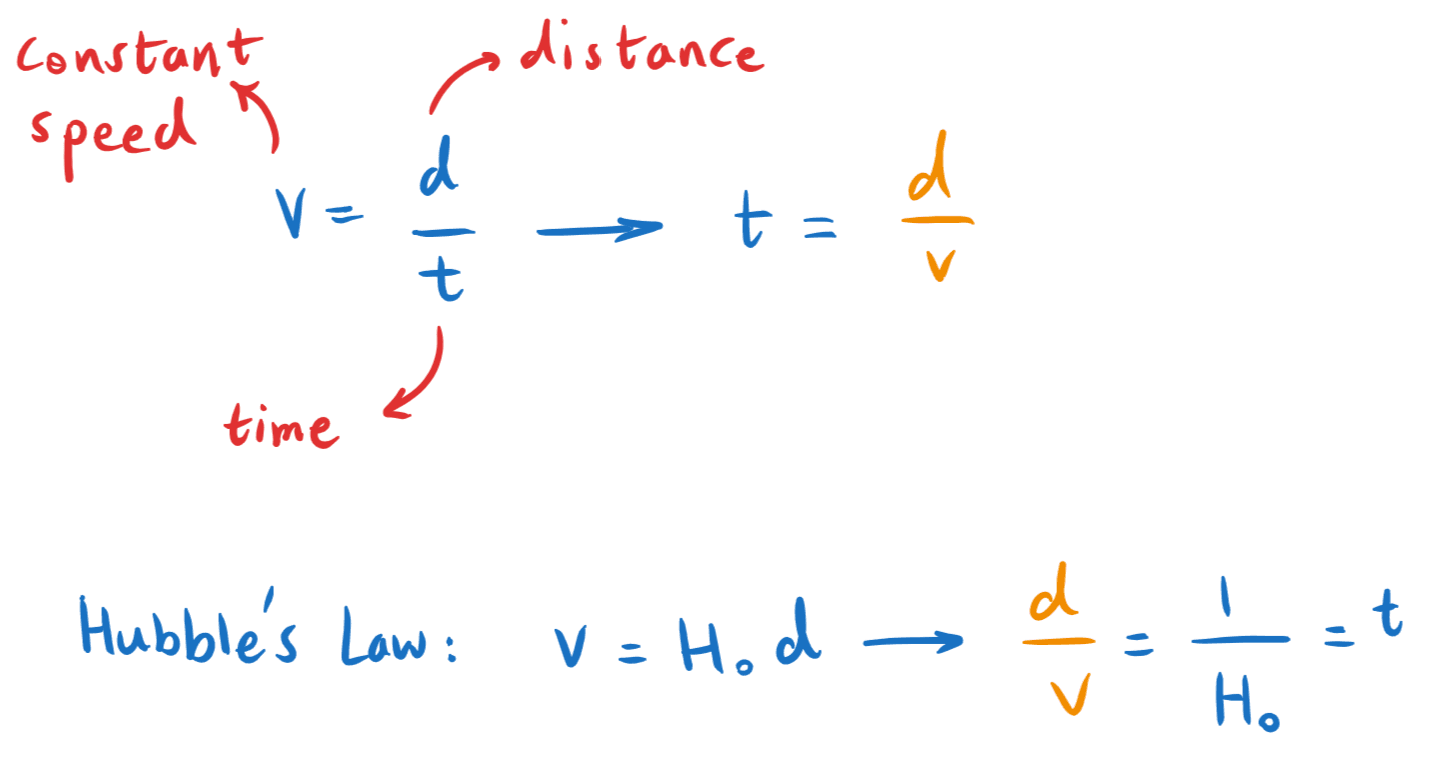
So time since the big bang is equal to inverse of Hubble’s constant.
Of course this a rough value as the Hubble’s constant itself has a large uncertainty, and universe expansion is accelerating, but we assumed it is uniform!
5.5.3-7 Absolute Darkness!
Dark Energy:
Expansion of universe is accelerating, this contradicts our understating of big bang, because according to Newton’s 2nd law, acceleration needs an external force. And if there has been no more source of force (energy or work) since the big bang, we have no idea what is the source of this accelerating expansion! We simply say there must be some dark energy out there! It is said to take up 68% of the universe!
Dark matter:
Studying our solar system e.g. moons of Jupiter, we see speed of an object decreases as its distance from centre of galaxy increases. This is expected because most of mass of solar system is at its centre. So same would be expected from other gravitational systems.
But studying the Doppler Effect from stars in other galaxies show that their speed increases when their distance from centre of galaxy increases!
This can only be explained if there is more matter in the galaxy not at its centre, and that we cannot see, providing the pull! We call this the dark matter! It is estimated dark matter makes up 27% of the universe.
Dark energy 68% + dark matter 27% = 95%
We only know 5% of our world! And that is what we think we know!
The mystery is yet to be solved by the next generation of scientists!
.
.
.
.
.
Revise and Get Paid!
If you like taking summary notes of lessons and solving past papers, see the Join Us page!