OCR Physics
Nuclear fission and fusion
6.4.4 Nuclear fission and fusion
Energy is the same as mass!
Total amount of energy and mass in a closed system is conserved.

If an object moves, it has more energy (KE), so it has more mass too!
For example if a woman with a mass of 60 kg is travelling on a plane with a speed of 250 m/s; we can calculate how much her mass changes:
Energy gain:

Gain in mass:

The gain in mass is more visible with subatomic particles moving at speeds close to speed of light!
In a radioactive decay energy is released to the surroundings, hence mass of the system decreases as well!
Which means total mass of the products is less than the parent nuclei. And the change in mass is equivalent to energy released.
6.4.4-1 Annihilation & pair production
Annihilation:
When a particle and its anti-particle collide they turn into energy in the form of two photons.
The two photons released move in opposite directions (conservation of momentum).
The energy of the photons depend on mass of the particles and their KE.
Pair production:
When a high energy photon turns into mass, and a particle and its anti-particle are created.
The mass and KE of the particles created is equivalent to energy of the photon.
Example 1:
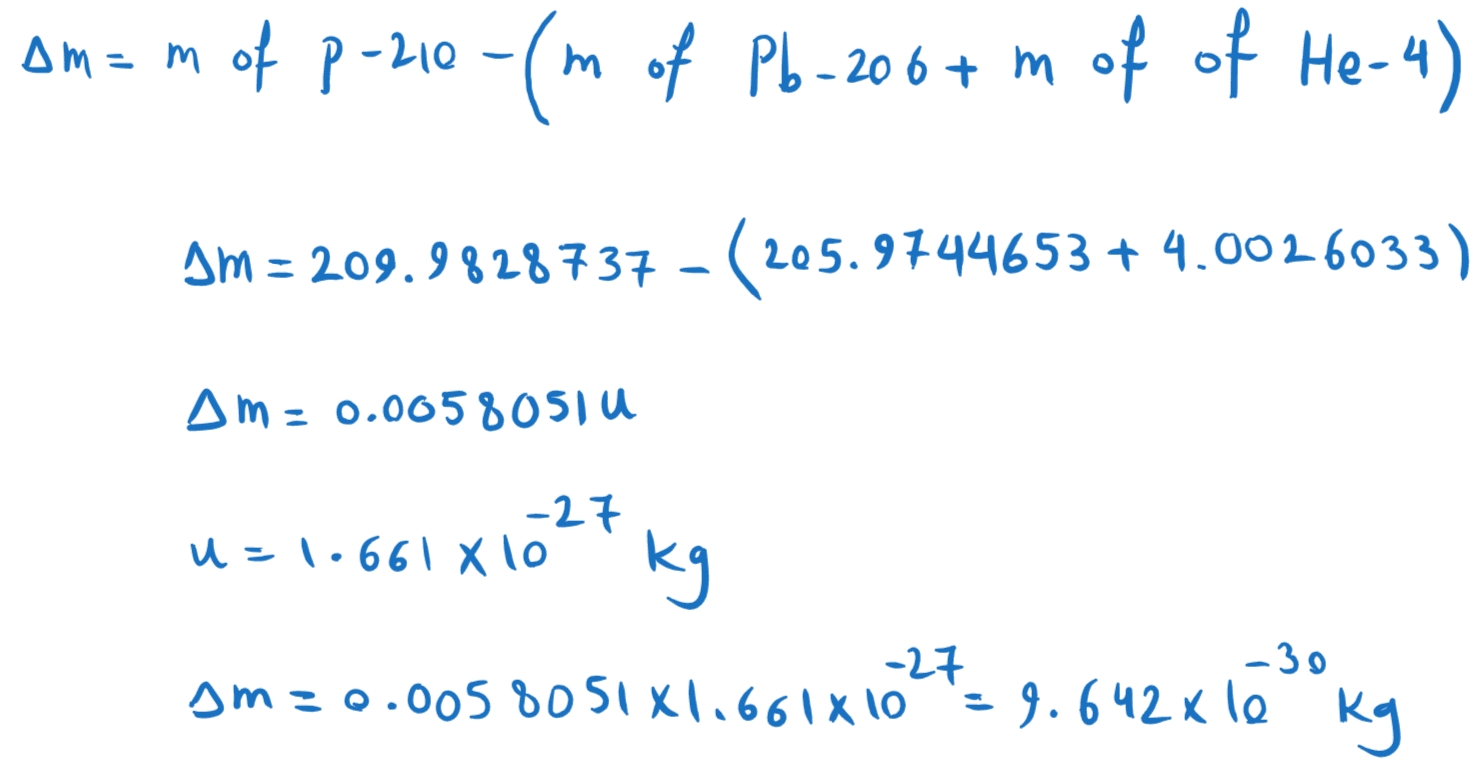
Calculate the energy release in the following alpha decay from a nucleus of a polonium-210.

Mass of polonium-210 = 209.9828737 u
Mass of lead-206 = 205.9744653 u
Mass of helium-4 = 4.0026033 u.
Solution:
Calculate the mass defect:
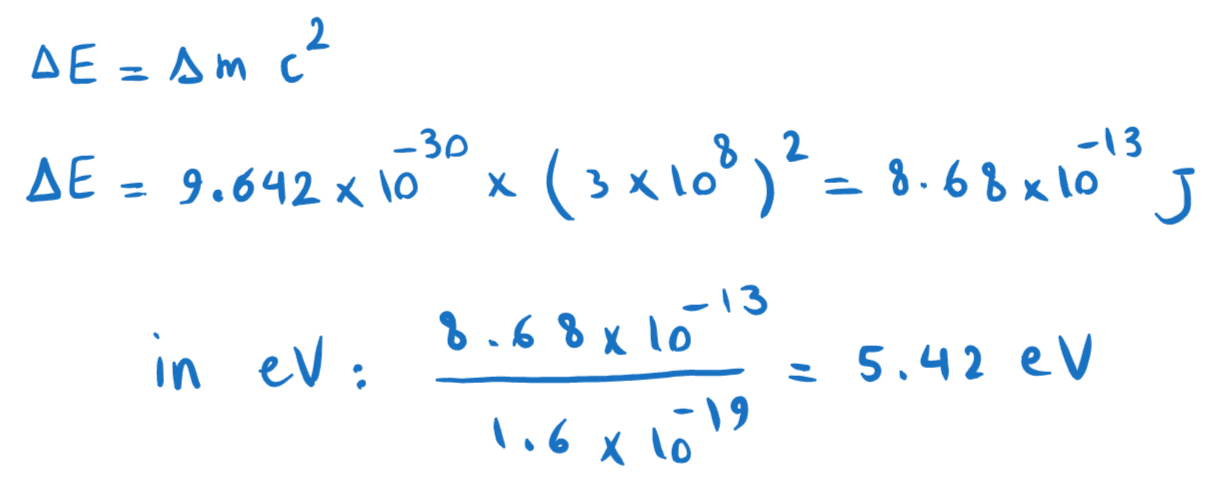
Convert mass defect to energy released:
6.4.4-2 Binding energy (BE)
An isotope of hydrogen is deuterium which has 1 proton and 1 neutron in its nucleus.
These two particles are bound together in the nucleus with strong nuclear force.
To separate them, we need to spend energy on the nucleons. So total energy of the system increases.
As mass and energy are equivalent, this means total mass of the system increases.
Which means the sum of masses of individual proton and neutron when separated, is more than their mass when bound together in the nucleus.
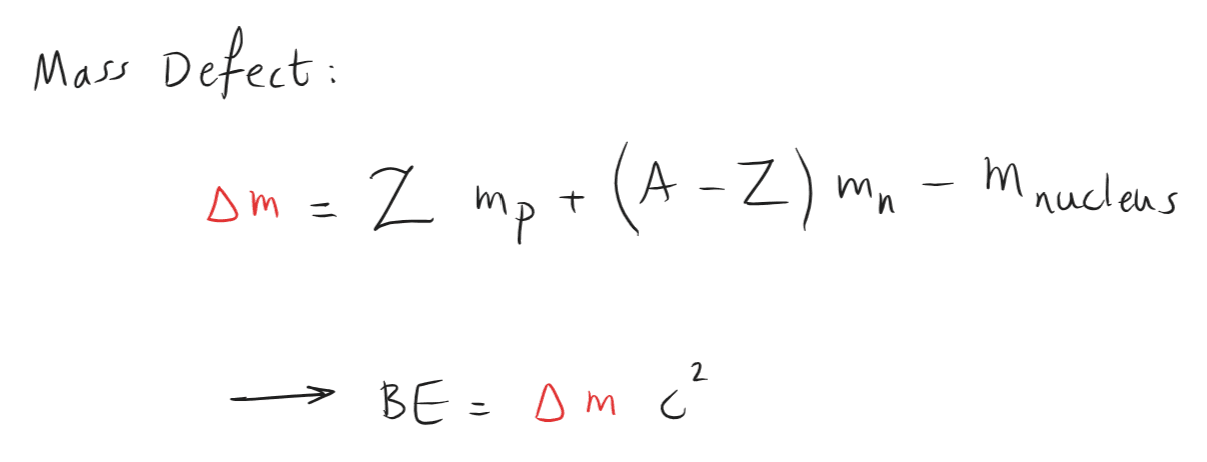
The difference in mass is called mass defect (Δm).
Example 2:
Calculate the energy released when a deuterium nucleus (an isotope of hydrogen:  ) is formed by joining a proton and a neutron.
- Mass of deuterium nucleus itself = 3.344512 x 10⁻²⁷ kg (or 2.013553 u)
- Mass of a proton = 1.673 x 10⁻²⁷ kg (or 1.007276 u)
- Mass of a neutron = 1.675 x 10⁻²⁷ kg (or 1.008665 u)
Solution:
Deuterium: has 1 proton and 1 neutron.
Mass defect (Δm):
Δm = (Mass of protons + Mass of neutrons) − Mass of nucleus
Mass of constituents added: 1.673 x 10⁻²⁷ kg + 1.675 x 10⁻²⁷ kg = 3.348 x 10⁻²⁷ kg.
(1.007276 u + 1.008665 u = 2.015941 u)
Δm: 3.344512 x 10⁻²⁷ - 3.348 x 10-27 = (-) 0.003488 x 10⁻²⁷ kg.
(Or 2.015941 u - 2.013553 u = 2.388 x 10⁻³ u)
Convert the mass defect to energy:


This is equivalent to about 2 MeV.
This also means to split a deuterium nucleus 2 MeV energy is needed to be spent on the nucleus!
Also means if a deuterium nucleus is formed from a proton and neutron, 2 MeV is released, because mass is lost and converted to energy!
This energy is called the binding energy!
Binding energy: minimum energy needed to separate the constituent nucleons of a nucleus.
To split a nucleus: external energy is spent on the nucleus à total mass increases.
To construct a nucleus: total mass decreases à energy is released.
The work in constructing the nucleus is done by the strong nuclear force and because we don’t do the work (work is done by the system itself) the energy of the system decreases.
In spontaneous decay, fission and fusion, the total binding energy of the products (all added together) is always more than the binding energy of the parent. But after the decay, fission, and fusion the totalmass of the products is less than the parent.
Fusion increases total binding energy only up to iron (Fe-56). For elements heavier than iron, fusion needs a lot of energy to happen and the mass of the product is more than mass of the parents. Meaning binding energy of products is less than the parent! That’s why for elements heavier than iron, fission is more likely to happen!
Binding energy of any particle on its own is zero!
6.4.4-3 Binding energy per nucleon (BEPN):

The higher the binding energy per nucleon, the more stable the nucleus, as the nucleons are more tightly bound.

Observations from the graph:
- When two low nuclei with low nucleon number fuse together, BEPN of product is more than the parents, and energy is released;
- When a high nucleon number undergoes fission, the BEPN of products is more than that of the parent and energy is released.
- Iron-56 (
 ) has the highest binding energy per nucleon and is the most stable isotope found in nature.
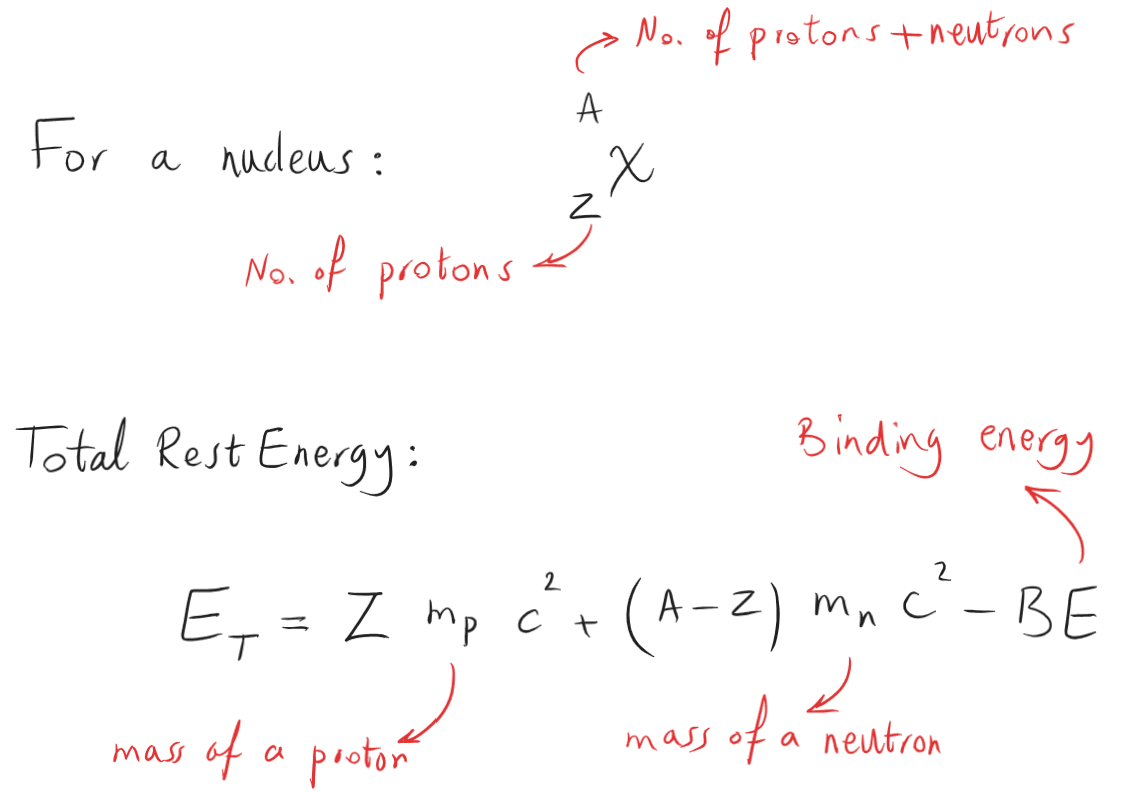
6.4.4-4 Total rest energy
This topic is not explicitly in OCR specification, but comes up in questions as you will see in the example that follows from the 2018 paper.
Example 3: (OCR 2018 – P2 – Q25)
Reaction below shows collision of a proton with kinetic energy of 0.25 × 10⁻¹¹ J with nucleus of oxygen-18.

Binding energy of nucleus of  = 2.20 × 10⁻¹¹ J
Binding energy of nucleus of  = 2.24 × 10⁻¹¹ J
Estimate the minimum wavelength of the gamma photon γ emitted (3).
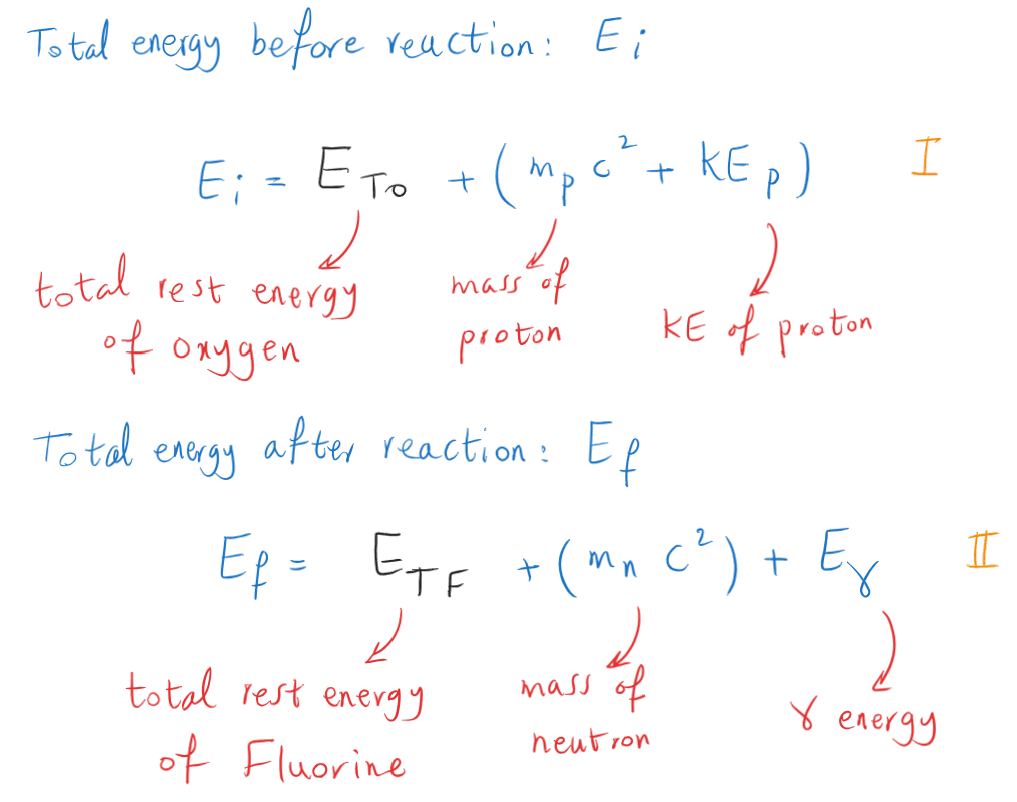
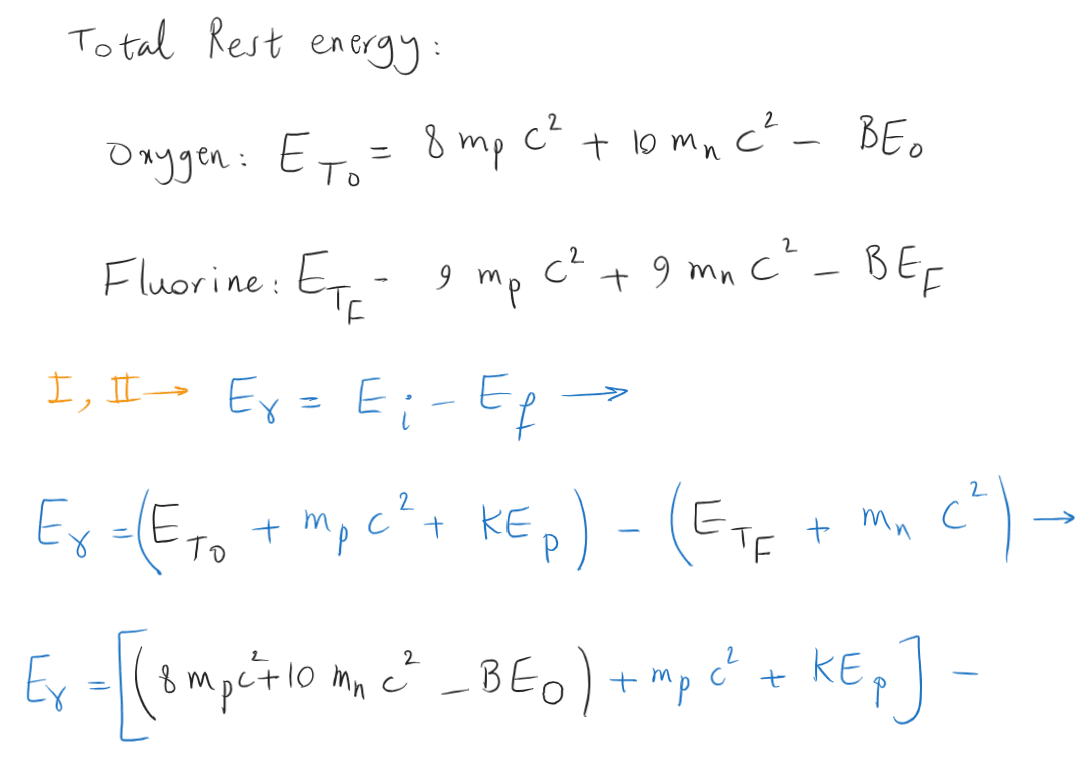
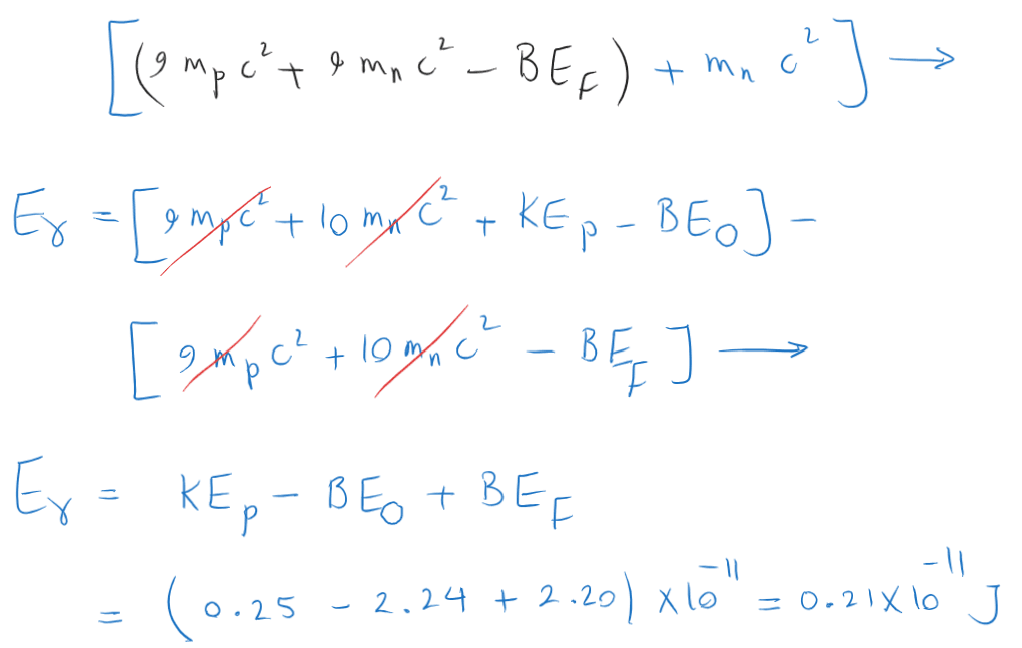
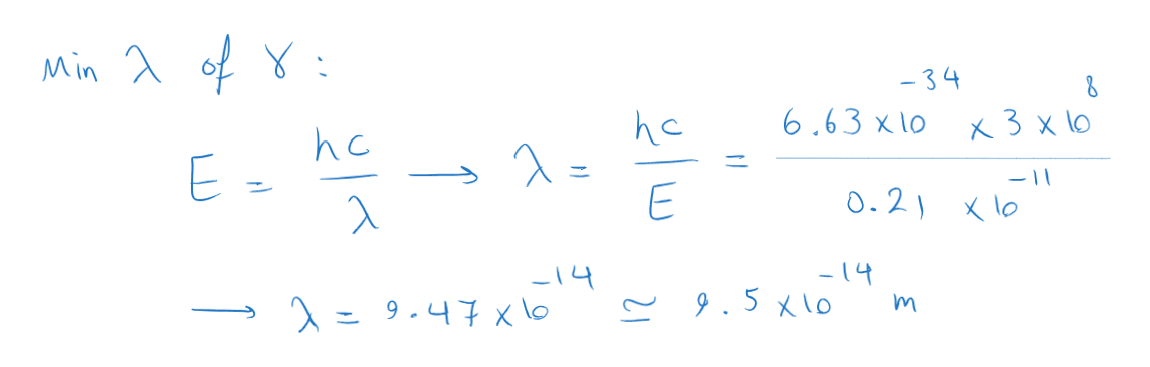
This of course could be explained a little easier:
In any nuclear reaction, the energy released (or absorbed) comes from the difference in total binding energy between products and reactants, plus any initial kinetic energy.
1: Energy from binding energy change
The total binding energy of the system initially:
Oxygen-18 nucleus: BEO
Proton: 0 (single nucleon has no binding energy)
Initial total binding energy = BEO
Final total binding energy:
Fluorine-18 nucleus: BEF
Neutron: 0
Final total binding energy = BEF
Step 2: Where does the energy go?
When nucleons rearrange into a more tightly bound system (or less tightly bound), the change in binding energy appears as kinetic energy of the products or as a photon.
Here, BEF is less than BEO by:
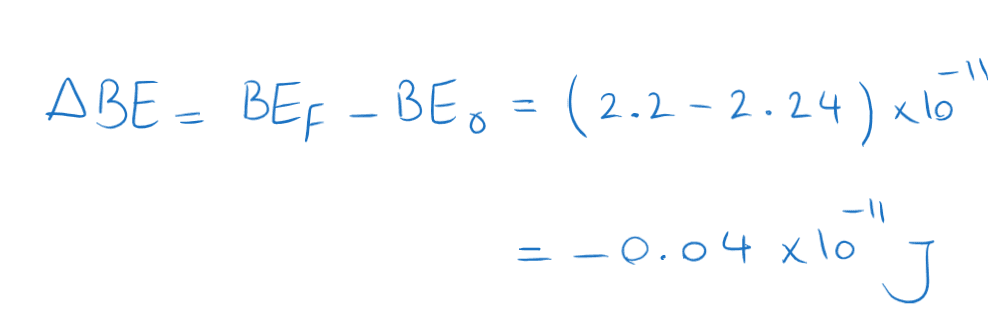
That’s negative, meaning the products are less tightly bound than the reactants. So, if there were no initial kinetic energy, the reaction would actually require energy input (endothermic).
Step 3: Including proton’s kinetic energy
The proton provides initial kinetic energy EKp=0.25×10⁻¹¹ J.
This energy can:
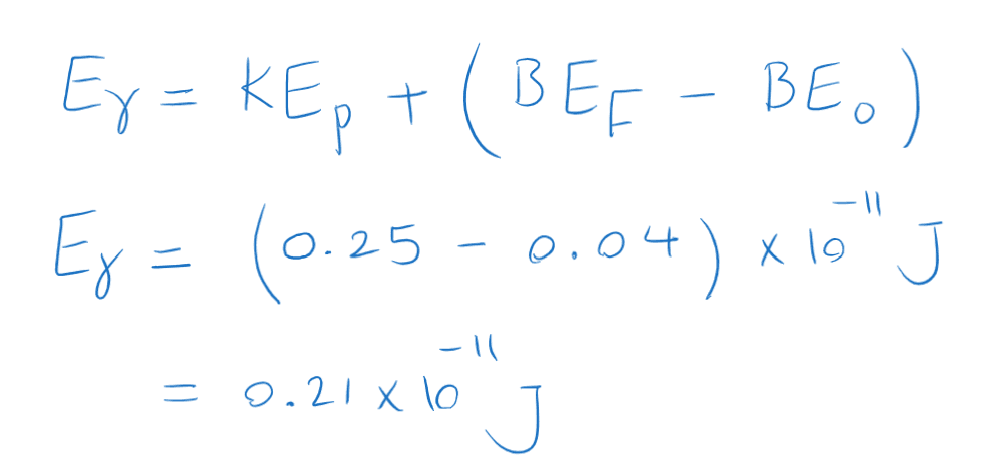
- Supply the “deficit” from the binding energy change (∣BEF −BEO ∣)
- Any leftover becomes the gamma photon energy (assuming products are at rest for minimum wavelength)
So:
6.4.4-5 Nuclear fission
A nucleus of Uranium-235 absorbs a slow moving neutron.
The resulting Uranium-236 is very unstable and in less than a microsecond spontaneously decays into two daughter nuclei, and three fast moving neutrons are also produced.
A possible decay fission equation of uranium-235:

Energy released from fission:
- Total mass of products is less than the parents. The difference in mass is equivalent to energy released, or;
- Total binding energy of products is more than parents. The difference in binding energy is equal to energy released.
Example 4:
(a) State what is meant by the binding energy of a nucleus. (1)
Work done to separate a nucleus into its constitutional nucleons
A possible fission of U-235 can be represented by:

The table below gives the binding energy per nucleon for each nuclide in the fission.
Nuclide | Binding energy per nucleon / MeV |
U-235 | 7.59094 |
Cs-136 | 8.38981 |
Rb-97 | 8.37460 |
(b) Calculate, in J, the energy released in this reaction.
235 x 7.59094 = 1783.8709 MeV
(136 x 8.38981) + (97 x 8.37460) = 1953.35 MeV
1953.35 - 1783.8709 = 169.47946 MeV
169.47946 x 106 eV X 1.6 x 10-19 = 2.71 x 10⁻¹¹ J
(c) The average energy released by the fission of a U-235 nucleus in a reactor core is 3.2 × 10⁻¹¹ J.
The fission of U-235 generates a power of 1.5 GW in the core.
Calculate the average mass of U-235 that undergoes fission in one second in this reactor core.
Molar mass of U-235 = 235 g
1.5 x 109 = E / T
1.5 x 10⁹ / 3.2 x 10⁻¹¹
4.6875 x 10¹⁹ fissions
(4.6875 x 10¹⁹) / 6.02 x 10²³
7.787 x 10-5 mol x 0.235
1.83 x 10⁻⁵ kg
.
Nuclear reactors:
- Fuel rods (made of enriched uranium mostly U-238, and 2-3% U-235) are distanced equally.
- Uranium absorbs slow moving neutrons, the moderator slows the fast moving neutrons from previous fissions.
Moderators are made of cheap and abundant material (such as water or carbon) and must absorb the neutron. Water can act as coolant too.
- As from each fission three neutrons are emitted, if they all slow down and be absorbed by fuel rods again, a chain reaction occurs, and the energy produced gets out of hand! Control rods are lowered between the fuel rods to make sure only one neutron is passed over to other fuel rods.
Material in control rods absorbs neutrons. They are made of boron or cadmium.

(image has been modified)
Environmental impacts of nuclear reactors:
Neutrons with medium speed are absorbed by U-238 and rapidly decays into plutonium-239, with half-life of 24’000 years, which is highly radioactive and toxic.
Pu-239 is a nuclear waste.
Nuclear waste must be buried underground for centuries, far from our water or food resources. The location of burial should not be disturbed by earthquakes, explosions etc.
Many groups are advocating for cleaner and safer sources of energy such as wind and solar.
6.4.4-6 Nuclear fusion
- All nuclei are positively charged and repel each other.
- For fusion nuclei should be brought close to each other (few fm (10-15 m) from each other).
- This happens under high temperature and pressure, like the core of the Sun.
- Then strong nuclear force attracts and join them.
An example of fusion:
Two protons fuse to form a deuterium isotope of hydrogen.
In the process one of the protons decays into a neutron via weak nuclear force.

Binding energy of individual proton is zero.
Binding energy of deuterium is 2.2 MeV. This is the energy released in the fusion process.
Another fusion that may happen:
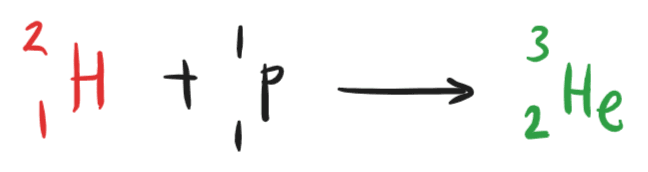
In this process 5.5 MeV is released.
Or the helium from this fusion can fuse with another helium:
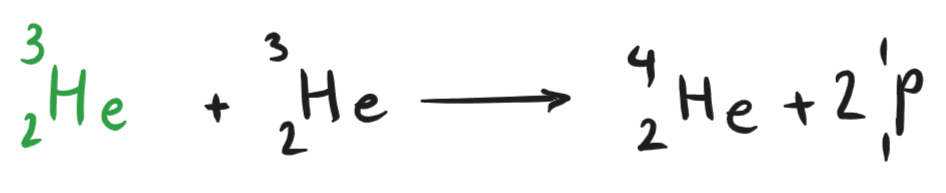
This one releases 12.9 MeV of energy.
And the two protons produced go on to fuse with each other!
The cycles repeats! This is called proton-proton or hydrogen burning cycle.
We have done fusion on small scales in labs. Fuel is deuterium and tritium:

This process releases 17.9 MeV energy.
.
.
Revise and Get Paid!
If you like taking summary notes of lessons and solving past papers, see the Join Us page!