OCR Physics
Particles
6.4.2 Particles
All particles have an anti-particle, which have the same mass but opposite charge (if charged!).
To show anti-particles we draw a bar on top of the symbol:
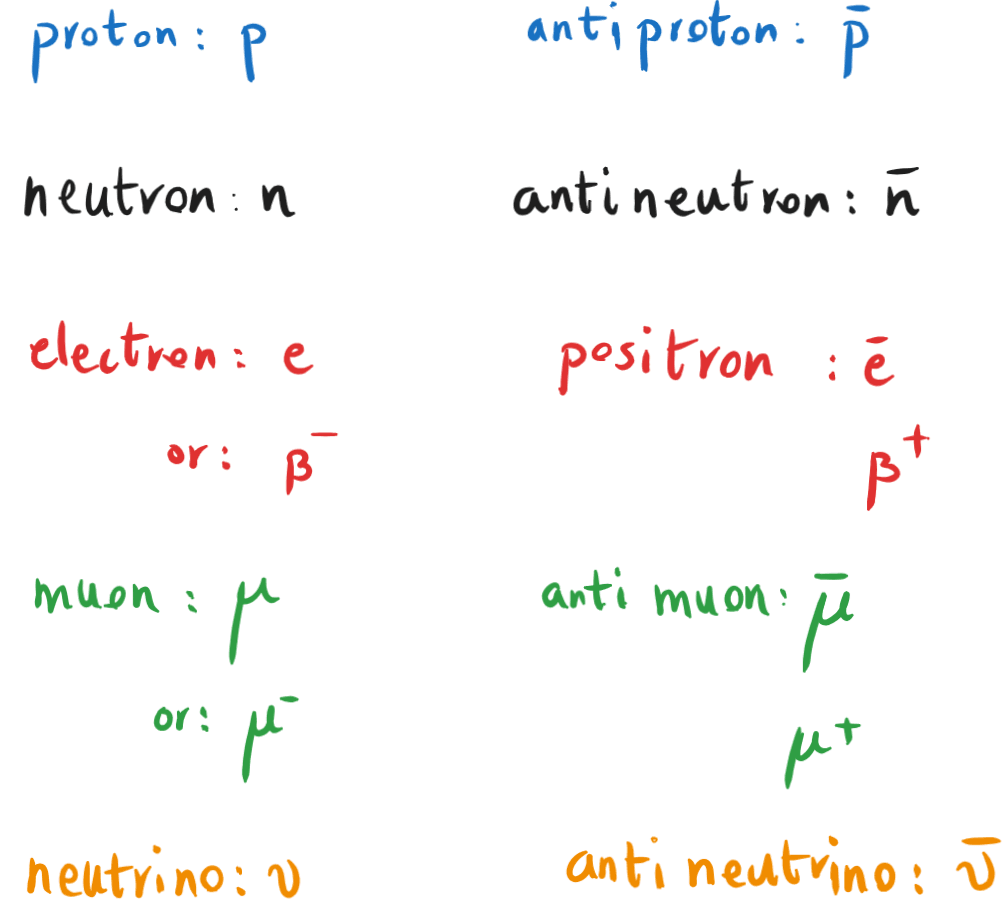
6.4.2-1 Classification of particles
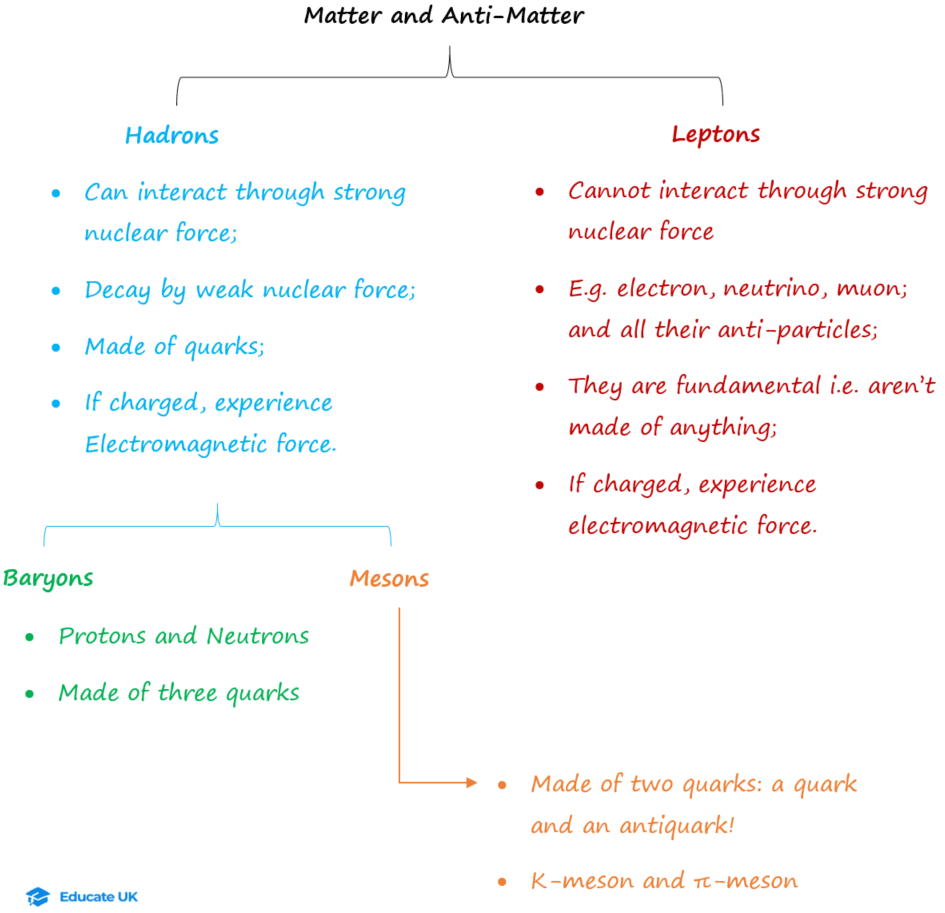
6.4.2-2 Hadrons
All hadrons are made of quarks:
Quarks | Anti-quarks | ||||
Name | symbol | charge | Name | Symbol | charge |
up |
|
| Anti-up |
|
|
Down |
|
| Anti-down |  |
|
strange |
|
| Anti-strange |
|
|


Quark combinations of Baryons:
Particle | Quark composition | Anti-particle | Quark composition |
Proton |
| Anti-proton |
|
Neutron |
| Anti-neutron |
|


Charge of a proton = +1 à uud = 
Charge of a neutron = 0 à udd = 
Quark combination of mesons:
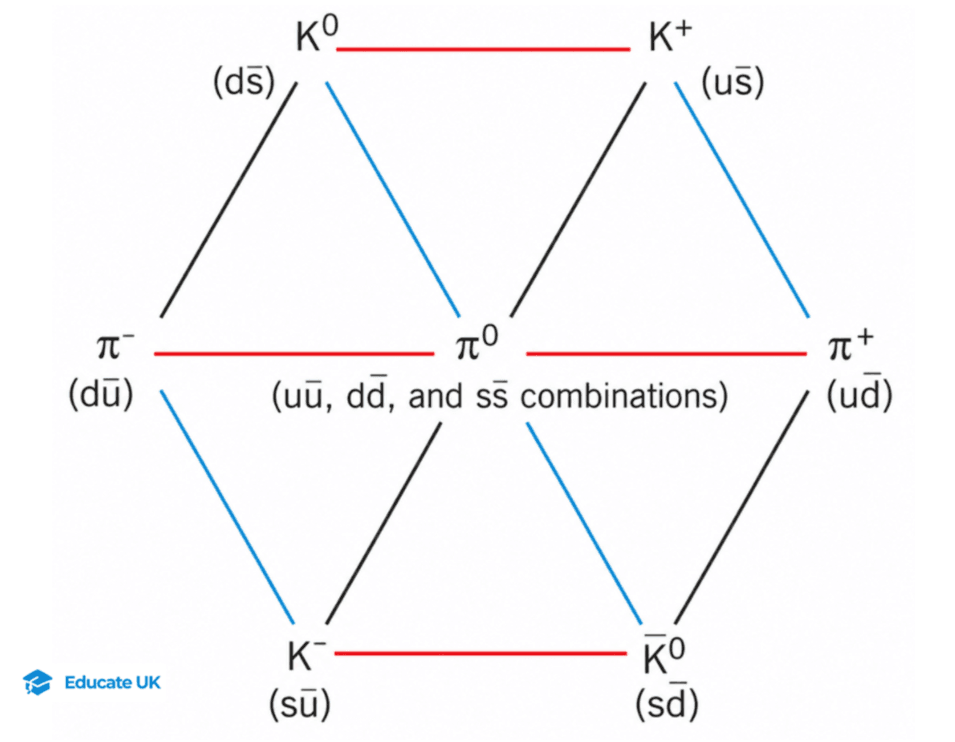
6.4.2-3 Leptons
Leptons are not made of anything. We call them fundamental or elementary particles.
You already know electrons, or  ; and its anti-particle: positron:
Neutrino does not have charge, extremely small mass, almost zero!
Two types that you should know:
- Electron neutrino:

- Electron anti-neutrino:

Beta-minus ( ) decay
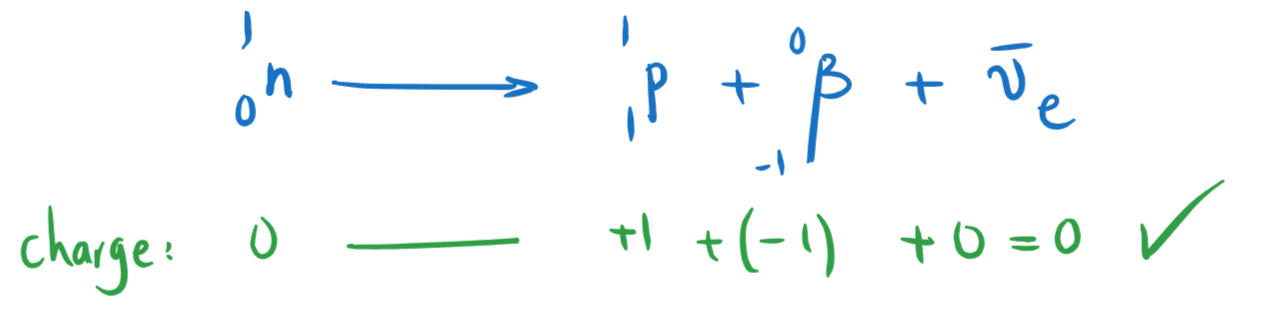
A neutron in the nucleus decays into a proton. Then an electron and an Electron anti-neutrino are ejected:
Charge on both sides of an interaction should be equal (conservation of charge!).
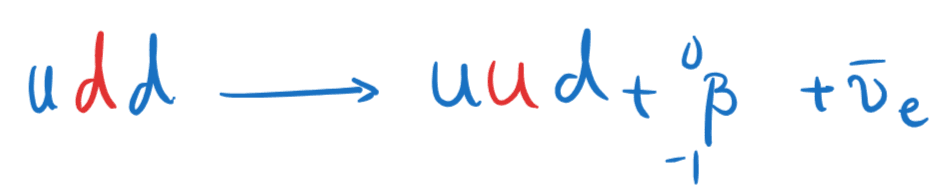
Looking at it from quarks transformation perspective.
Which can be written only with the changing quarks:
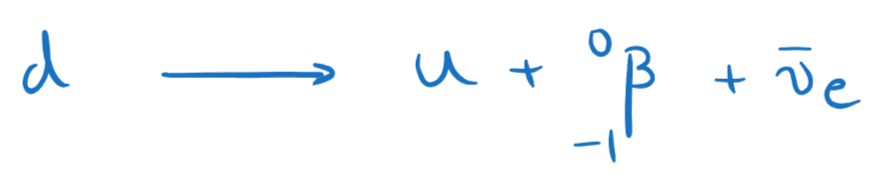
If you check the charge for individual quarks, that should be conserved as well!
Beta-plus ( ) decay
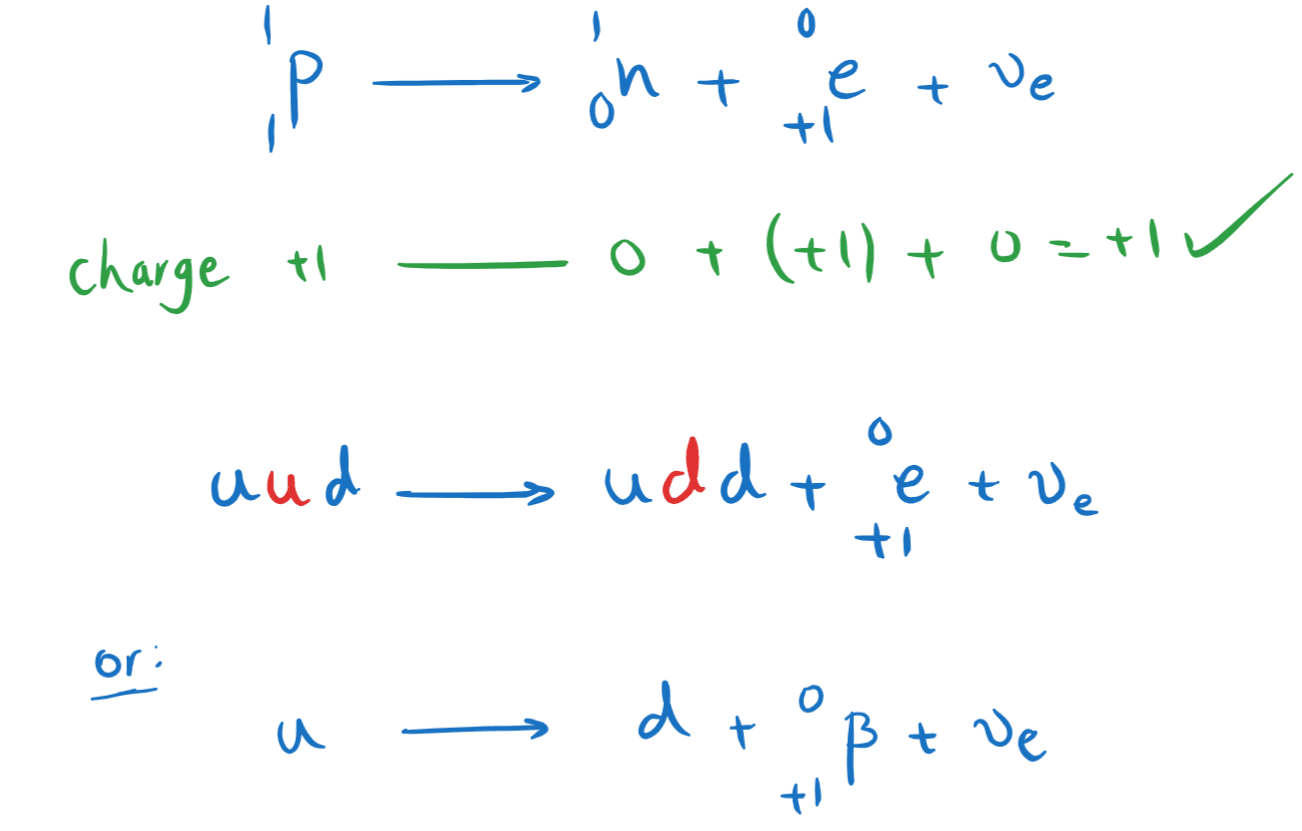
A proton inside the nucleus decays into a neutron. Then a positron, and electron neutrino are ejected.
Four fundamental forces
Fundamental force | Range | Exchange particle | Relative strength | Effect |
Strong nuclear | 10-15 m | Gluon | 1 | In nucleus |
Weak nuclear | 10-18 m | W+ or W- | 10-6 | Beta-decay |
Gravitational | Infinite | Graviton | 10-40 | Masses |
Electromagnetic | Infinite | Photon | 10-3 | Charges |
.
Revise and Get Paid!
If you like taking summary notes of lessons and solving past papers, see the Join Us page!