OCR Physics
Radioactivity
6.4.3 Radioactivity
Radioactive decay is a random and spontaneous process.
It is random because:
- At any moment, we don’t know which nucleus is going to decay;
- We don’t know when a specific nucleus is going to decay.
It is spontaneous because:
- No external factor (e.g. temperature or pressure) affects the decay of a nucleus;
- Decay of other nuclei does not affect decay of a nucleus either.
Different types of radiation emitted by radioactive material:
- Alpha - α
- Beta - β
- Gamma – γ
| Property | Alpha (α) | Beta (β) | Gamma (γ) |
|---|---|---|---|
| Nature | Helium nucleus (2 protons, 2 neutrons) | High-energy electron (β⁻) or positron (β⁺) | Electromagnetic wave (photon) λ<10-13m |
| Penetration | Low (stopped by paper or skin) | Moderate (stopped by 1-3 mm aluminium) | High (penetrates most materials, stopped by few centimetres of lead or concrete) |
| Range in Air | Few centimetres (≈5 cm) | Few meters (≈1–2 m) | Several meters to kilometres |
| Ionisation | High | medium | Low |
All of the above radiations are ionising, because they can remove electrons from an atom.
This makes them dangerous and that’s why they are kept in boxes with lead lining.
6.4.3-1 Separating radiation
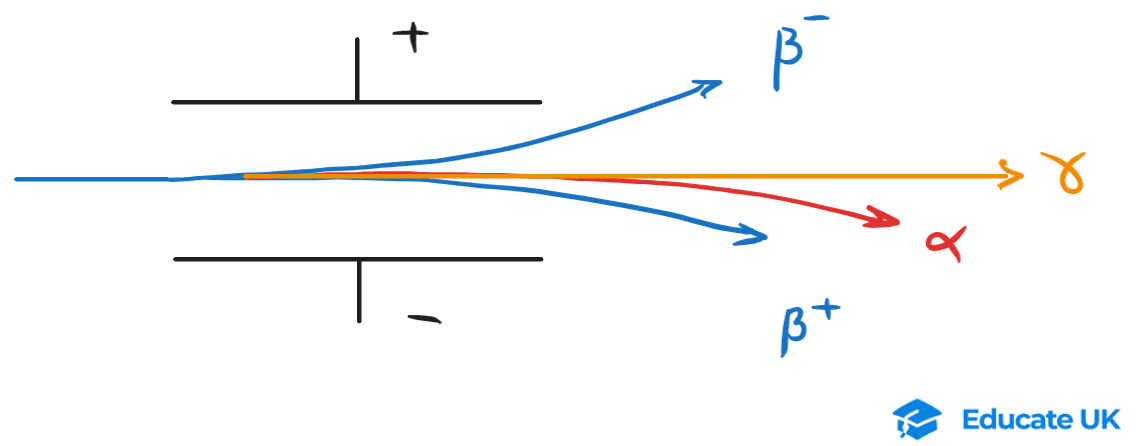
To separate the radiations from a source, they are passed through either an electric or magnetic field:
In an electric field:
- Alpha deflects less than positron, because its mass is bigger;
- Gamma does not deflect because it’s not charged.
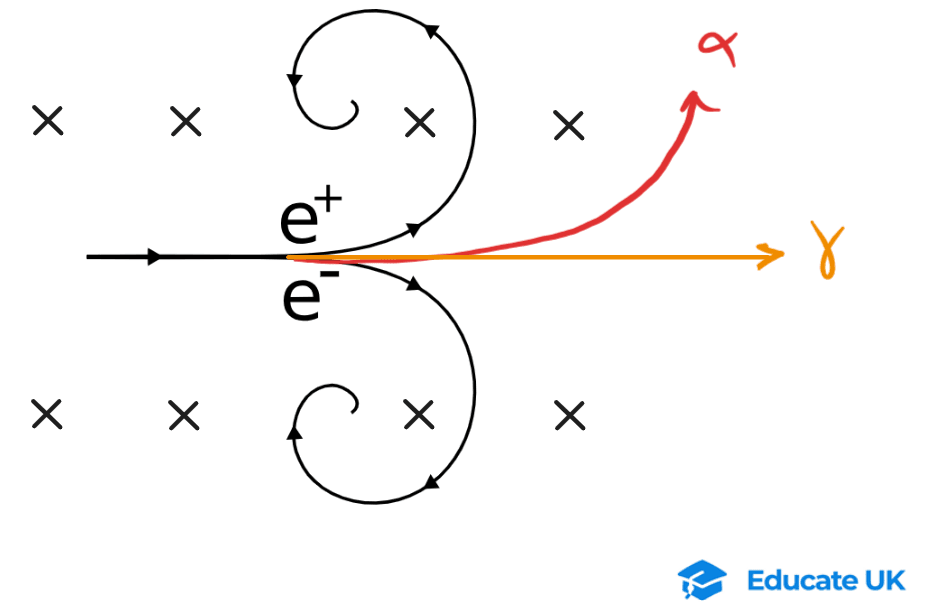
In a magnetic field:
- Use Fleming left hand rule to determine the direction of force on the particles;
- Force from magnetic field is always perpendicular to the velocity of particles, hence they move in a circular path;
- Force does not change the speed (because they are perpendicular);
- Gamma does not deflect as it has no charge;
- In the figure below, direction of magnetic field is into the page.
6.4.3-2 Some definitions
Geiger-Muller (GM) tube: a radiation detector usually connected to a counter.
Count rate: number of radiation received by a detector (e.g. Geiger-Muller tube) per second.
Background radiation: the radiation present in the room coming from walls, the earth, cosmic rays, food, people, nuclear tests, hospitals, etc…
Corrected count rate: count rate – background radiation.
Activity (A): all radiation released from a source per second; or “the rate of decay of nuclei” =  (unit: Becquerel (Bq) or decay per second).
Decay constant (λ): probability of decay of a nucleus per unit time (unit: 1/s or s-1 or hour-1 or year-1‑, but not Bq!). But always use the s-1 in questions.
More explanation as why in section 6.4.3-6: Activity and decay constant.
Atomic mass unit (u): one-twelfth of mass of neutral carbon-12 atom.
1 u = 1.661 × 10⁻²⁷ kg.
6.4.3-3 Radiation absorption
Figure below shows the setup used to investigate which material with what thickness can absorb different types of radiation:
Image for experiment…
- The distance between the source and GM tube is kept constant;
- Different material and thicknesses are placed as the absorber;
- Measure background radiation;
- Calculate the corrected count rate for each absorber;
- Determine which material and thickness can stop each type of radiation.
6.4.3-4 Decay equations
All radiations originate from the nucleus.
Nucleus before decay is called parent nucleus, and after, is called daughter nucleus!
In decay equations the proton number, and the mass number is conserved i.e. total before and after the decay must be the same.
Alpha decay:
A nucleus ejects two protons and two neutrons.
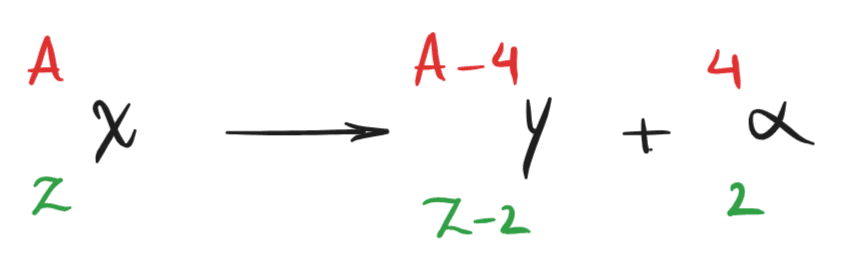
Because the daughter nucleus has different number of protons, we write it with a different letter (Y), because it is a different chemical element!
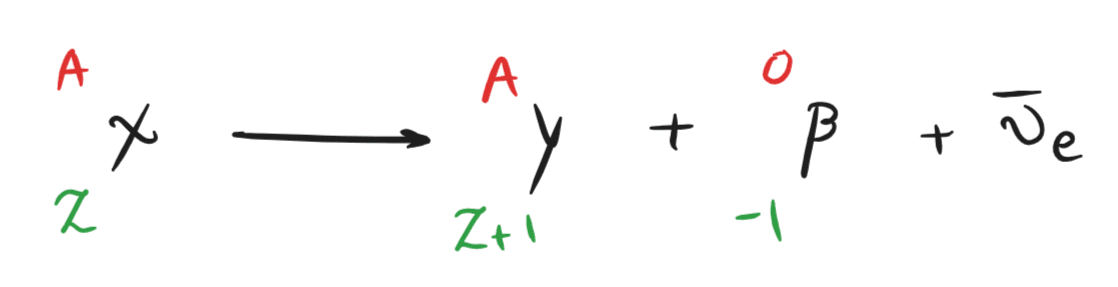
Beta-minus decay:
Happens in nuclei with too many neutrons.
A neutron in the nucleus changes to a proton and an electron, then the electron is emitted at high speed.
It happens by weak nuclear force.
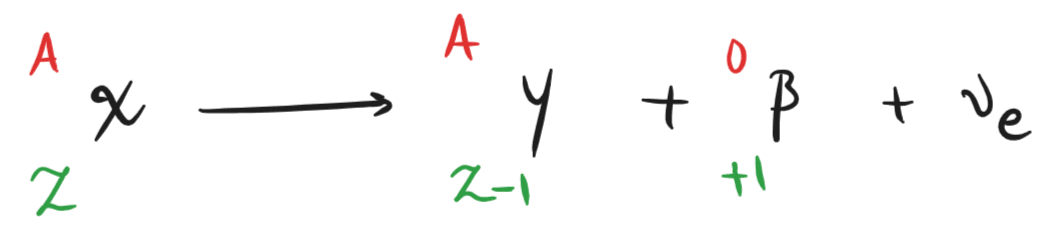
Beta-plus decay:
Happens in nuclei with too many protons.
A proton in the nucleus changes to a neutron and a positron, then the positron is emitted at high speed.
It happens by weak nuclear force.
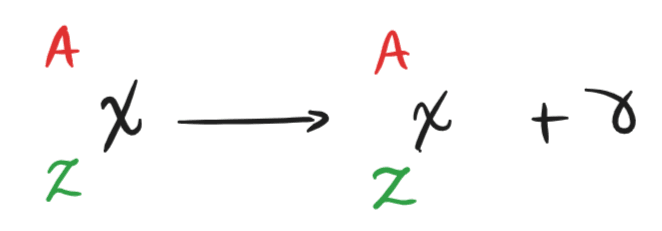
Gamma decay:
Happens following an alpha or beta decay, if the nucleus has extra energy.
6.4.3-5 Half-life and decay calculations
Half-life (t1/2): time taken for half of the active (undecayed) nuclei to decay.

Simulation of radioactive decay using dice:
Imagine we take a large number of dice, e.g. 1296, and we throw them all at the time same time.
If the dice are fair, probability of getting a 3 (as with any other number) on the top of the die is 1/6.
Assume getting a 3 means the die decays!
In this example, each throw is the time passed for λ% of the die to decay! (decay constant λ = 1/6)
So we expect to get  number 3 on the top faces of all of them.
So 1296 – 216 = 1080 remain undecayed, which is  of 1296.
After the second throw:  die decay.
And 1080 – 180 = 900 remain undecayed which is  of 1296!
Decay of nuclei follows the same exponential pattern.
Each throw represents 1 second of time!
6.4.3-6 Activity and decay constant:
Decay constant (λ): probability of decay of a nucleus per unit time (unit: 1/s or s-1 or hour-1 or year-1‑, but not Bq!).
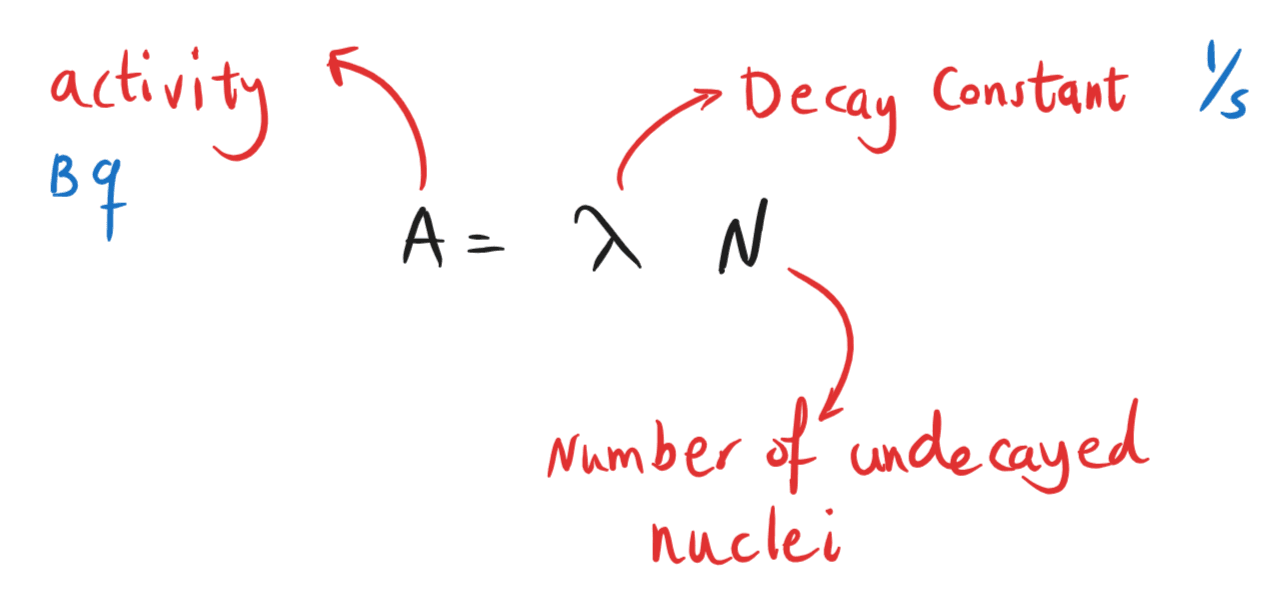
The number of nuclei (N) in a sample is measured with a mass spectrometer.
Decay formulae:
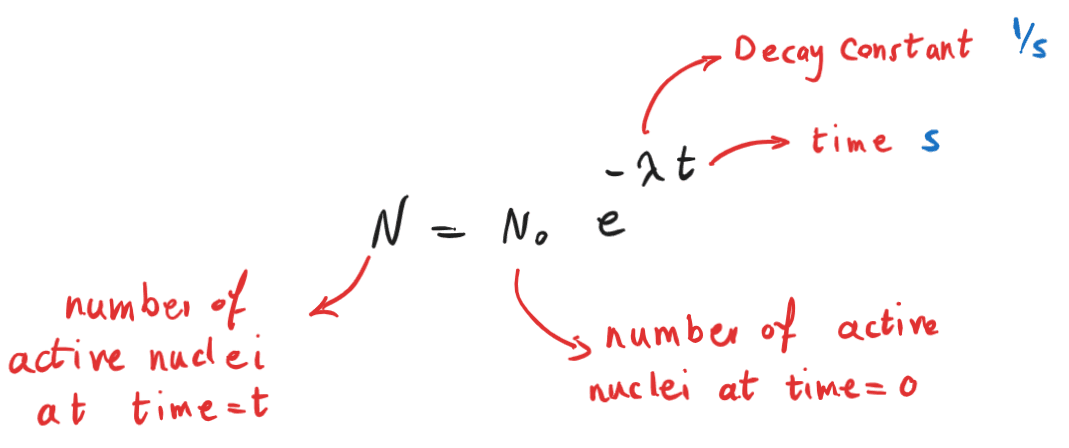
Activity is directly proportional to number of undecayed nuclei, so:
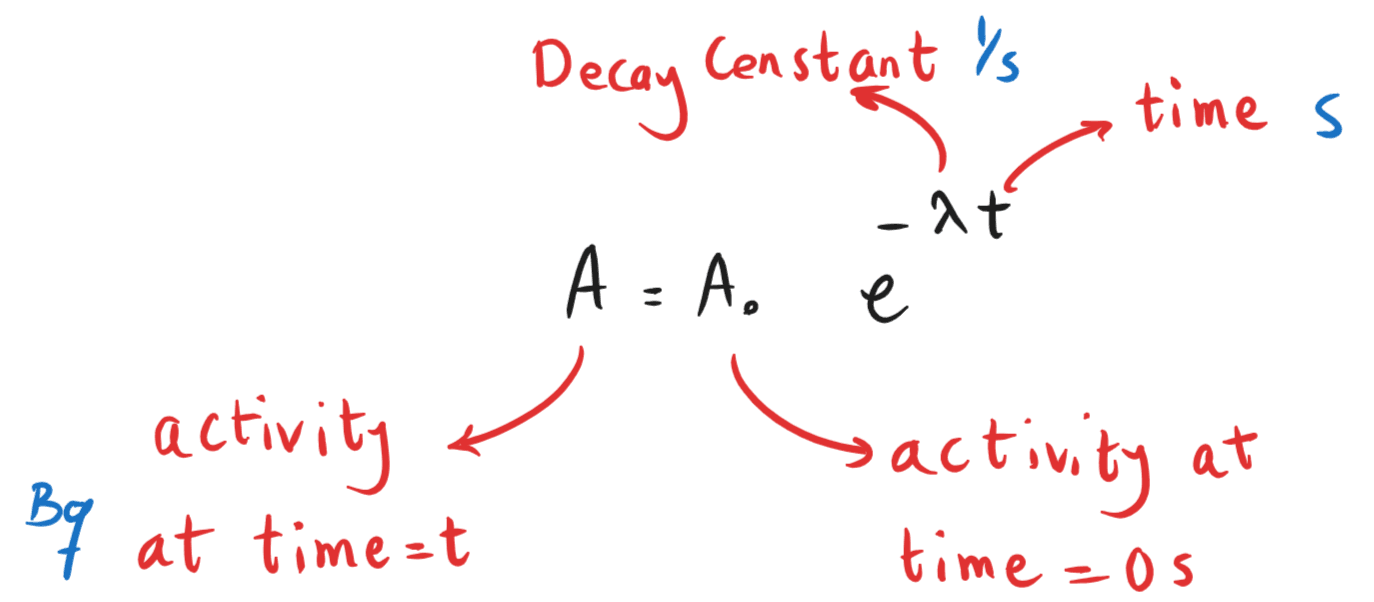
So I told you it is better to use s-1 as the unit for λ.
Take a look at this questions to understand why:
Example 1:
OCR 2018
The activity of a sample of lead-209 ( ) is 12 kBq after 7 hours. If half-life of lead-209 is 3.3 hours, determine the initial number of lead nuclei in the sample. (4)
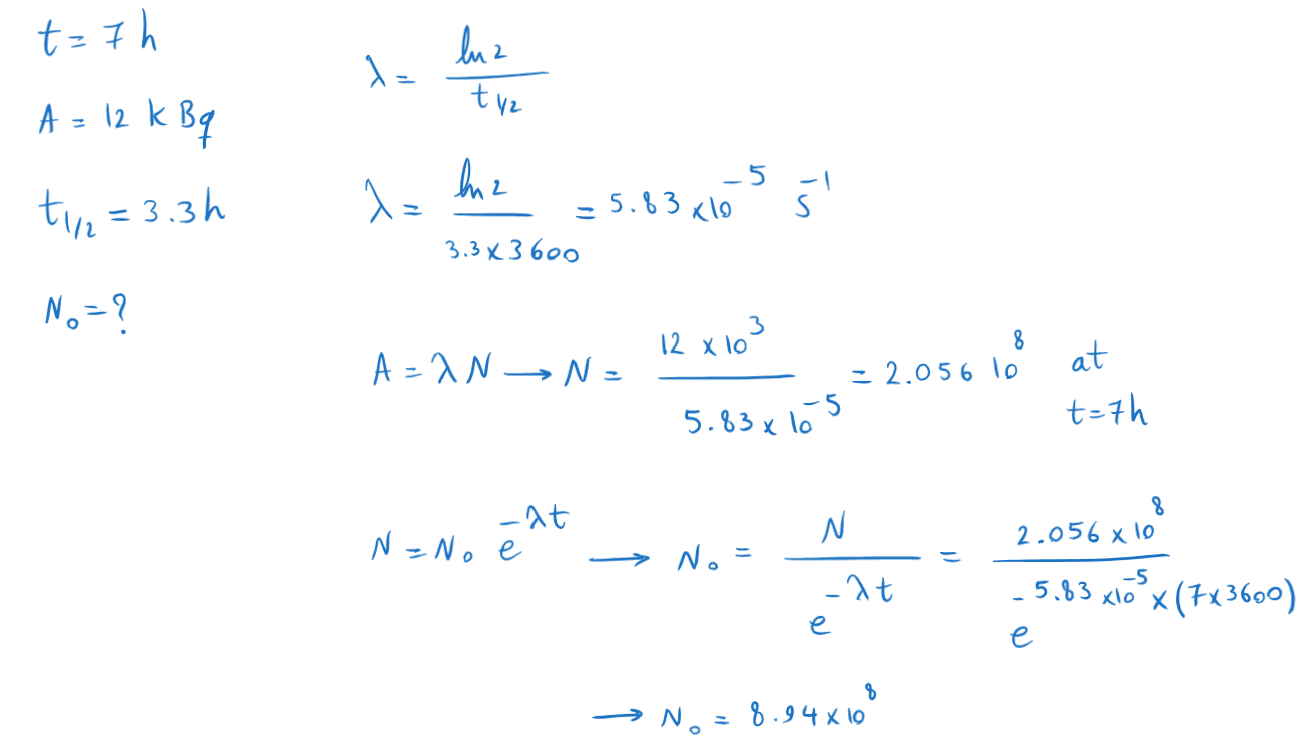
But if we keep everything in hours, this is what we get:
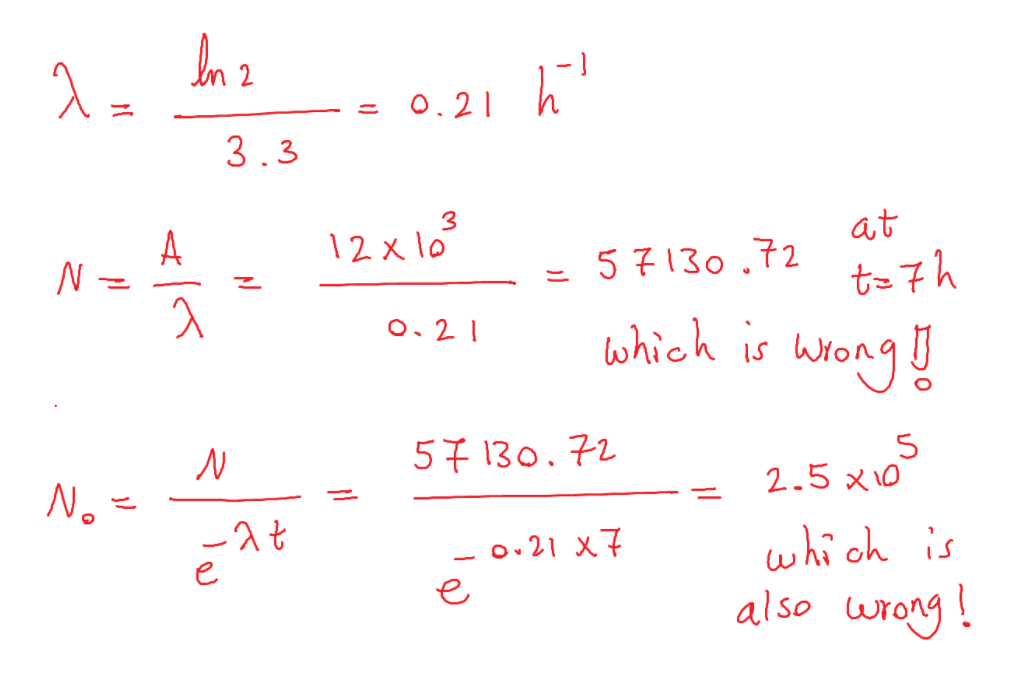
Now you could calculate λ in hours, and find activity at t = 0, based on that. But then at the very end when you want to find N0, you need to convert the λ to seconds anyway!
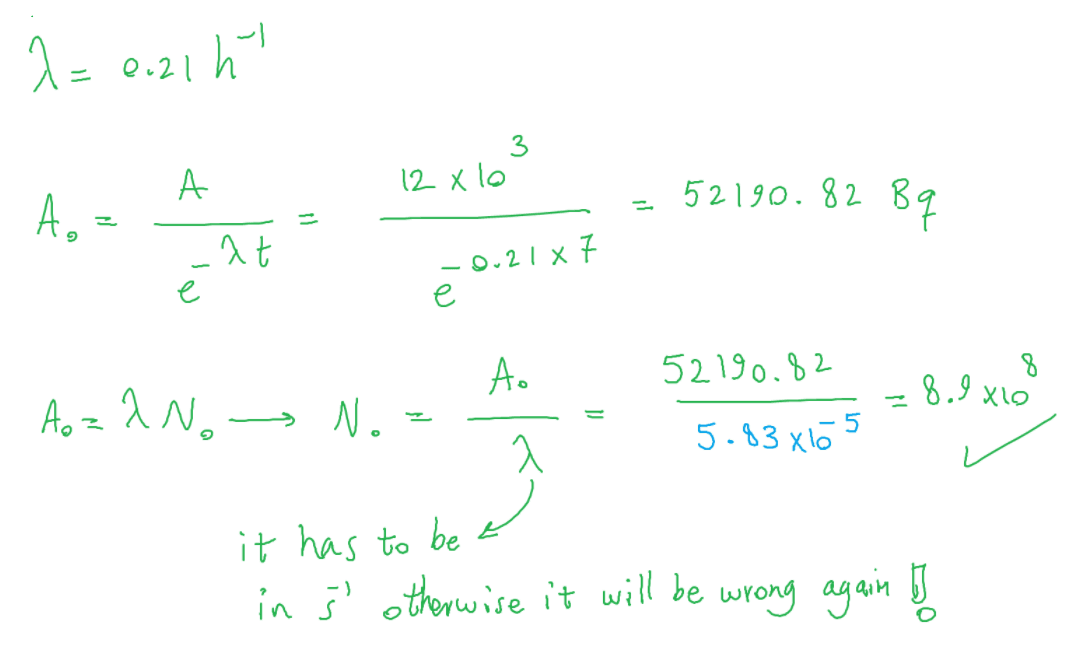
So just keep everything in seconds from the get go, like a good boy /girl / them / it / dog / cat / whatever!
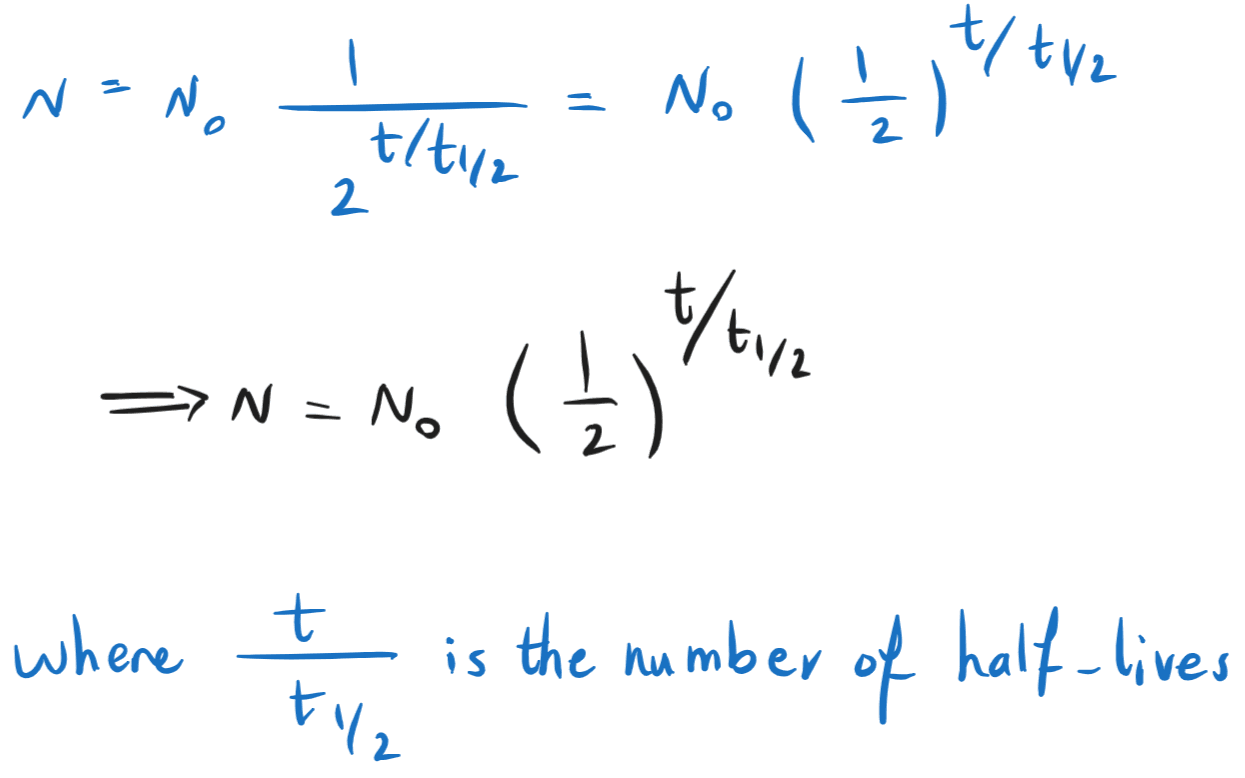
Relationship between decay constant and half-life:
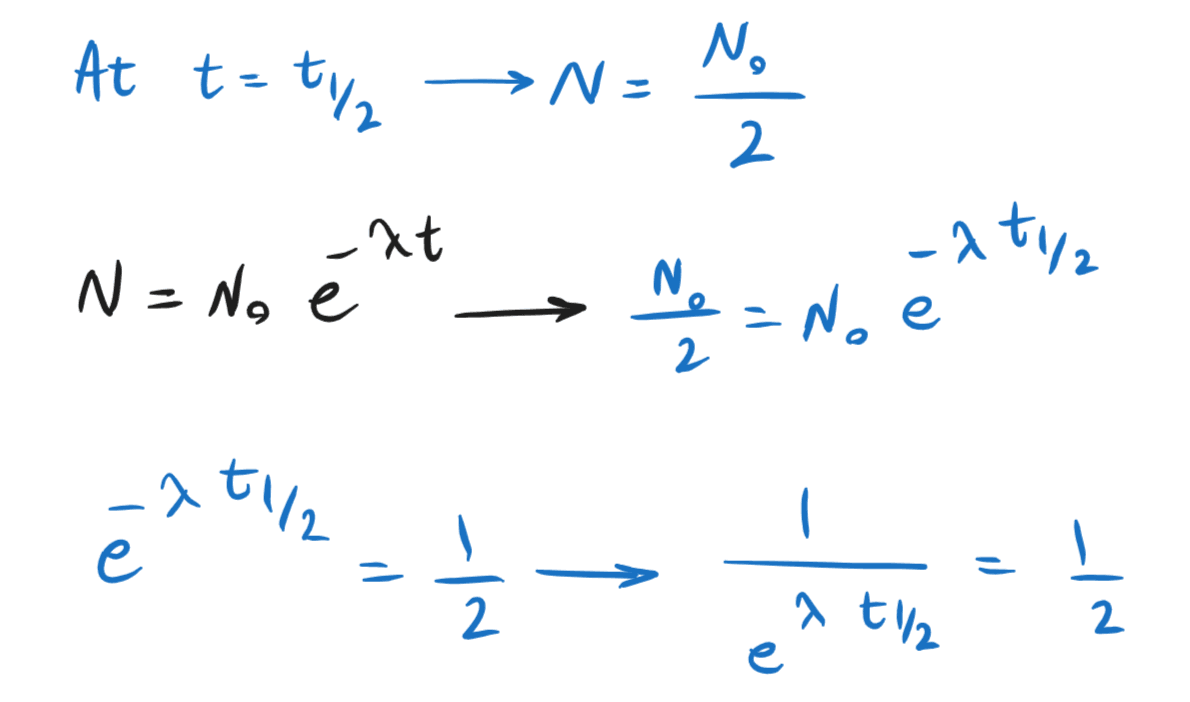
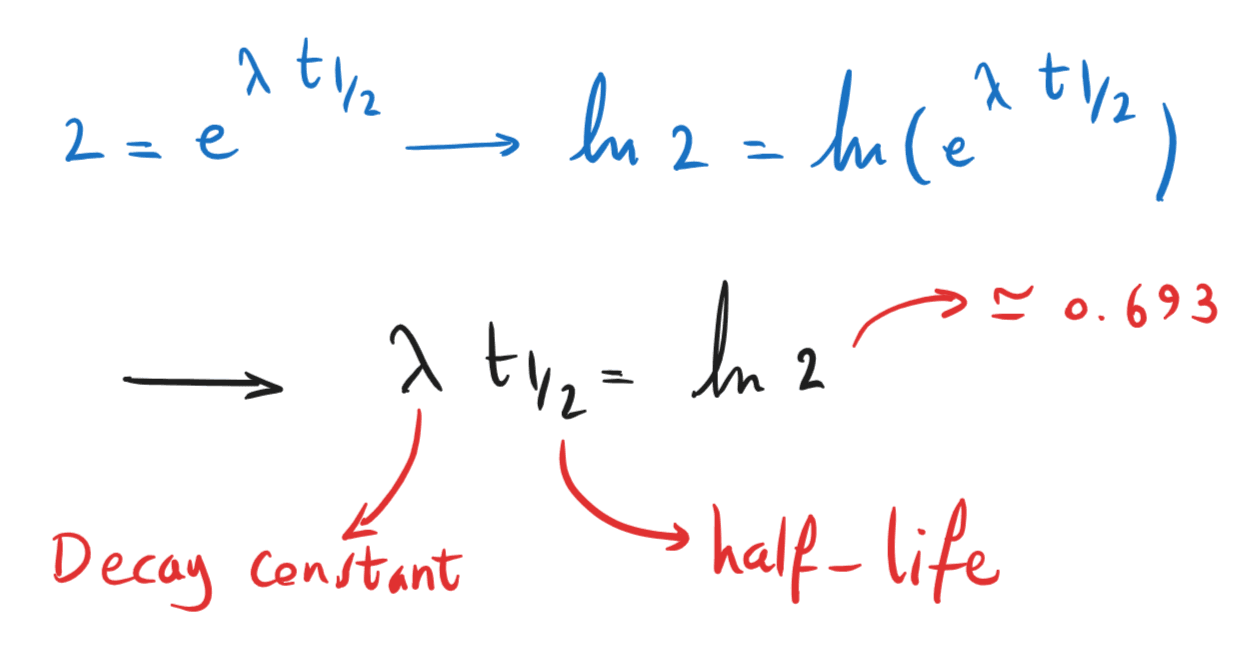
We can also derive a new formula from the two above (if you have A-Level maths the following makes sense, otherwise don’t worry, just use the final formula!):
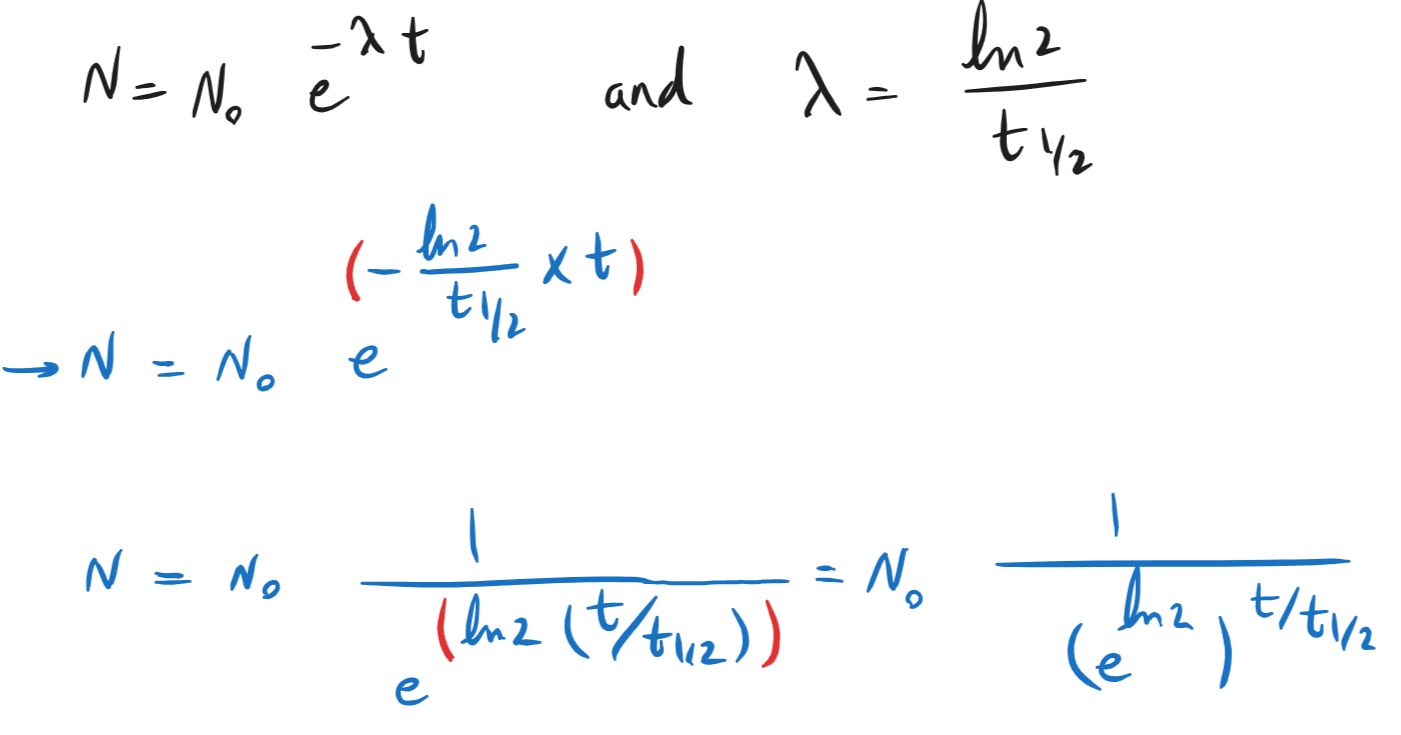
Example 2:
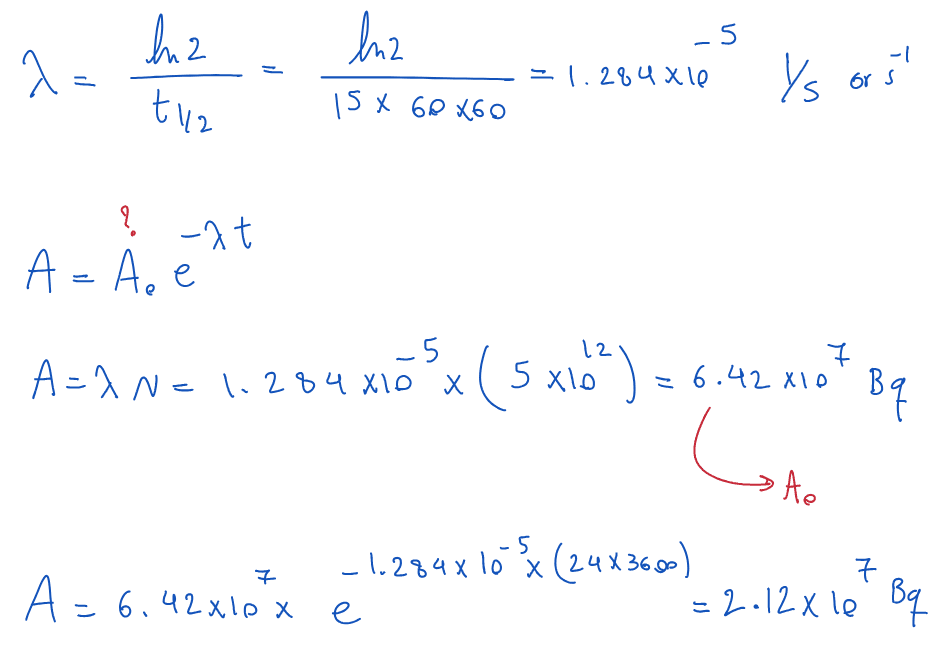
If a sample of sodium-24 has 5.0 × 10¹² nuclei, and half-life of 15 hours, calculate the activity of the sample after 24 hours.
Procedure for Half-life measurement:
An isotope with short half-life is needed: e.g. Protactinium-234.
Radon-222 is not for use in schools as it is a gas.
Protactinium-234 is a decay product of thorium-234.
To separate the Protactinium-234 from thorium-234, we use an organic solvent in a plastic bottle.
Protactinium-234 is soluble in the organic solvent, but thorium-234 is not!
Measure the background count rate.
Place the GM-tube near the organic solvent in the bottle.
GM-tube must not touch the bottle to avoid contamination.
Measure the count rate for 10 seconds, and repeat after 30 seconds.
Calculate the corrected count rate.
Plot a graph of corrected count rate vs. time.
Half-life can be determined from the graph!
6.4.3-7 Modelling radioactive decay by spreadsheets
Activity (A): all radiation released from a source per second; or “the rate of decay of nuclei” which can be shown as:

So the formula A = λ N, can be written as:

And the number of decayed nuclei can be calculated by:

For example, assume a sample has:
Initial undecayed nuclei of: N0 = 100
Half life t1/2 = 0.5 s
Decay constant λ = 0.693 1/s
And we want to calculate the number of remaining active nuclei every 0.1 s à
Δt = 0.05 s
Δt should be much smaller than t1/2, so that we can safely assume activity does not change.
Use a spreadsheet to calculate ΔN for every time increment.
Calculate the remaining active nuclei (N) by subtracting ΔN from previous N.
Plot a graph of N-t.
Add another column for active nuclei calculate from the formula:

The discrepancy from the two sets of values can be reduced by using smaller time intervals (Δt).
6.4.3-8 Carbon dating
All living creatures in the world contain carbon-12.
Carbon-12 is the most abundant isotope of carbon in the atmosphere.
But there is also carbon-14 in the atmosphere, which has a half-life of 5700 years.
Ratio of carbon-14 to carbon-12 in the atmosphere and living things is constant and about 1.3 × 10⁻¹².
When the living creature stops breathing (dies!) it does not take in carbon anymore!
So carbon-14 starts to decay (carbon-12 is stable) and the ratio decreases.
By comparing the ratio in a dead organic tissue, to the ratio from a living tissue, its time of death can be estimated.
This is called carbon dating.
This can be done by comparing the activity of carbon-14 in a dead tissue to living one as well.
Limits of carbon dating:
Assumption that ratio of carbon-14 to carbon-12 is always constant.
Burning fossil fuels, volcanos, solar flares, nuclear tests, etc. may have changed this ratio.
Carbon-14 half-life (5700 years) is rather small compared to the age of rocks on the earth and cannot be used to date those.
For rock dating rubidium-87 with half-life of 49 billion yeas!
Estimated age of the earth: 4.5 billion years.
Estimated age of the universe: 13.7 billion years.
Example 3:
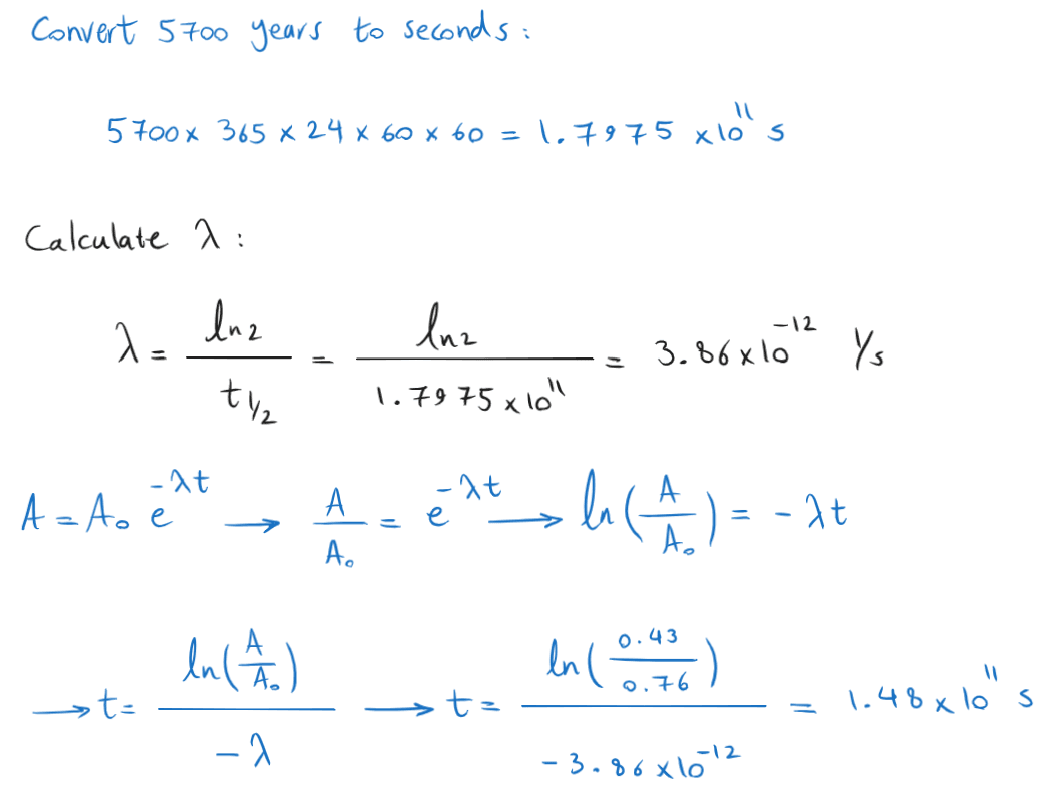
A wooden spoon found in an Egyptian pyramid has an activity of 0.43 Bq. The activity of similar wood cut from a living tree is 0.76 Bq.
Half-life of carbon-14 = 5700 years.
Estimate the age of the spoon.

.
.
Revise and Get Paid!
If you like taking summary notes of lessons and solving past papers, see the Join Us page!