OCR Physics
The Nuclear Atom
6.4.1 The Nuclear Atom
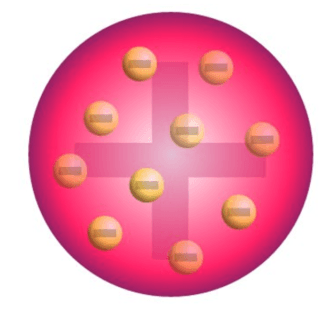
In 1897 J.J. Thompson discovered the electron is much lighter than the atom, and hence realised the atom is not the smallest particle. So he proposed the Plum Pudding model:

The pudding is positive, and the plums in it are negative!
JJ Thompson did not think of neutrons!
Nuclear Model (Rutherford Model):
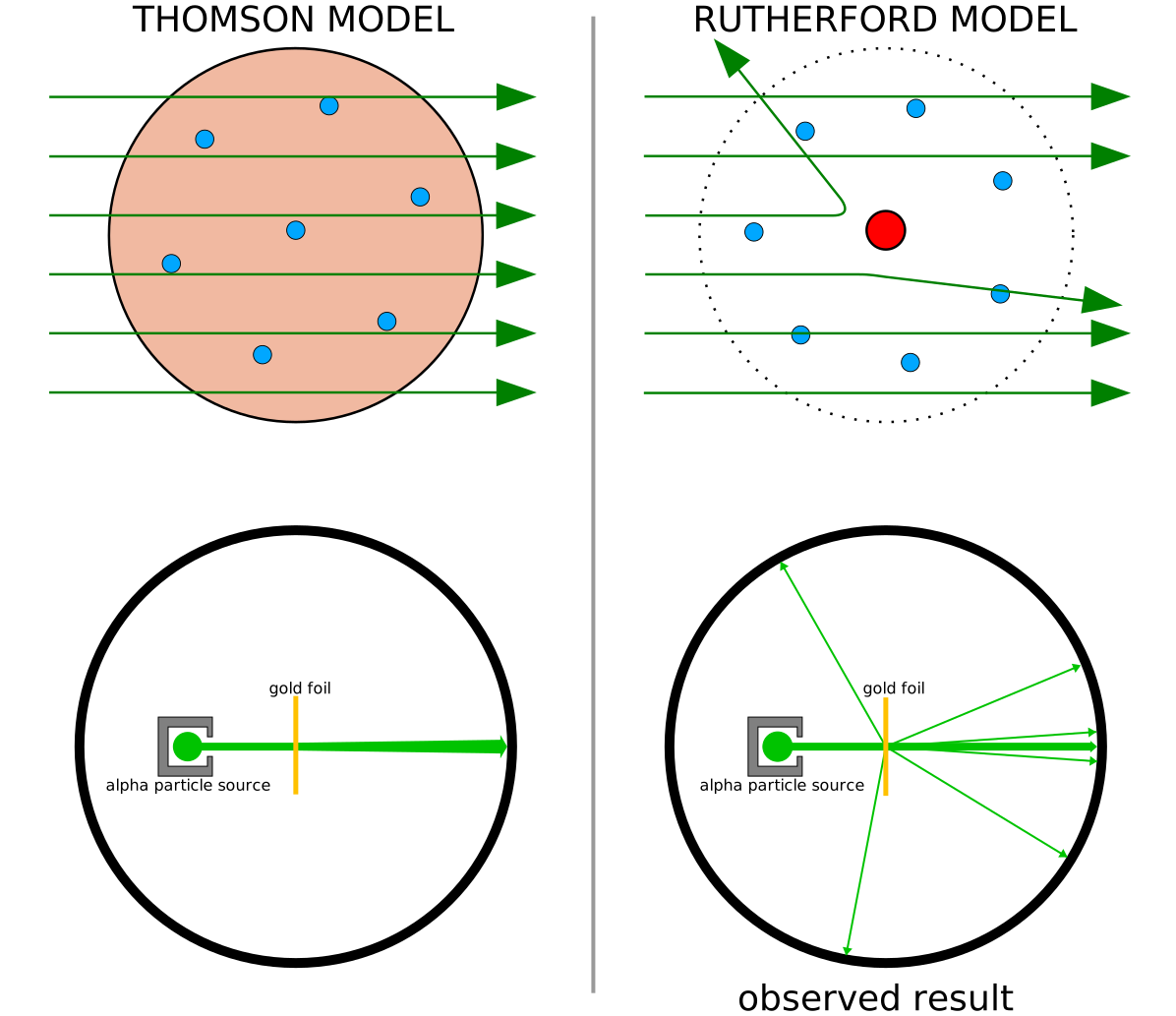
In 1909 Geiger and Marsden fired some alpha particles towards a thin sheet of gold (alpha particle is made of two protons and two neutrons).
Because they thought atoms are like a plum pudding and hence it is soft, they expected all of the alpha particles to pass through the metal sheet.
But…
Observations:
- Majority of alpha particles pass straight through;
- Few alphas were deflected through angles of more than 90o.
Conclusions:
- Most of the atom is empty space, as most α’s pass through;
- Majority of atom mass is concentrated at its centre called nucleus;
- Nucleus has a positive charge, as some α’s are deflected;
- Radius of nucleus ≈ 10-14 m.
This new model is called the nuclear model.

(Image has been modified.)
Example:
Calculating the closest distance an α particle gets to the gold nucleus:
Alpha particles of Kinetic energy 7.5 MeV are fired towards the gold nucleus with 79 protons.
- Calculate the minimum distance the α particles can approach the gold nucleus;
- Determine the maximum electrostatic force the α particles experience.
Solution (a):
Conservation of energy:
KE of α particles = 7.5 × 106 × 1.6 × 10-19 =1.2 × 10⁻¹² J
α particles momentarily stop close to the nucleus and reflect (C, below).
(Image has been modified.)
So KE converts to electric potential:
Gold nucleus has 79 protons à Q = 79 × 1.6 × 10-19 C.
Electric potential at distance d from gold nucleus (per unit charge!):

Electric potential for an α particle at distance d:

Where Q: charge of the gold nucleus;
And q: charge of an alpha particle.
Rearrange and solve for d:

Solution (b):
Electrostatic force:

With more accurate calculations it was seen that:
- Radius of nucleus is in order of 10-15 m;
- And radius of atom in 10-10 m.
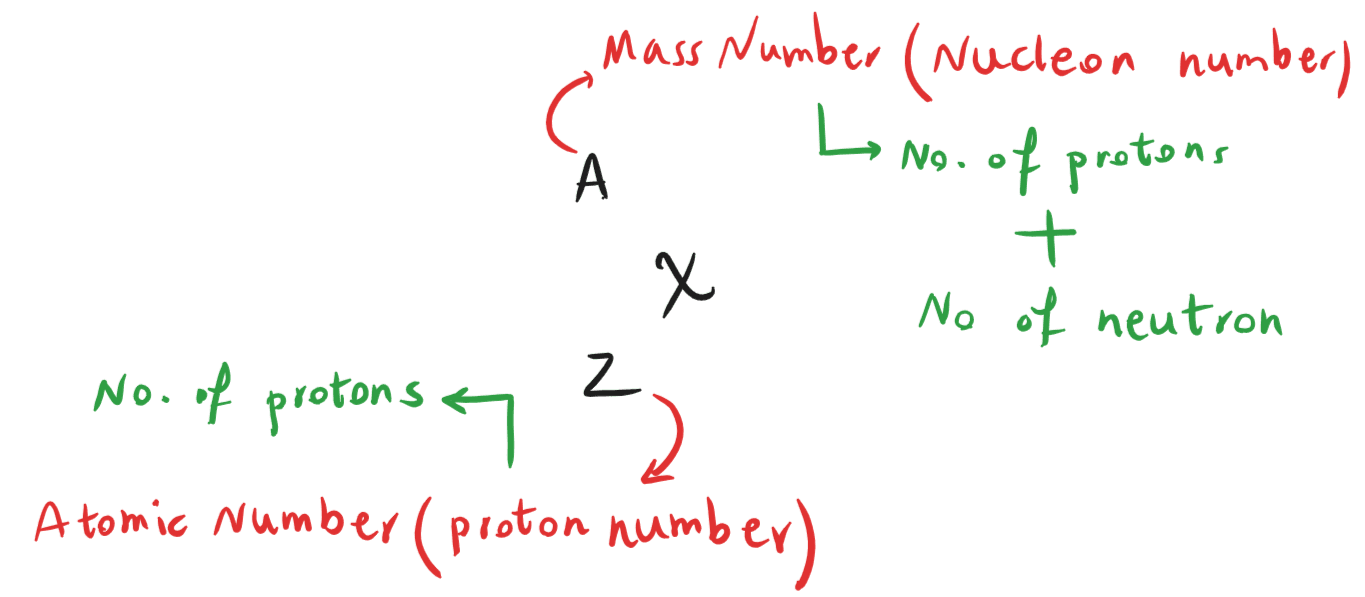
Nucleon: particles in the nucleus: protons and neutrons!
Nuclei: plural of nucleon!
Isotope: nuclei of an element with same number of protons but different number of neutrons!
If number of protons change in the nucleus, it will be a different element!
Atomic mass unit (u): one-twelfth of mass of neutral carbon-12 atom.
Mass of a nucleus is almost equal to its nucleon number × u
For example:
Nucleus | Mass in u |
Helium-4 | 4.00151 |
Carbon-12 | 11.99671 |
Iron-56 | 55.79066 |
1 u = 1.661 × 10⁻²⁷ kg.
Mass of atom is almost the same as mass of nucleus, as electrons have very small mass compared to protons and neutrons.
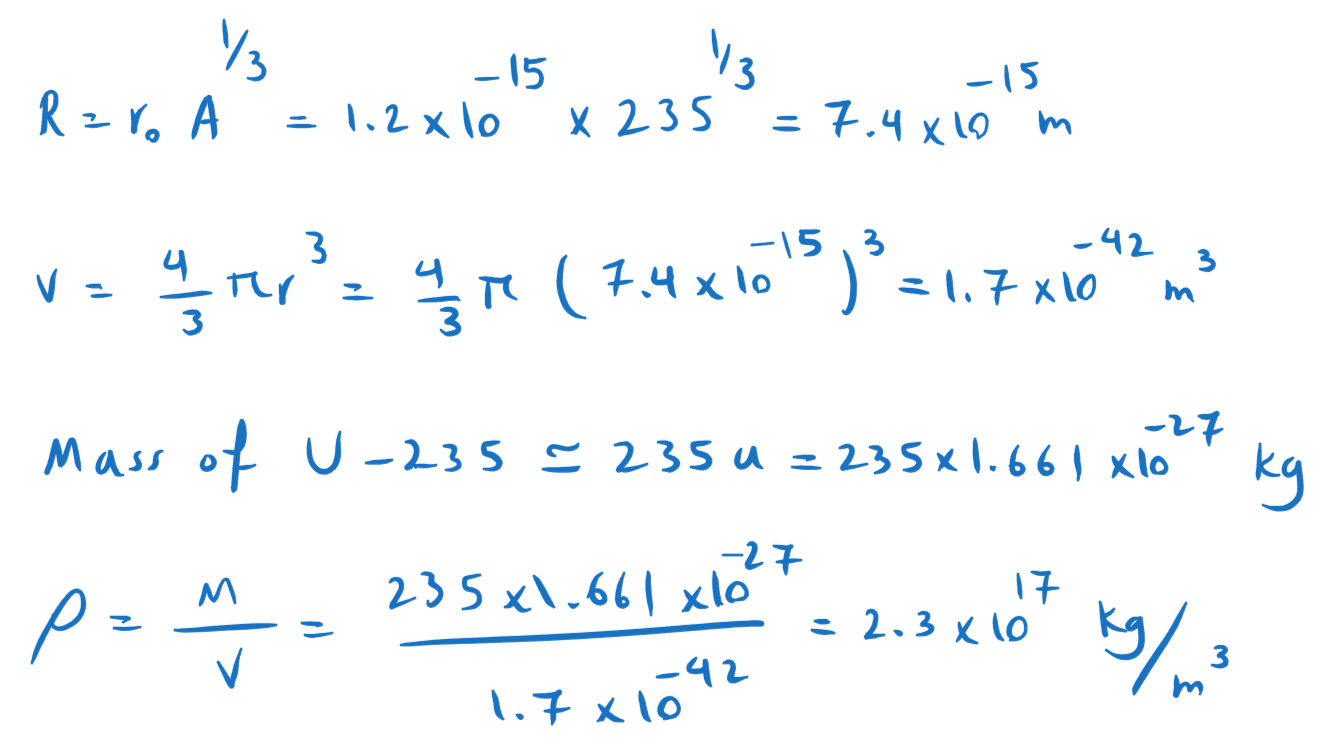
6.4.1-1 Radius of a nucleus:
1 fm = 10-15 m.
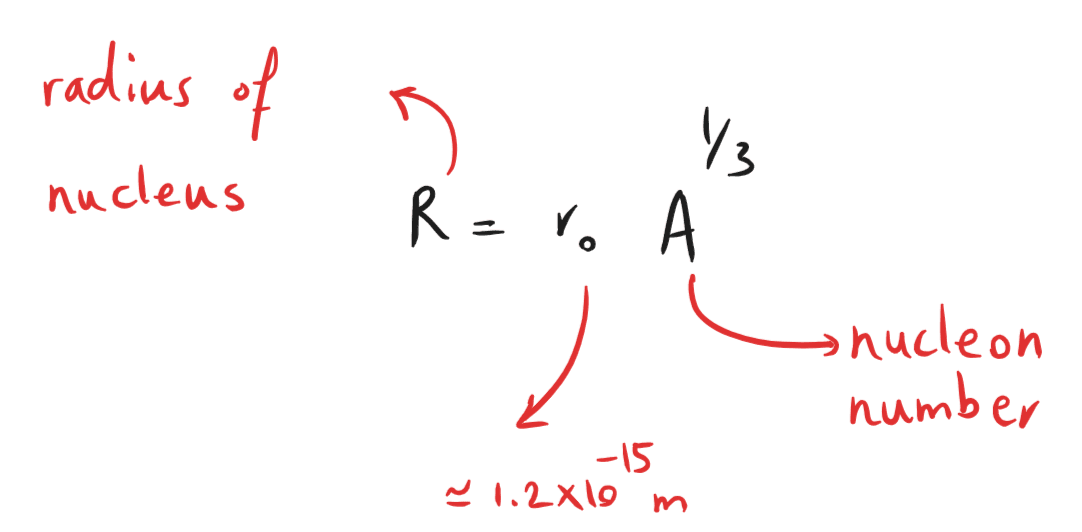
Simplest nucleus is for hydrogen with A = 1, so R = r0 (almost radius of a proton).
Example 1:
Calculate the density of a Uranium-235 nucleus.
6.4.1-2 Strong nuclear force
The two protons in the nucleus of a helium repel each other with an electrostatic force of about 230 N (assuming separation of 10-15 m).
Gravitational force between the protons is about 10-34 N.
So there must be another force keeping them together in the nucleus!
We call this the strong nuclear force!
This is force is attractive from 3 fm to 0.5 fm.
But below 0.5 fm it is repulsive, otherwise the protons would crush into each other!
.
.
.
.
.
.
Revise and Get Paid!
If you like taking summary notes of lessons and solving past papers, see the Join Us page!